San Peder: A Medieval Church and Fortified Complex in Sent, Switzerland
Visitor Information
Google Rating: 4.3
Popularity: Very Low
Google Maps: View on Google Maps
Official Website: notvital.com
Country: Switzerland
Civilization: Unclassified
Remains: Military

History
San Peder is a historic site situated in the former municipality of Sent, now part of Scuol, in Switzerland. The complex, consisting of a church and castle elements, was constructed by the medieval inhabitants of the region during the High Middle Ages.
The core of San Peder, the Romanesque church dedicated to St. Peter, likely dates to the 12th century, with architectural evidence suggesting it was built around 1173. While written sources from the 12th and 13th centuries mention individuals bearing the name “de Sancto Petro,” it is unclear if these persons directly owned or were connected to this specific site. Around 1160, the Lord of Sent served as a vassal to the Bishop of Chur, though records do not identify him as the owner of San Peder’s castle or church. By 1340, the church had become a chapel rather than the primary place of worship in the village.
The church experienced interior renovations in the 15th century, during which new murals were added to its walls. Following the Protestant Reformation, the building was abandoned as religious practices shifted to another church, San Lurench, which then became the main parish church for Sent. After its religious function ceased, the bell tower took on a practical role, serving as a communal storage site for gunpowder and munitions for several centuries.
A large defensive tower south of the church was erected during the 13th century atop earlier foundations, highlighting a phase of fortification at the site. This tower was used for roughly one hundred years before being abandoned in the 14th century. Archaeological findings indicate that the church, bell tower, and large tower may have once formed part of a fortified complex, possibly enclosed by a surrounding wall.
Excavations initiated in 1937 under Peider Lansel, a noted Romansh poet and scholar who acquired the site in 1856, led to significant restoration efforts, including a conservation project in 1901. Further preservation work was conducted in the late 1960s, helping safeguard the ruins for posterity. Lansel also created a small chamber within the tower, reflecting his personal connection to the location.
Remains
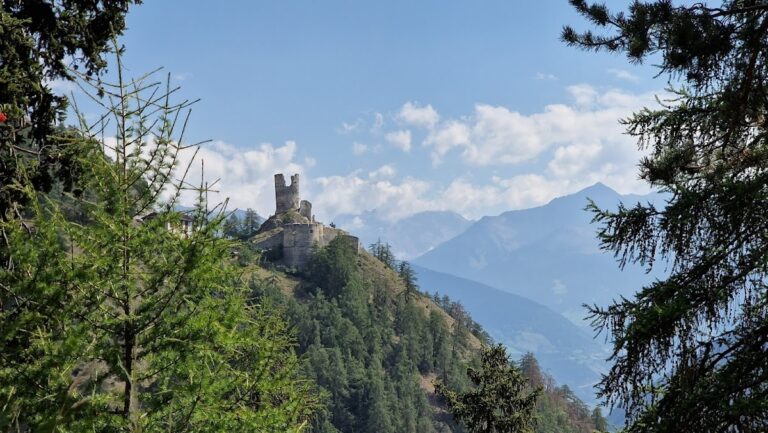
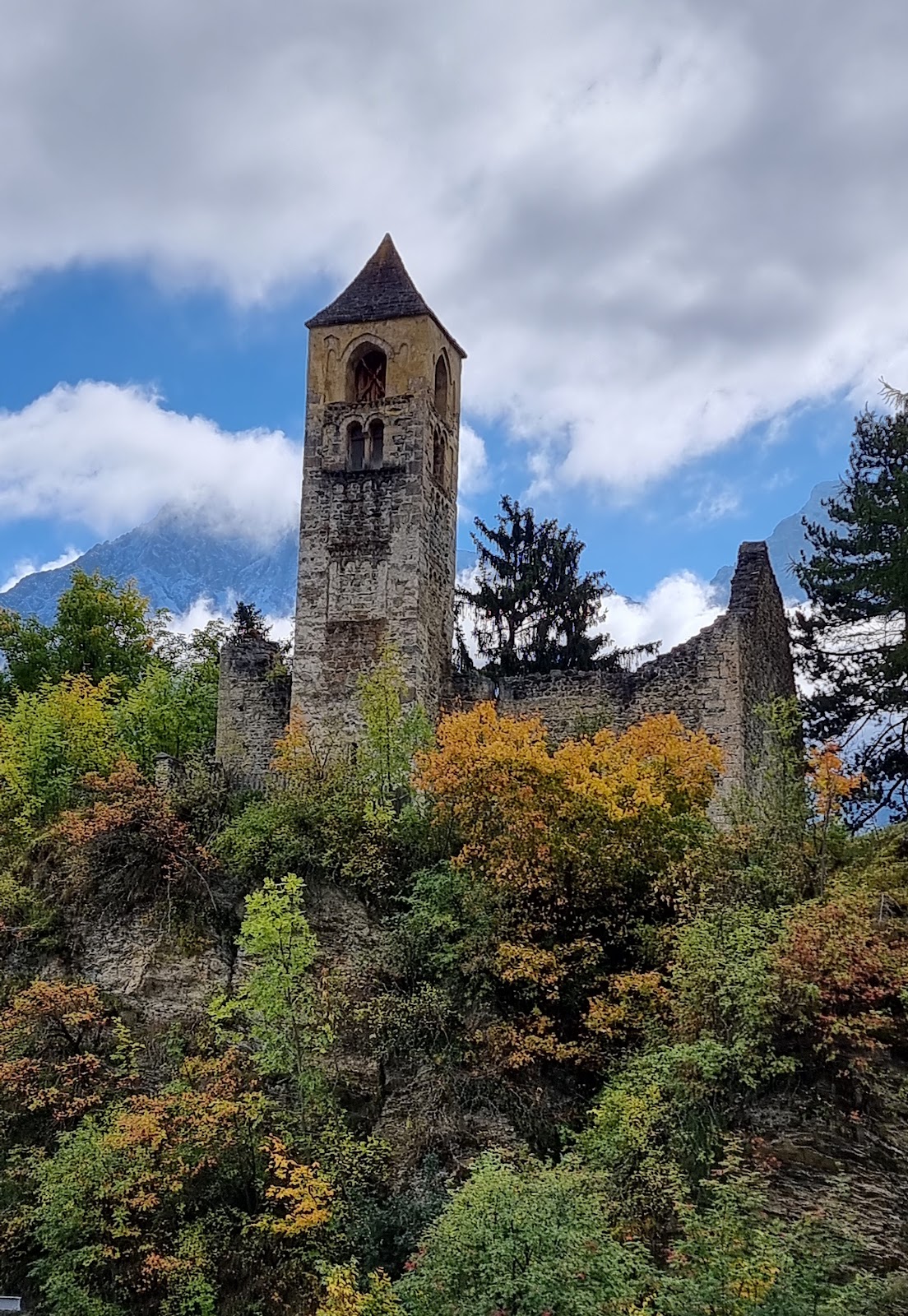
San Peder’s remains include a Romanesque church and associated towers positioned on a rocky hill at the western edge of the former village of Sent. Together, they suggest a complex designed for both religious and defensive purposes. The buildings are constructed predominantly from local stone, with thick walls reflecting the need for durability and protection.
The church itself exhibits classic Romanesque architecture and is dominated by a tall bell tower that resembles a medieval watchtower in its form and massing. This tower rises five stories and features walls that taper from about 2.2 meters thick at the base to roughly 1 meter at its upper levels. A notable defensive feature is a bricked-over high entrance located on the north wall at the tower’s fifth floor, typical in such structures to control access. However, evidence indicates the tower was not regularly inhabited as living quarters.
Southeast of the church lies a large tower measuring approximately 12 by 13 meters, with walls up to 2.3 meters thick. Built during the 13th century on older foundations, this structure was abandoned about a century later. Excavations revealed this tower to be a significant fortified element, contributing to the complex’s defensive capabilities.
The site as a whole may have been enclosed by a defensive wall connecting the church, bell tower, and large tower, forming a fortified church complex. The church interior shows signs of renovation from the 15th century, including murals that enlivened the sacred space, though detailed descriptions or inscriptions regarding these paintings have not been recorded.
Today, the ruins have been stabilized and partially restored. Peider Lansel’s involvement in conservation included establishing a small chamber within the tower, which served as a unique feature reflecting his personal scholarly and poetic interests. Archaeological finds from ongoing excavations are preserved in the Rätisches Museum, where they help confirm the dating and historical phases of the large tower and the broader site.
Nearby sites