Wildenberg Castle: A Historic Planta Residence in Switzerland


Site at a Glance
- Rating
- 4.3
- Popularity
- Very Low
- Country
- Switzerland
- Primary era
- Early Modern
- External website
- Open
- Eras represented
- Medieval, Early Modern
- Civilizations
- Holy Roman Empire
- Site type
- Domestic
- Remains
- Castle
On this page9 sections
History
Wildenberg Castle, also called Wildenberg-Planta Castle, is a medieval and early modern hilltop complex in Switzerland, standing in Zernez in the canton of Graubünden. The site developed from a thirteenth-century residence associated with the Wildenberg family and later became a principal seat of the Planta family. It is recognized as a Swiss heritage site of national importance.
The Wildenberg and Planta families
The Wildenberg family belonged to a younger branch of the Greifenstein family of Filisur and held castles and estates across Graubünden. Wildenberg Castle was first mentioned as the family’s residence around 1280–1290. A predecessor estate connected with the site had been transferred to the Bishop of Chur before 1298, and in 1302 it passed to Conrad Planta.
In 1296, the Bishop of Chur pledged the right to collect tithes from Wildenberg to the Lords of Planta. It is uncertain whether the castle itself formed part of that pledge. By the fourteenth century, however, the bishop owned the castle while the Planta family held it. Around 1400, the branch in possession used the names von Wildenberg and Planta-Wildenberg and held the castle as a permanent fief.
The family’s wealth came from episcopal lands and rights, a mining concession in the Lower Engadine granted by Emperor Henry VII, and iron mines near the Ofen Pass. Their relationship with the Bishop of Chur could be openly hostile. In 1430, Conradin von Planta-Wildenberg demanded the bishop’s abdication, and the bishop responded by excommunicating him.
Political influence and conflict
Representatives of communities around Chur met at Wildenberg in 1365 under Planta patronage. They were concerned about the growing power of Tyrol and the bishop’s debts. The agreements reached at the castle helped lead to the creation of the League of God’s House two years later, a late-medieval political association formed to restrict the secular authority of the Bishop of Chur. The league later entered into relations with the Swiss Confederation.
In the late fifteenth century, the Planta-Wildenberg family supported the bishop against the emperor. Hans von Planta-Wildenberg signed a 1498 treaty between the League of God’s House and the Swiss Confederation that sought to limit imperial power. A later tradition says that Hans killed an imperial knight at the Battle of Calven during the Swabian War in 1499.
In 1570, the chronicler Ulrich Campell described Wildenberg as a medieval castle with a central tower and three residential wings. At that time, its owner was Balthasar von Planta-Wildenberg, whose six marriages and numerous children were associated with the family’s growing wealth and influence.
Seventeenth-century destruction and rebuilding
Rudolf von Planta-Wildenberg changed his political allegiance in 1616. He moved from the faction that supported the bishop against the Habsburgs to the pro-Habsburg party. The Habsburgs were the European ruling dynasty whose Austrian branch sought influence in Graubünden and the Lower Engadine. When Rudolf received Archduke Leopold of Austria at Wildenberg in 1618, local villagers and minor nobles revolted. During the resulting attack and siege, Rudolf and his family escaped, while the castle was captured and damaged by fire. These events took place amid the Bündner Wirren, or Grisons troubles, a series of seventeenth-century conflicts involving local factions, the Habsburgs, and other regional powers.
Rudolf returned during an Austrian offensive four years later and began rebuilding the damaged castle in 1622. The work included a new residential wing and was imposed on the population of the Engadine. After Rudolf died in 1638, another cadet branch of the Planta family inherited the castle and enlarged it again in 1649–1650.
Johann von Planta helped secure the purchase by the Lower Engadine communities of their freedom from Habsburg rule, completed in 1652. He had occupied Wildenberg from 1645 and continued its restoration. Johann Heinrich von Planta and Peter von Planta commissioned further alterations and additions in the middle and later eighteenth century, giving the castle much of its present character.
Later ownership and public use
The Planta family retained Wildenberg for several centuries. Peter Conradin von Planta sold it to the Bezzola family in 1856. The municipality of Zernez acquired the castle in 1956 and adapted it for municipal administration, completing alterations by 1957. Further repair and restoration took place between 1989 and 1994. Since 2007, the historic building has housed the administrative headquarters of the Swiss National Park, Switzerland’s protected alpine national park.
Remains
Hilltop setting and medieval tower
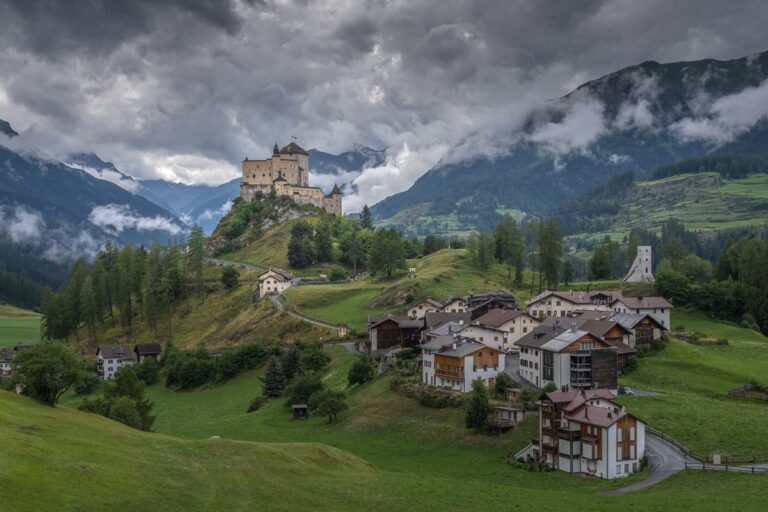
Wildenberg Castle stands at about 1,570 metres above sea level on the eastern edge of Zernez’s old Runatsch district. Runatsch, together with the Protestant parish church and the Catholic Chapel of St. Sebastian, survived the village fire of 1872. The oldest part of the complex is probably a square medieval tower built in the thirteenth century. Its broad openings on the lower floors were cut through at a later date, while the keyhole-shaped openings in the upper floors date from around 1630. An eighteenth-century curved spire crowns the tower.
Residential wings and interior connection
The castle has an L-shaped plan, with the medieval tower positioned where the two wings meet. The wings are Baroque residential buildings without a defensive function and derive from the rebuilding of 1622. Their interiors and roof date from the seventeenth century, with additional changes made in 1649 and during the second half of the eighteenth century. Rubble stone forms the main construction material, with some surfaces finished in flush stonework.
A large staircase connects the two wings. Its ceiling has rich stucco and painted decoration in a classical style dating from the seventeenth century. The external staircase was added in 1760 and carries the coats of arms of Johann von Planta and his wife, Maria Jecklin.
Courtyards, gardens, and heraldic features
Stone walls enclose gardens within the northwestern angle of the L-shaped complex and along its south side. A walled courtyard lies to the east and northeast, while the castle as a whole is surrounded by a courtyard and two gardens. A garden house stands in the inner garden.
The entrance gate to the courtyard garden bears the combined coat of arms of Hartmann and Flandrina von Planta, dated 1650. A separate heraldic panel dated 1649 is also associated with the castle. Together with the later external staircase, these features reflect the continued adaptation of Wildenberg as a residence of the Planta family during the seventeenth and eighteenth centuries.