Rychmburk Castle: A Historic Czech Noble Residence


Visitor Information
Google Rating: 4.6
Popularity: Low
Official Website: rychmburk.cz
Country: Czechia
Civilization: Medieval European
Site type: Military
Remains: Castle

History
Rychmburk Castle stands in the village of Předhradí in the Czech Republic and was originally built by the Czech nobility in the early 14th century. Its construction is attributed to Tas of Mrdice, who is the earliest known owner recorded around 1325. The castle began as a stronghold of the Mrdice family and soon became part of an extensive estate that included several villages and towns such as Skuteč, Hlinsko, and Svratka.
During the late 14th century, Rychmburk was the residence of Smil Flaška of Pardubice, a well-known poet and nobleman, who contributed to the castle’s early prominence. Over the following centuries, the castle passed through various noble hands, including the Vartenberks and Pardubices, illustrating a typical pattern of medieval property transfer within the Czech aristocracy. In the mid-16th century, ownership shifted to the influential Berka of Dubá and Lipá family, who maintained control until the early 18th century.
The 15th century brought turmoil with the Hussite Wars, a series of religious conflicts that spread through Bohemia. Rychmburk provided shelter to Catholic nobles and inhabitants opposing the Hussite movement. In 1425, however, the castle fell into Hussite hands without the need for an assault, reflecting the tense and shifting political landscape. Ownership fluctuated afterwards, including confiscation by Emperor Ferdinand I in 1547 following political upheaval.
Under the Berka family, the castle underwent significant expansion and renovation from the late 16th through the 17th century, reflecting changing needs and tastes. They established a fideicommissum, a form of entailment that kept the estate intact across generations. In 1706, the castle entered the possession of the Kinský family through marriage, who introduced baroque-style modifications late in the 18th century, marking another phase of architectural and social transformation.
The estate was sold to the princely house of Thurn-Taxis in 1823, which retained ownership until the aftermath of World War II. In 1945, the castle was nationalized by the state and repurposed as a care home, first for the elderly and later for adults with mental illness. This function continued until 2021, when the castle was placed under the care of the Regional Museum in Chrudim and reopened to the public.
Remains
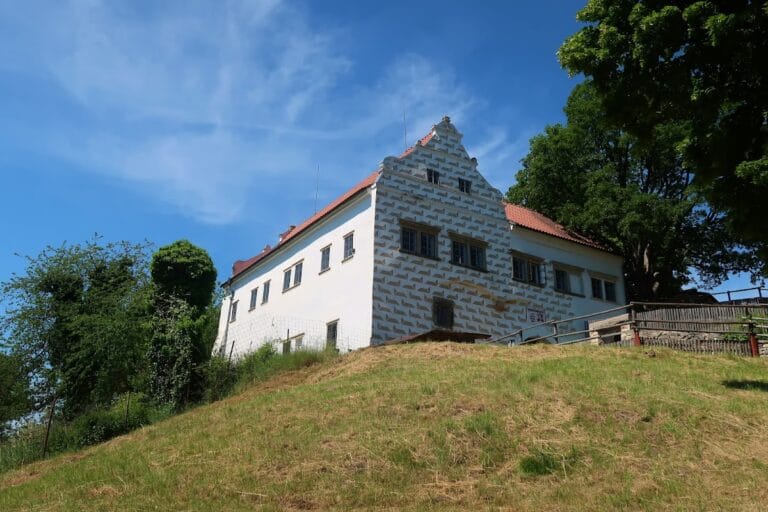
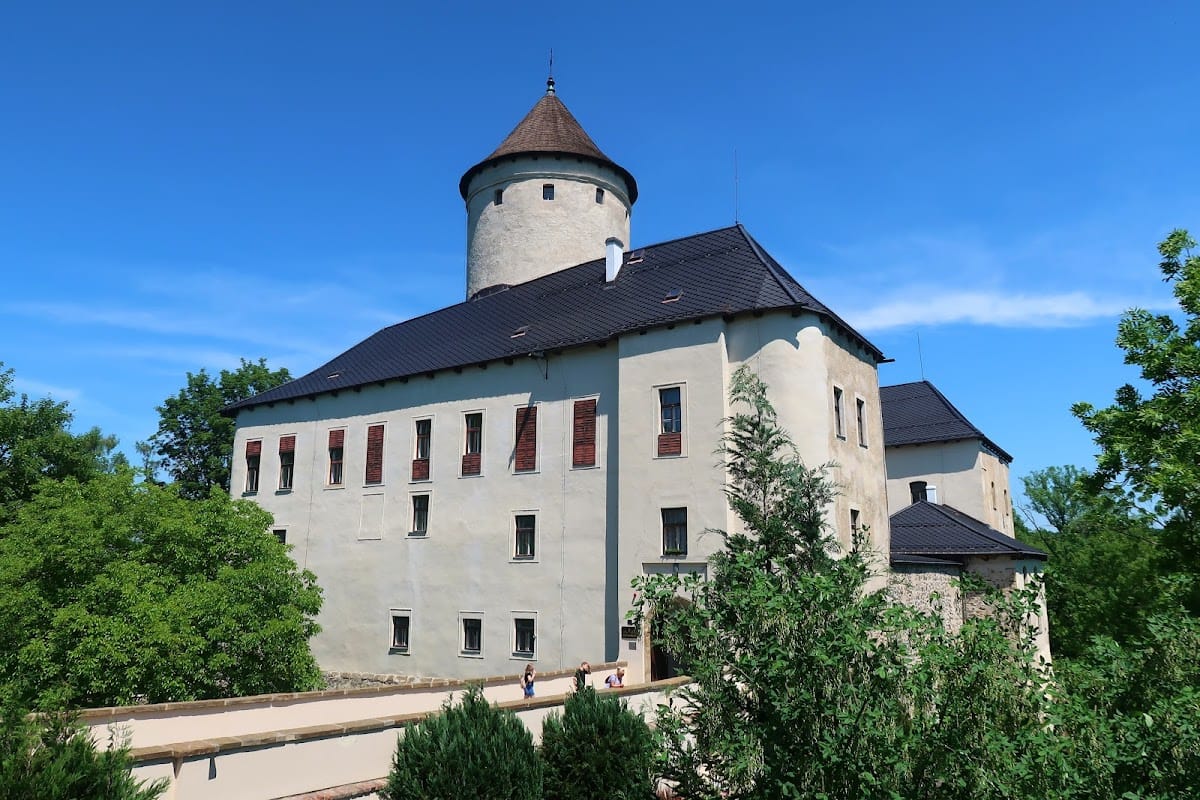
Rychmburk Castle is built on a prominent steep hill overlooking the merging of the Lešanský stream and the Krounka river, strategically separated from the nearby village of Předhradí by a man-made moat. The castle’s form is a rectangular two-story structure featuring elements from different periods, reflecting centuries of construction and adaptation.
At the southern entrance, visitors encounter a Renaissance-style gate highlighted by stone framing, linking the fortress to the architectural trends of the 16th century. Positioned on the western corner of the courtyard stands a notable round tower dating from the 14th century, rising approximately 30 meters tall. This tower features a conical roof and exhibits remnants of sgraffito, a decorative plaster technique that creates textured patterns. Its walls are punctuated by partly preserved Gothic embrasures—openings designed for defense—and corbels that once supported small oriel windows.
The castle’s northern wing is distinguished by a Renaissance gallery and three rectangular portals, all featuring stone surrounds consistent with late medieval and early modern design. A smaller four-sided tower anchors the northern corner, complementing the larger round tower and enhancing the castle’s defensive posture. Beneath the courtyard lies a vaulted cellar supported by a central pillar, surviving from the castle’s original Gothic construction phase.
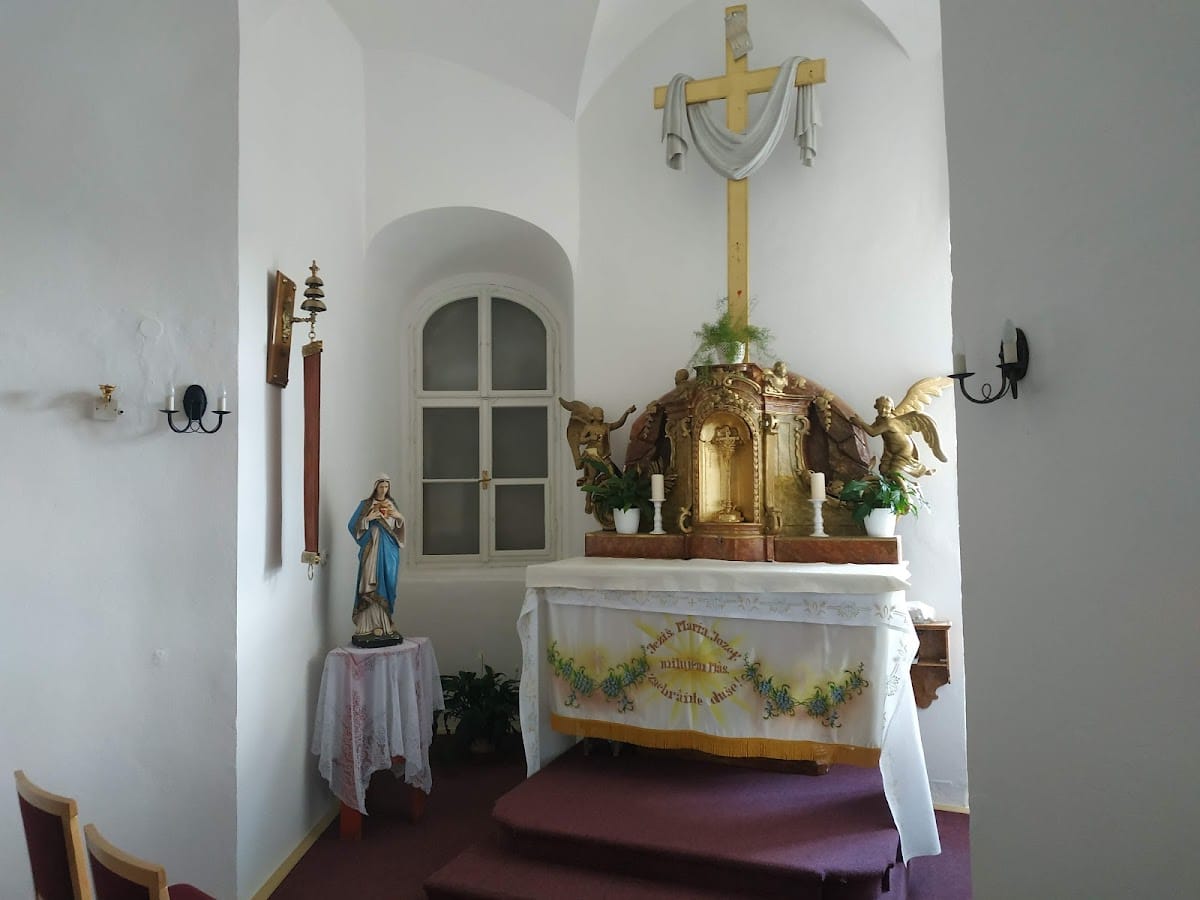
On the second floor of the round tower, the Chapel of the Holy Cross stands out for its vaulting and two panel paintings, dating to the latter half of the 17th century. This chapel reflects the castle’s religious function during that period and demonstrates an interior enrichment that followed the Berka family’s renovations. The castle retains its original Gothic vaulted cellars as well as Renaissance vaulting on the first and second floors, revealing layers of architectural history in its construction.
Surrounding the castle, a large fortified outer bailey was added around the year 1500. This substantial enclosure gave rise to the adjacent settlement of Předhradí, notable today as one of the best-preserved examples of its kind in Czech urban development. The defensive network once included a strong curtain wall and a broad ditch guarding the southwestern approach; this ditch is now crossed by a stone bridge, representing later infrastructural adaptation.
Together, these features illustrate Rychmburk’s evolution from a medieval stronghold to a Renaissance and baroque residence, combining military utility with noble habitation across several centuries.
Nearby sites