Ricina: An Ancient Roman Town in Italy’s Marche Region


Visitor Information
Google Rating: 4.3
Popularity: Low
Google Maps: View on Google Maps
Official Website: musei.macerata.it
Country: Italy
Civilization: Roman
Remains: City

History
Ricina is located in Villa Potenza, within the province of Macerata in the Marche region of Italy. The town was originally established by the Romans around the 3rd century BCE on the site of an earlier Italic settlement, likely inhabited by the Piceni people.
In the Roman Republic period, Ricina developed as a settlement positioned in the Potenza river valley. It lay at the crossroads of important Roman roads, including the Via Salaria Gallica and a branch of the Via Flaminia. This location facilitated trade and communication across the region. By the mid-1st century BCE, Ricina was granted the status of municipium, a self-governing town, and was settled by veterans of the Roman Civil Wars. The town prospered during the reigns of Augustus and Tiberius, as shown by public works and funerary monuments from this era.
In 205 CE, Emperor Septimius Severus elevated Ricina to the rank of a Roman colony. The town was renamed Helvia Recina Pertinax in honor of the earlier Emperor Publius Helvius Pertinax. This change is confirmed by a marble inscription found on site.
Christianity reached Ricina early in its history. The first bishop, Flavianus, was martyred in the 3rd century CE. The area is also associated with Saint Julian the Hospitaller. Although undocumented, local tradition links the Christian community’s origins to Saint Peter.
Ricina declined during the late Roman period due to repeated Gothic invasions. In the 4th and 5th centuries CE, raids by the Ostrogothic king Radagaisus caused damage. Later, during the Gothic War in the mid-6th century, the city suffered destruction under Ostrogothic king Teia. Following these events, the population moved to nearby hilltop settlements, which later became the medieval towns of Macerata and Recanati.
Despite partial abandonment, the ruins of Ricina remained visible through the Middle Ages. Building materials were reused, and quarrying damaged some structures. Archaeological interest began in the 19th century and continues today, revealing much about the town’s history and layout.
Remains
Ricina was enclosed by a roughly rectangular city wall and covered about 22 hectares on flat terrain. The main street, called the decumanus maximus, ran southwest to northeast, aligned with the valley road. It intersected a north-south street near the forum, forming a clear urban grid.
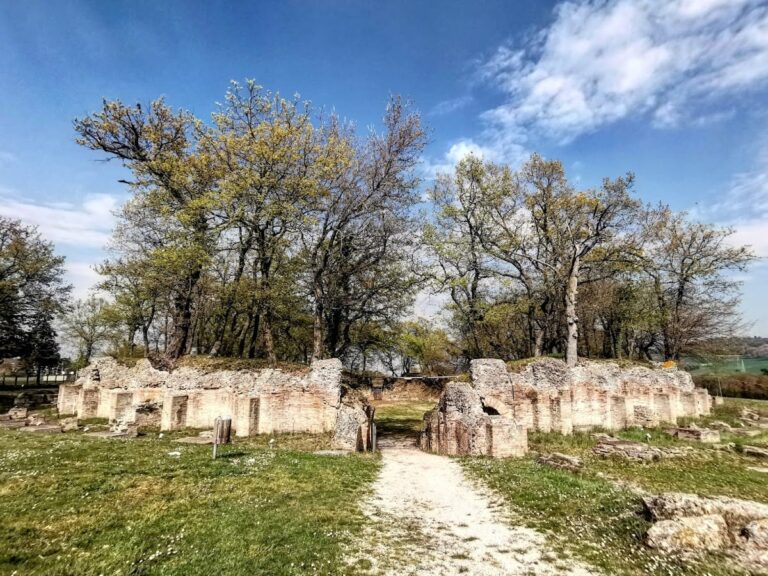
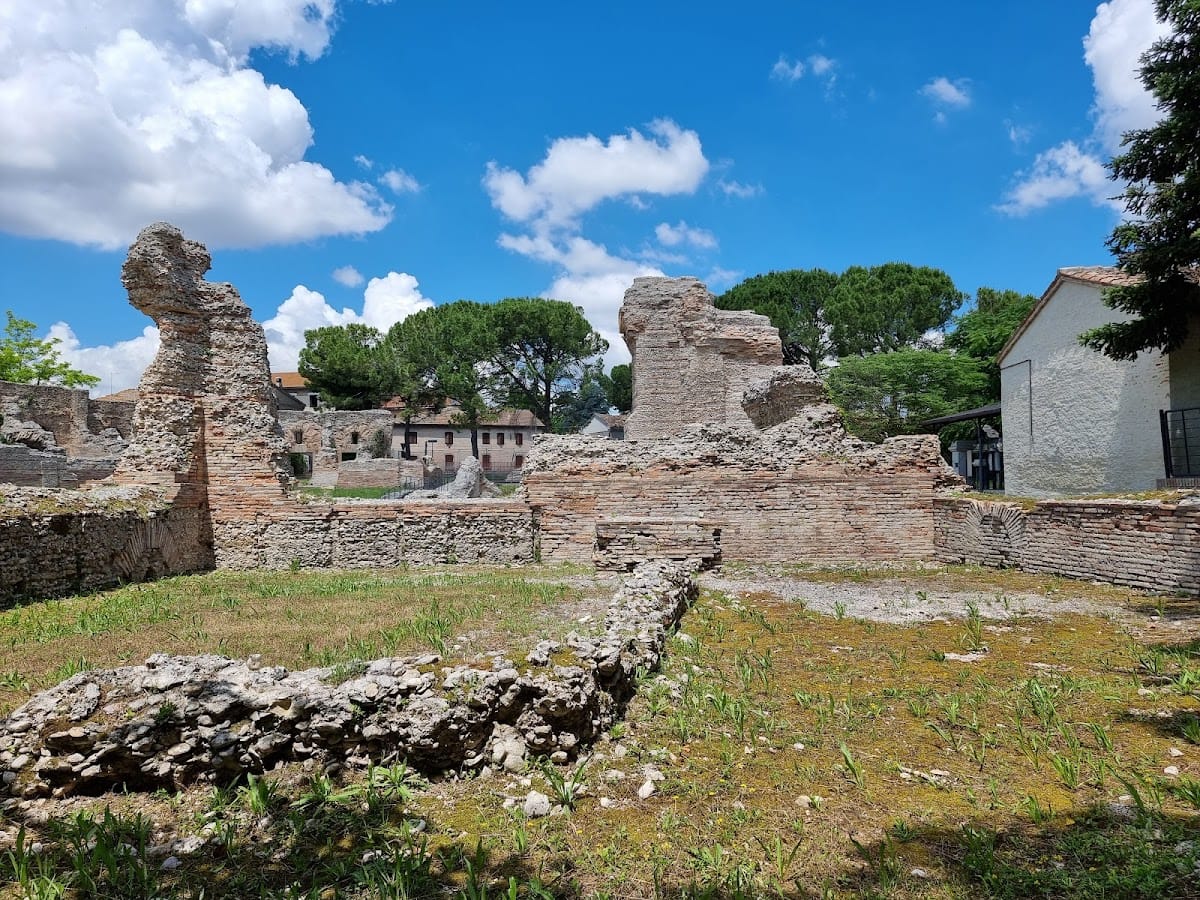
The most prominent surviving monument is the Roman theatre, built in the 2nd century CE. It was constructed on flat ground with an artificial elevation, reaching about 17 meters in height. The theatre’s seating area, or cavea, measured approximately 71.8 meters in diameter and had three tiers, accommodating around 2,000 spectators. The stage building was made of brick, while the cavea was decorated with marble and featured Doric and Corinthian capitals.
Near the theatre, aerial photography has revealed traces of an amphitheatre to the east. This structure may have been architecturally connected to the theatre, forming a larger entertainment complex.
The forum area contained a large rectangular building, at least 18 by 33 meters, oriented northwest-southeast and perpendicular to the main street. This building likely served as the principal temple, possibly a Capitolium dedicated to the main Roman gods.
Other public structures include a bath complex excavated in 1873. Inscriptions mention Tuscilio Nominato, who funded repairs during Emperor Trajan’s reign. A large cistern was also part of the town’s infrastructure.
Residential areas featured several large houses, or domus, with mosaic floors. Commercial buildings such as tabernae (shops) and possibly a horreum (granary) have been identified through finds of storage jars and amphora fragments.
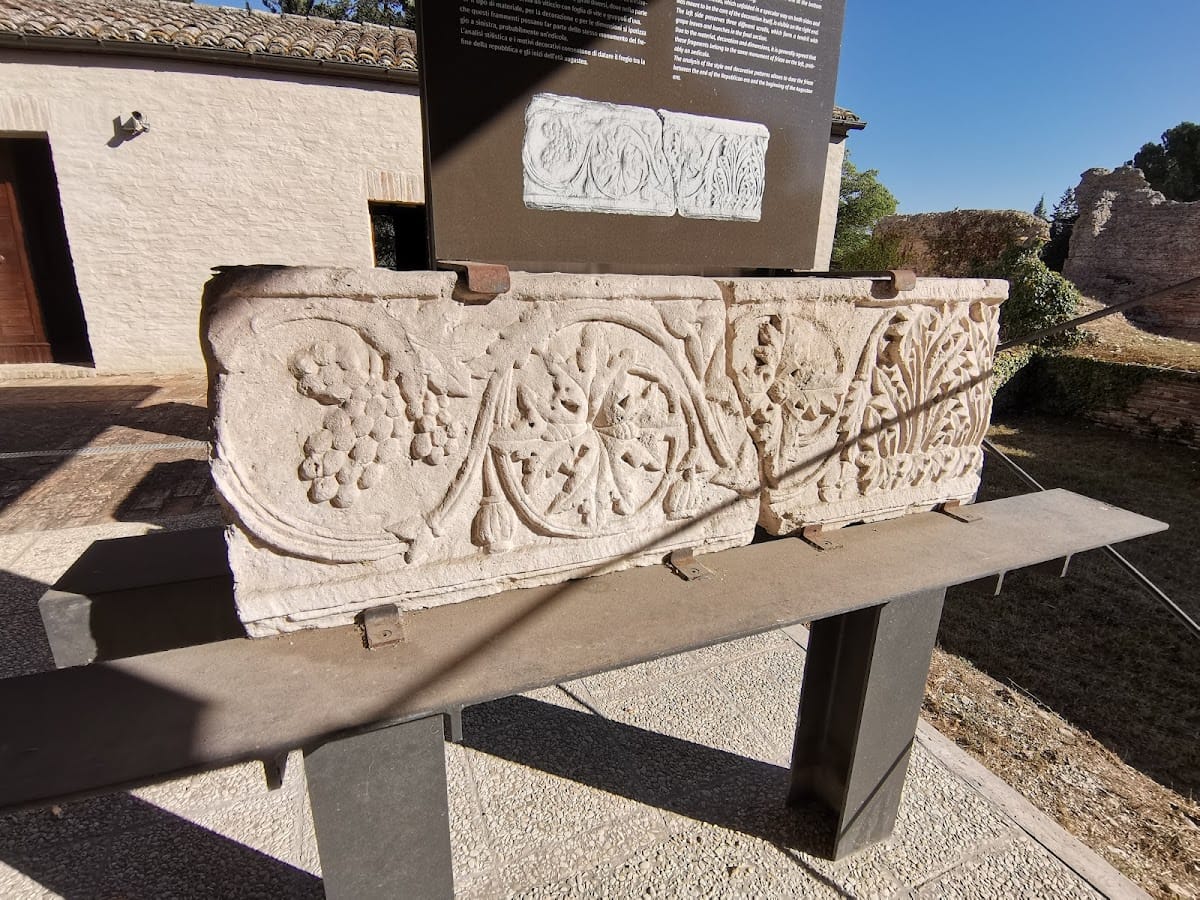
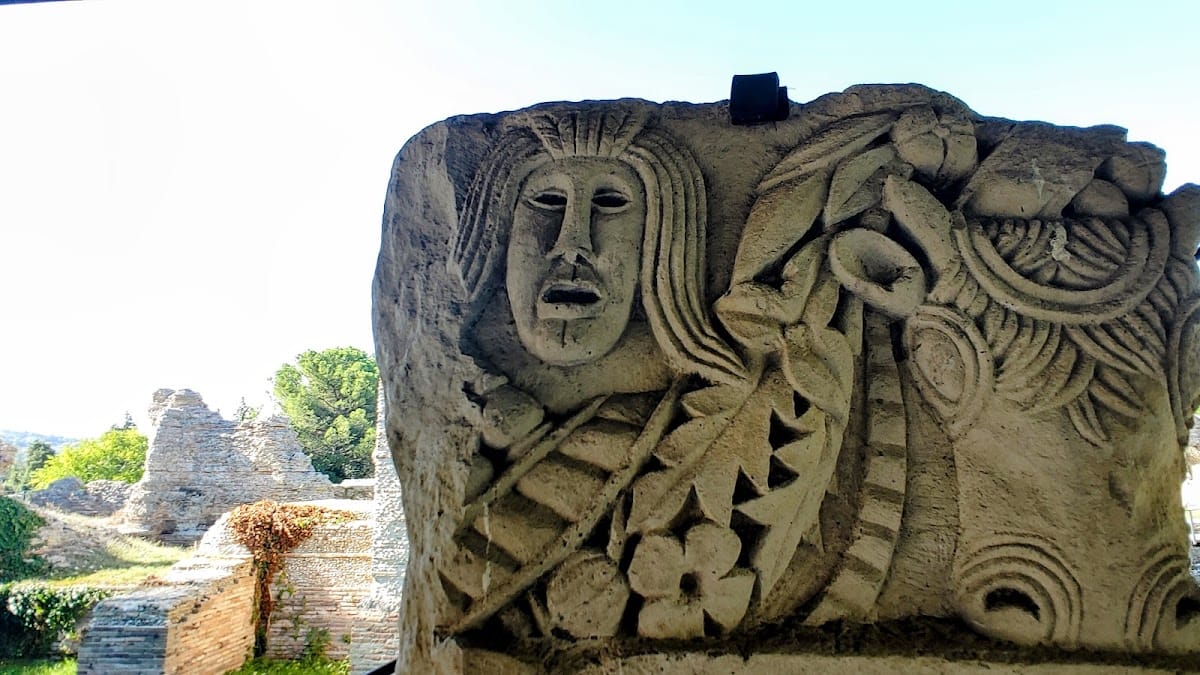
Necropoleis, or cemeteries, were located at opposite ends of the city. Significant funerary monuments have been reconstructed from 150 sculpted stone blocks recovered from the nearby riverbed. These are now conserved near the theatre.
Today, the theatre and other remains lie mostly beneath or surrounded by modern buildings in Villa Potenza, limiting visible surface ruins. Numerous inscriptions and sculptural fragments, including dedications to the god Mercury and funerary epitaphs, are preserved in the civic museum and the lapidarium of Macerata’s Palazzo Comunale.
Since 2000, archaeological surveys using aerial photography and geophysical methods have improved knowledge of Ricina’s urban layout. These investigations have revealed street grids, building foundations, and settlements outside the city walls to the southwest and northeast.
Nearby sites