Ērgļi Castle: A Medieval Fortress in Latvia




Visitor Information
Google Rating: 4.5
Popularity: Very Low
Google Maps: View on Google Maps
Official Website: www.visitmadona.lv
Country: Latvia
Civilization: Unclassified
Remains: Military

History
Ērgļi Castle ruins are located in the municipality of Ērgļu pagasts in present-day Latvia. This medieval fortress was constructed by the local vassals of the Riga Archbishopric during the 14th century, with significant ties to the noble Tiesenhausen family.
Before the castle’s establishment, the site was part of the ancient Latgalian lands and once belonged to the Jersika principality. In the early 13th century, control of the area passed through the Sword Brothers, a military order, before falling under the authority of the Riga Archbishopric. In 1229, the Archbishopric granted the lands as a fief to Engelbrecht von Tiesenhausen and his descendants, marking the beginning of the Tiesenhausen family’s long-standing ownership that would stretch over nearly four centuries.
The castle itself, although first recorded in surviving documents from 1397, likely originated earlier in the 14th century. It was strategically positioned to protect the region from raids, particularly from Lithuanian forces during the late 14th century. Over time, Ērgļi Castle became involved in the chaos of the Livonian War in the 16th century. Throughout this conflict, it changed hands multiple times, falling under the control of Russian, Polish-Lithuanian, and Swedish forces in turn.
Following the conclusion of the Livonian War, Ērgļi Castle became part of the Polish-Lithuanian Commonwealth. Swedish power briefly held the fortress in the early 1600s before it eventually was incorporated into the Russian Empire. Despite its military importance, the castle suffered extensive destruction during the war and subsequent conflicts. The Tiesenhausen family maintained ownership until 1734, when they sold the property.
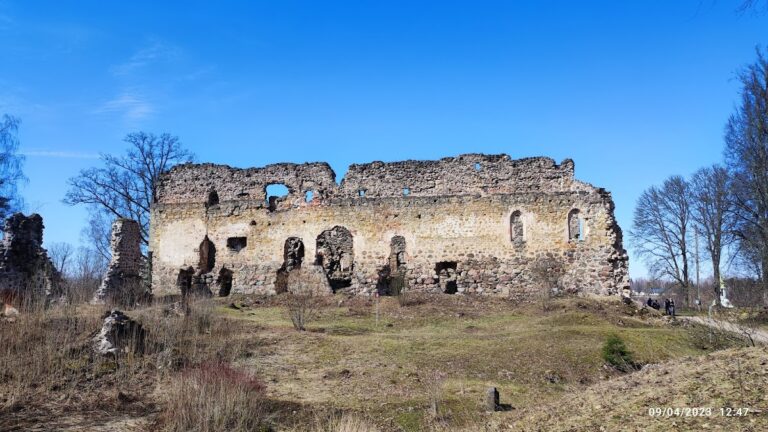
The castle remained in ruins over the centuries. By the 18th century, only the tall brick tower still stood while the rest of the structure had largely deteriorated. The 20th century brought further damage, with World War II battles in 1944 causing the final collapse of the remaining tower and significant portions of the walls. Today, only traces of the once formidable fortress remain.
Remains
Ērgļi Castle was built on a roughly square plan, around 44 meters on each side, situated prominently on a hill overlooking the right bank of the Ogre River. The natural landscape offered protection on three sides due to the river’s course, while an artificial moat fortified the western approach. Surrounding the central courtyard was a quadrangular defensive wall, enclosing various functional buildings.
A key architectural element was the large brick gate tower located on the southwest side. This tower, approximately 7 by 8 meters internally and rising to about four stories tall, featured distinctive design elements including decorative round niches set into its walls. Gun ports with narrow, keyhole-shaped openings were integrated for the use of firearms, reflecting adaptations made during the late medieval period. Ventilation apertures also punctuated the structure. The upper section of this tower was completed in the 15th century, illustrating ongoing construction and enhancement over time.
Inside the main castle walls stood a vaulted church chapel, indicating the religious role held within the fortress community. Adjacent to this was a cellar building in the southwestern corner, measuring about 10 by 12 meters, likely used for storage or economic activities essential to the castle’s function.
Towards the castle’s eastern side lay an outer bailey or forecourt with a triangular outline roughly 30 meters per side. Remnants of a surrounding outer wall with a thickness of about 1.2 meters are preserved in part, situated approximately 11 meters west of the main defensive wall, suggesting an additional layer of protection or a space for auxiliary buildings.
Access to Ērgļi Castle was controlled by a drawbridge spanning the moat, leading directly to the imposing gate tower on the southwest side, where the terrain allowed for entry. This configuration highlighted the castle’s defensive priorities.
By the 18th century, the tall gate tower remained the most prominent surviving structure, with the rest largely in ruins. Early 20th-century records describe the tower and sections of the ring wall as still standing but heavily damaged. The Second World War brought severe destruction during fighting in 1944, leaving only foundation walls rising to about two meters in height and the tower reduced to a scattered pile of bricks. These remains today provide a tangible connection to the castle’s storied past.
Nearby sites