Ralsko Castle: A Medieval Fortress Ruin in the Czech Republic



Visitor Information
Google Rating: 4.8
Popularity: Low
Google Maps: View on Google Maps
Official Website: turistickamapa.cz
Country: Czechia
Civilization: Unclassified
Remains: Military

History
Ralsko Castle is a medieval fortress ruin located near the village of Ralsko in the Czech Republic. It was constructed by members of the Bohemian nobility during the late Middle Ages.
Although the site’s origins are not precisely recorded, archaeological evidence shows that its stone castle was built in 1377 by Jan of Vartenberk. He replaced an older wooden fortification with a more durable stone structure as part of a defensive network intended to secure trade routes in the region. The powerful Vartenberk family maintained the castle, with Jan Chudoba of Vartenberk, who took the name “of Ralsko,” holding it from 1389. This period saw the castle serve imperial interests under King Wenceslaus IV and Emperor Sigismund, often involving military actions against the Hussite movement that challenged the established religious and political order.
During the Hussite Wars, the castle fell under Hussite control in 1427. Its loyalty and leadership were contested; Jan Ralsko the Younger, an important figure, was captured and executed by Lusatian forces in 1433 following his violation of an agreement. After the wars, ownership changed frequently. In 1468, Lusatian troops seized the castle, which subsequently became a refuge for outlaw knights and housed a clandestine mint responsible for producing unauthorized currency.
The estate passed to the Bibrštejn family in 1505, but their lack of care led to the castle’s decline. By the early 1600s, it was described as deserted. Over time, treasure hunters further damaged the site. In the 20th century, from 1969 until 1990, it was inaccessible due to its location inside a Soviet military zone, during which the historic observation tower was destroyed by fire.
In 2012, the castle and its surrounding land were sold to Milan Baier, a local businessman and politician who vowed to maintain public access and promote its historical value. Archaeological excavations in 2014 revealed that the original castle and its defensive structures occupied a considerably larger area than previously estimated. Reconstruction efforts initiated by the nearby town of Mimoň in 2006 have progressed with careful adherence to preservation standards.
Remains
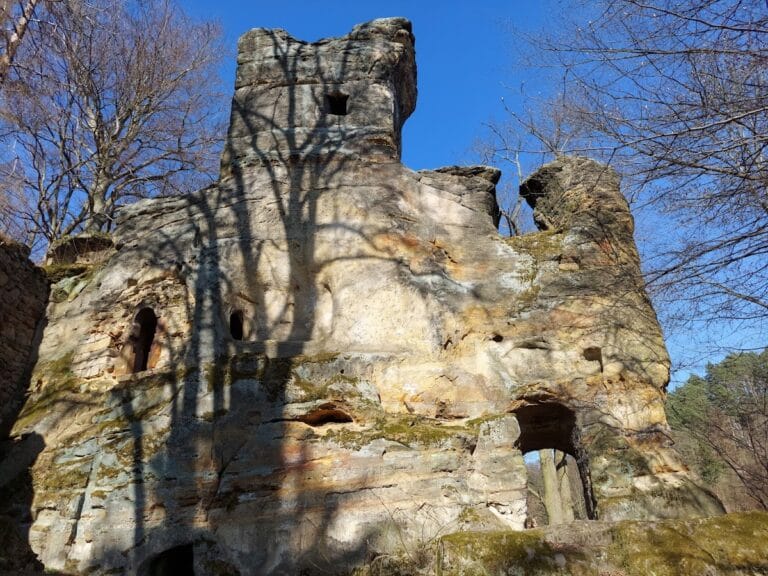
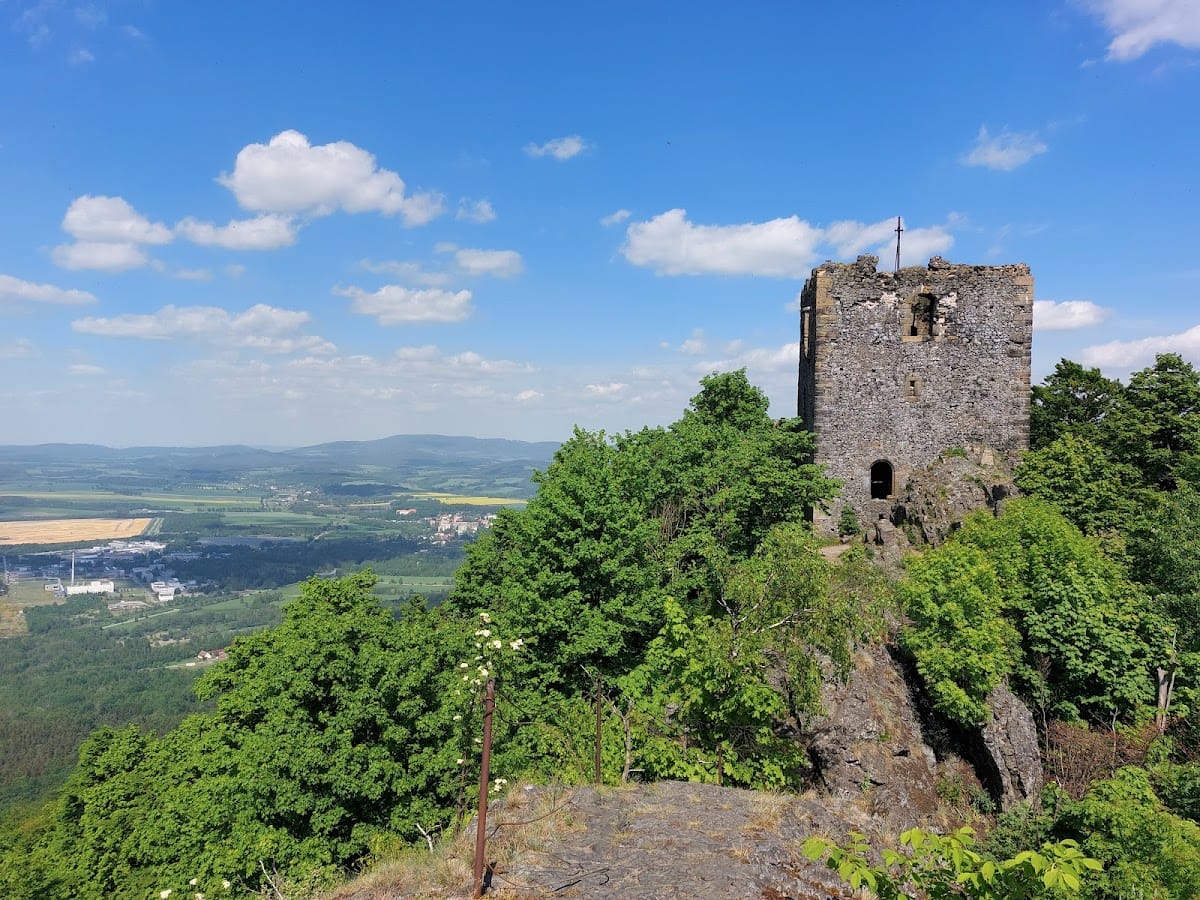
The ruins of Ralsko Castle crown a rocky hilltop bordered by forest, revealing the layout of a medieval stronghold constructed primarily of stone. The castle’s design includes protective walls encircling the site, with the remains of two residential towers, parts of the palace building, and fragments of other structures scattered within the enclosure. One of the defensive features still visible are shield walls reaching a remarkable thickness of 5.6 meters, indicative of efforts to withstand siege warfare.
The castle divides roughly into two cadastral sections. The southern portion contains the main rectangular tower, known as the donjon, which covers about 355 square meters. The northern section extends over 421 square meters and encases additional courtyard and defensive features.
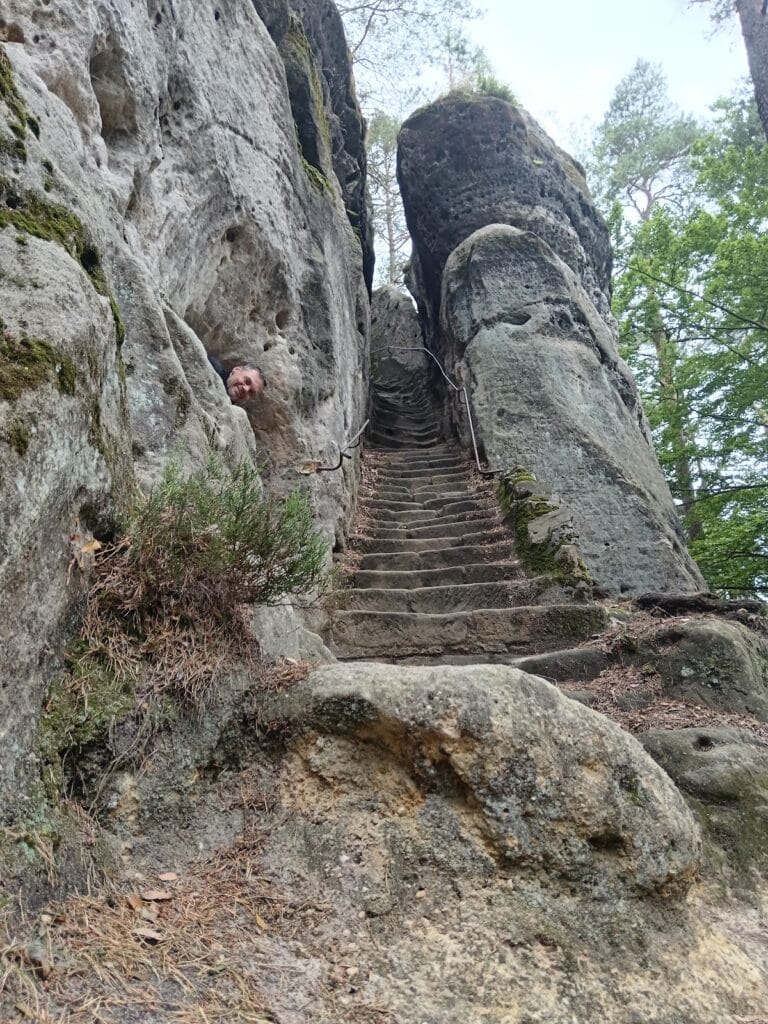
Access to the fortress was originally secured by a path carved directly into the bedrock, passing through two natural gate-like rock formations before arriving at a bailey platform situated on the hillside’s edge. This bailey—a fortified courtyard—was enclosed by walls equipped with a bastion, a protruding defensive outwork. Before entering the lower castle area, visitors would pass through another gate that provided controlled entry to the inner complex. The bailey ended at a two-story tower linked to the upper palace. From this palace, a drawbridge once spanned a gap to the rectangular donjon, emphasizing the layered defense system.
Today, the ruins allow visitors to observe the remnants of these architectural features, offering a broad, circular view of the surrounding Bohemian landscape. Distant landmarks visible from the site include prominent hills and castles such as Ještěd, Hazmburk, Říp, Bezděz, and others. This setting underscores the castle’s strategic placement in its historical context.
Ralsko Castle’s ruins have been officially protected as a cultural monument of the Czech Republic since the mid-20th century and are located within the boundaries of the Ralsko nature reserve, ensuring their preservation and recognition. Photographic records document various portions of the ruins, including the surviving residential towers, the castle’s entrance to the inner courtyard, and the main donjon, providing valuable insights into its original form and scale.
Nearby sites