Castle Jestřebí: A Gothic Rock Castle in Czechia



Site at a Glance
- Rating
- 4.7
- Popularity
- Medium
- Country
- Czechia
- Primary era
- Medieval
- External website
- Open
- Eras represented
- Medieval, Modern
- Civilizations
- Holy Roman Empire, Kingdom of Bohemia
- Site type
- Military
- Remains
- Castle
On this page10 sections
History
Castle Jestřebí is a Gothic rock castle in Jestřebí, Czechia, built by the Berkas of Dubá around 1400, although its precise foundation date remains uncertain. A rock castle used a natural formation as part of its foundations, defenses, or interior spaces. The site stands above the village in the valley of the Robečský stream and reflects the power of a Bohemian noble family that controlled estates and castles in northern Bohemia.
The Berkas of Dubá and the Hussite Wars
The settlement around the castle was recorded in 1295 as the property of Heinrich of Dubá and Jestřebí. The Berka family of Dubá continued to hold the surrounding area in the early fifteenth century. Heinrich Hlawatsch of Dubá is recorded as the castle’s owner from 1407 to 1427.
Hussite forces captured Jestřebí in 1426 together with nearby Česká Lípa. The Hussites were a reform movement and military-political force in fifteenth-century Bohemia, and their wars brought many fortified sites under new control. After the capture, they placed Jestřebí under the care of their hetman, Heinrich Hlawatsch of Dubá.
Raiding, siege, and changing ownership
After the Hussite Wars, Čeněk of Dubá used the castle while leading raiding expeditions into Lusatia with members of the Vartenberg family and Mikeš Pancíř of Sloup. Lusatia answered with a punitive expedition into Bohemia. Čeněk then quickly sold Jestřebí to Jan Smiřický, commander of the Litoměřice garrison.
The castle’s connection with raiding also brought a siege in 1445 by the Upper Lusatian Six-City League, an alliance of six Lusatian towns that acted together in regional military and political affairs. Czernik Berka of Dubá paid for the castle’s release and prevented its demolition. On 28 March 1446, he sold it to Jan Smiřický.
Jan Smiřický was later executed for treason against the king, but his descendants retained the Jestřebí estate for about forty years. His son Albrecht held the property from 1460, and the castle and estate were later sold to Christoph of Wartenberg in 1478. Wenceslas of Wartenberg was resident at Jestřebí in 1530. By the middle of the sixteenth century, the castle was described as deserted and then began to deteriorate progressively.
Collapse and protection
During the eighteenth century, villagers began dismantling the castle’s masonry. The sandstone also weakened through continuing rockfalls. In 1825, three houses below the castle had to be removed because of falling rock. Romantic-style alterations were made around 1830, while local sandstone quarrying and trees growing in cracks contributed to further instability.
Rockfalls were recorded in 1813, 1825, 1852, 1868, 1922, and 1936. The major collapse of 1852 split the rock and destroyed substantial parts of the ruin. Larger masses fell from the northern side during the 1980s, and another section of the western side fell on 1 October 2009. The site was closed for approximately six months after that collapse before reopening.
Continuing instability led to debate about protective barriers and steel nets. In 2012, the heritage council of the National Heritage Institute, the Czech state institution responsible for the care and documentation of cultural heritage, assessed the site in person and accepted the possibility of constructing barriers. The material does not establish that such barriers were later built. The ruin is owned by the Czech Republic and has been protected as a cultural monument since the mid-twentieth century. It also lies within the Zahrádecko Landscape Conservation Area.
Remains
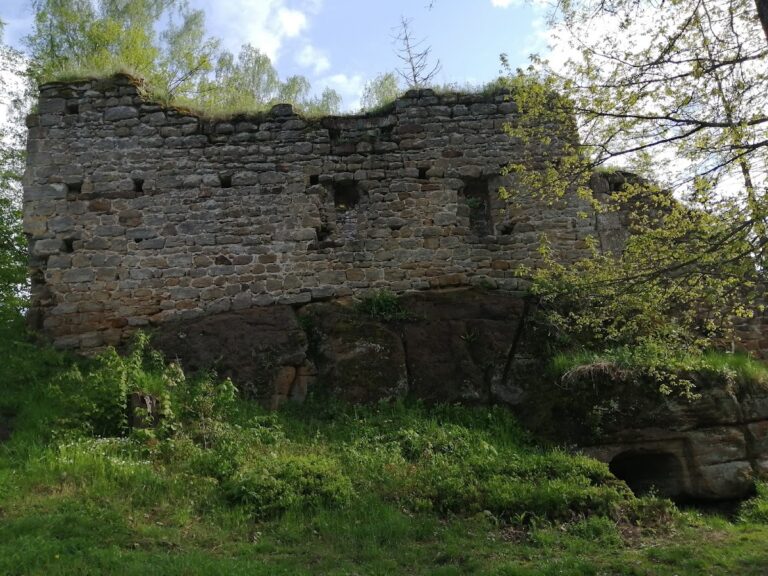
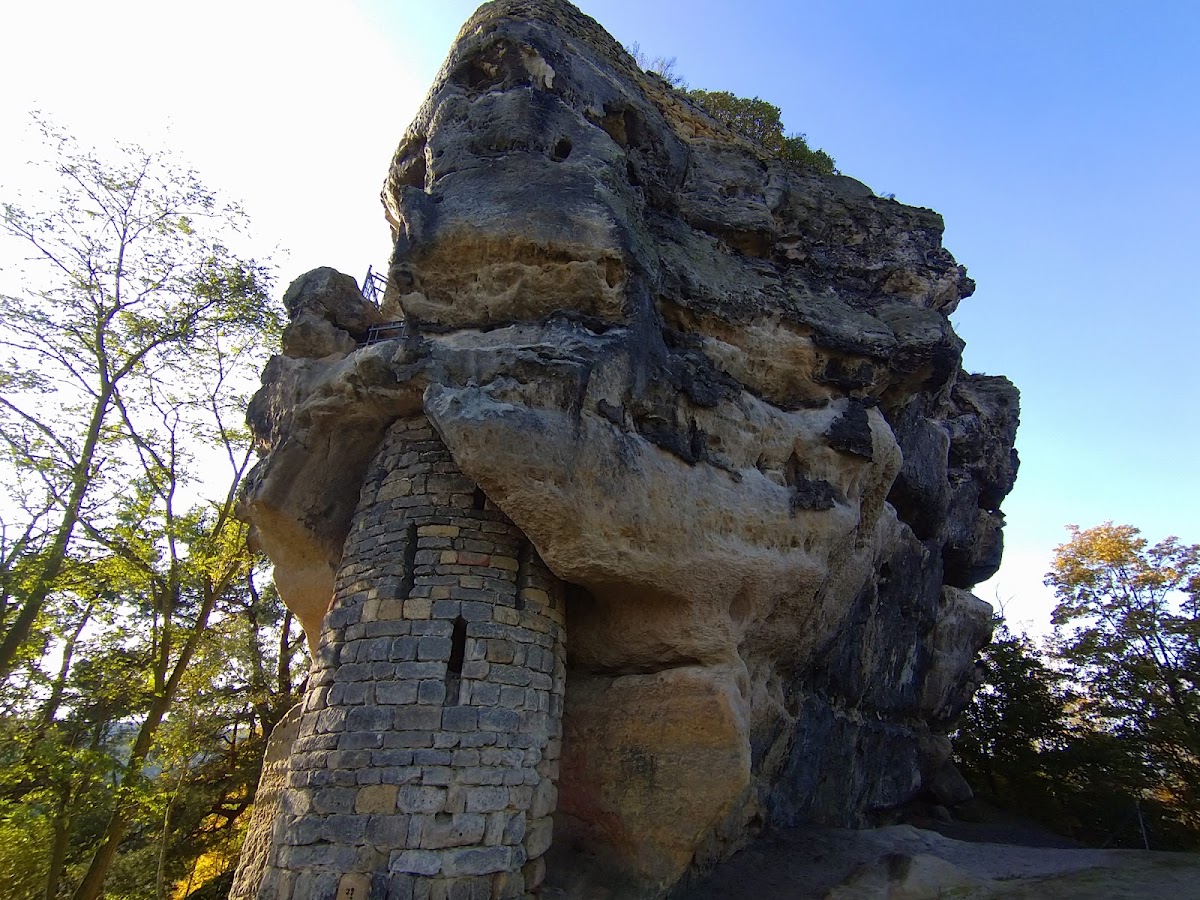
Castle Jestřebí occupies a sandstone outcrop approximately 259 metres above sea level and about 60 metres above the village. The rock originally resembled a ship’s hull stranded on a hill, with overhanging sides. Collapses and quarrying substantially changed that form. The castle was partly cut into the sandstone, and its summit was furnished directly with a battlement rather than enclosed by conventional walls.
Rock formation and defensive layout
Southern and northern rocks
The ruin is divided between a lower southern rock and a higher northern rock. The southern rock is reached by a spiral staircase inserted into the former well. The higher northern rock is not open to the public. Together, the two surviving rock masses preserve the castle’s unusual dependence on the natural formation rather than on freestanding enclosing walls.
Rock-cut chamber
One of the most distinctive remains is a chamber cut into the sandstone. It contains important remnants of the treadwheel mechanism used with a winch. A treadwheel was a large human-powered wheel for raising loads, so the surviving chamber preserves evidence of the practical equipment used within the castle.
Well and access
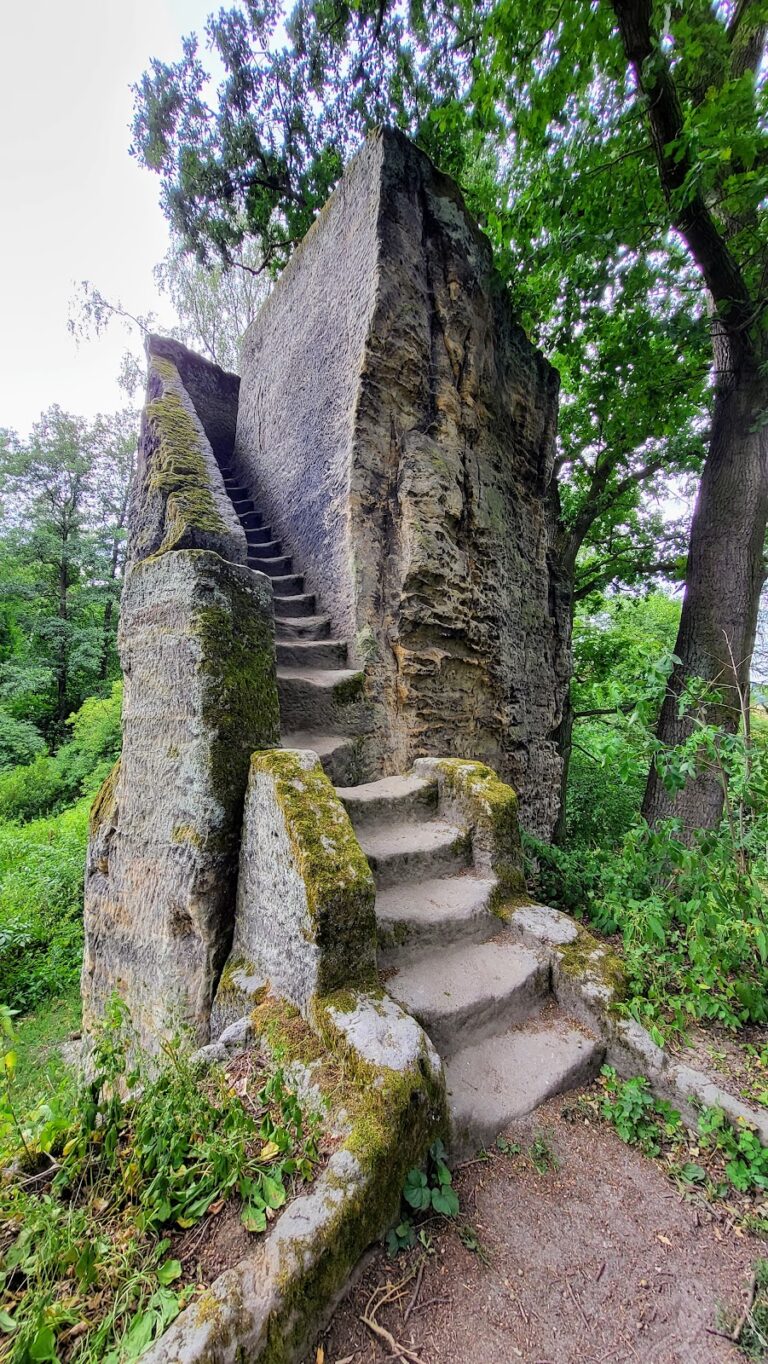
The exposed castle well survives outside the ruin as an unusual feature. Above its circular shaft is a chamber carved into the rock for a treadwheel. During the nineteenth-century rise of tourism, a spiral staircase was inserted into the former well, creating the ascent to the southern rock. The route to the upper level includes 77 steps.
Landscape setting and names
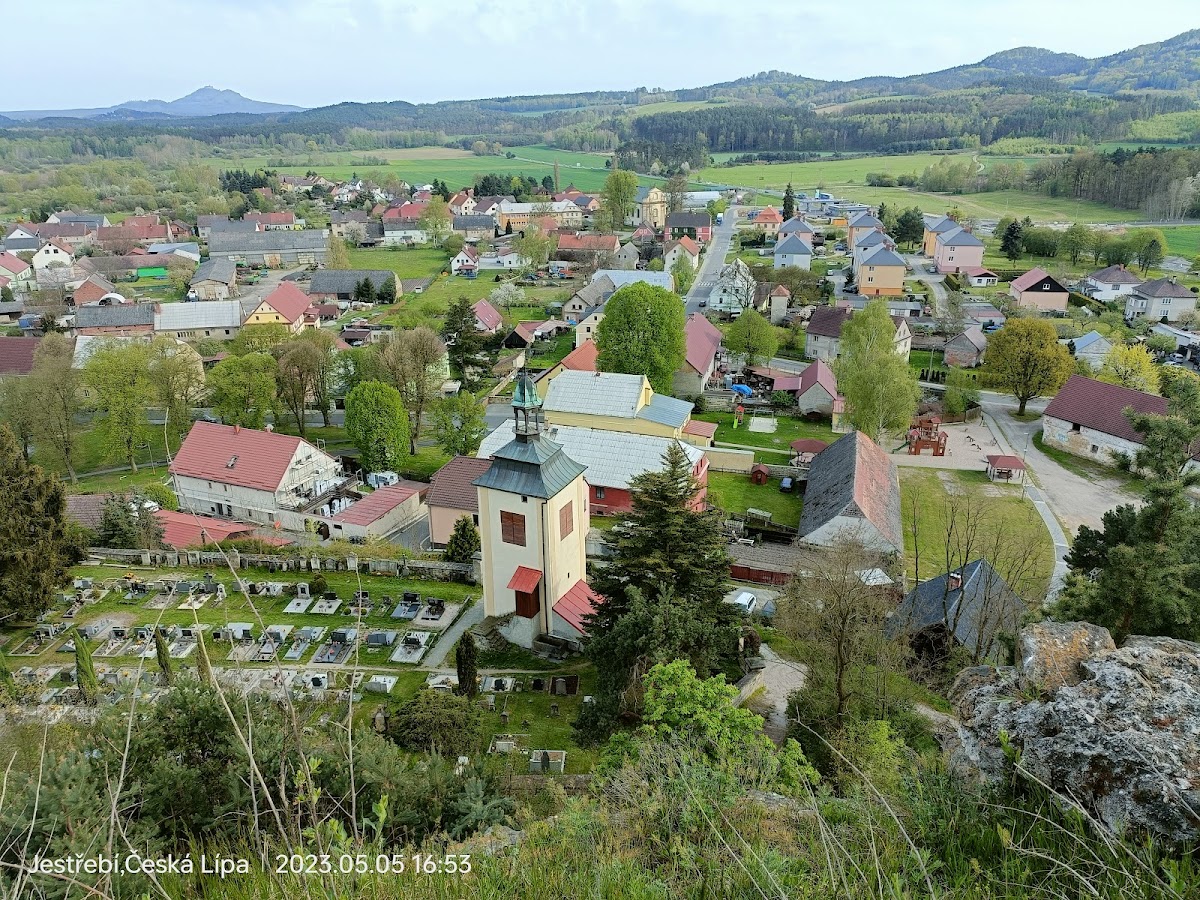
Views from the castle rock extend across Jestřebí, the Bezděz hills, the Kummer Mountains, and the Provodín Rocks with Lysá skála. To the north, the water surface of Novozámecký Pond appears among extensive reed beds.
Castle Jestřebí is also known as Habštejn and Krušina. German forms include Habstein and Habichtstein. The village below was formerly called Krušina, while Habichstein translates into Czech as “Hawk Stone.”