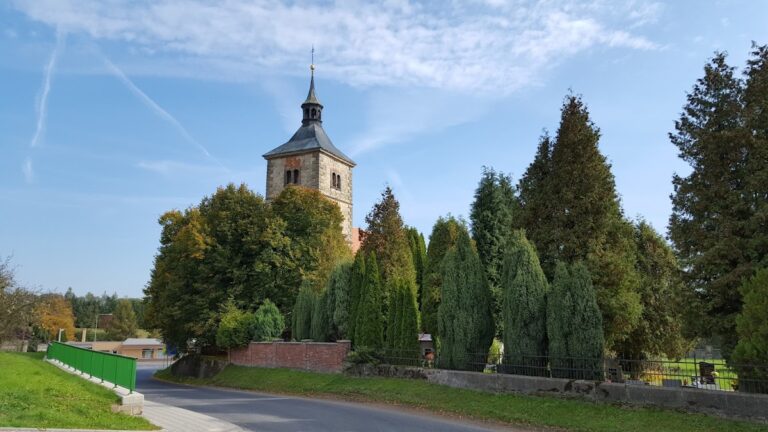
Svojkov Castle: A Gothic Rock Castle in Czechia

Site at a Glance
- Rating
- 4.6
- Popularity
- Low
- Country
- Czechia
- Primary era
- Medieval
- Eras represented
- Medieval, Early Modern
- Civilizations
- Habsburg, Holy Roman Empire, Kingdom of Bohemia
- Site type
- Military
- Remains
- Castle
On this page6 sections
History
Svojkov Castle is a Gothic rock castle in Czechia, at the northern edge of Svojkov. Its existence was first documented in 1355, placing it within the medieval history of the region.
Medieval holders
The earliest known holder was Ješek, recorded in 1370 and probably a member of the Berka family of Dubá, a noble family associated with a medieval lordship in Bohemia. In the early fifteenth century, Jan of Chlum also held the castle. He was one of the guides who accompanied Jan Hus, the Bohemian religious reformer, on his journey to the Council of Constance, where Hus was executed in 1415.
Around 1437, Ctibor of Kačice became Svojkov’s holder. From this period, his noble family adopted the territorial name “of Svojkov,” indicating its association with the estate.
Destruction and abandonment
In 1444 and 1445, the robber knight Mikeš Pancíř of Smojno seized Svojkov Castle. Forces from the Lusatian towns, communities in the historical region of Lusatia, then undertook a retaliatory campaign against him. They captured and burned Svojkov Castle, as well as nearby Sloup Castle, which Pancíř also held.
Svojkov Castle was abandoned around 1530. About two centuries later, Count Josef Jan Maxmilián Kinský purchased the surrounding lands. In 1780, the rock castle was repaired in the Romantic style and fitted with a wooden staircase. A recreational summerhouse was added later. The ruins are protected as a cultural monument of the Czech Republic and are state-owned.
Remains
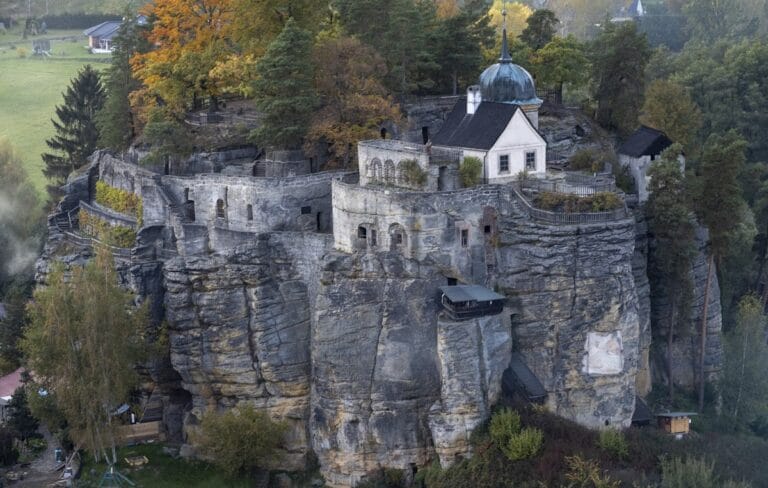
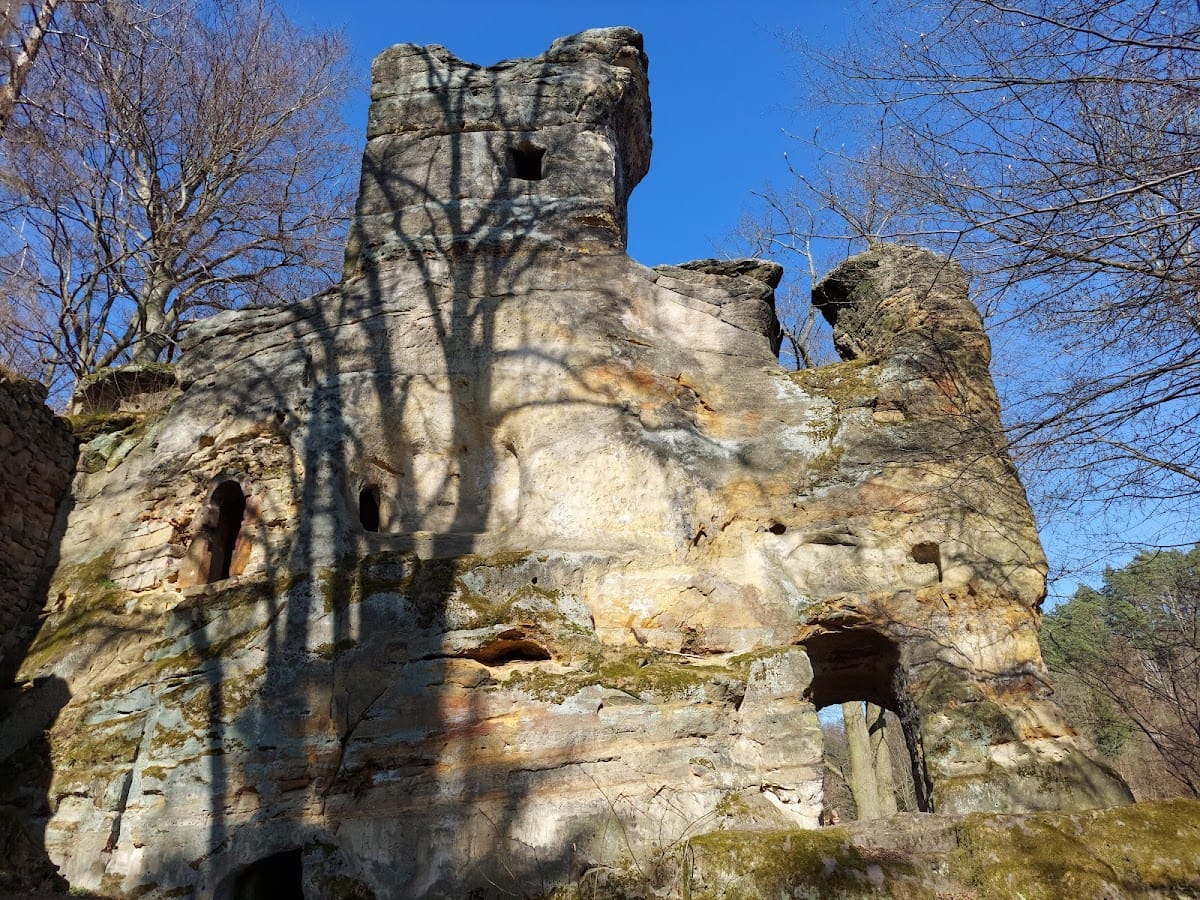
Svojkov survives as a Romantic ruin of a stone Gothic rock castle. The castle was formed by cutting rooms into a sandstone pillar 13 metres high, which stands on a wooded hill rising 20 metres above its surroundings. The excavated spaces extended across three storeys and were connected by passages and stairs along the rock faces.
Rock-cut rooms and circulation
Numerous rooms and passageways cut directly into the sandstone remain visible. Stairs once followed the rock faces, while several wooden galleries helped connect the castle’s levels. These galleries were later removed. Some rooms served as storage areas for weapons, clothing, and food, reflecting the practical functions accommodated within the rock-cut complex.
Castle palace
A two-winged palace stood on the sandstone rock. Its surviving remains consist of fragments of masonry integrated into the rock-cut setting. Together with the excavated rooms and passageways, these fragments preserve the arrangement of a medieval castle whose spaces were created both from stone construction and by cutting into the natural sandstone.