Priene: An Ancient Ionian City in Western Turkey
Table of Contents

Visitor Information
Google Rating: 4.7
Popularity: Medium
Google Maps: View on Google Maps
Official Website: muze.gov.tr
Country: Turkey
Civilization: Byzantine, Greek, Roman
Remains: City

Context
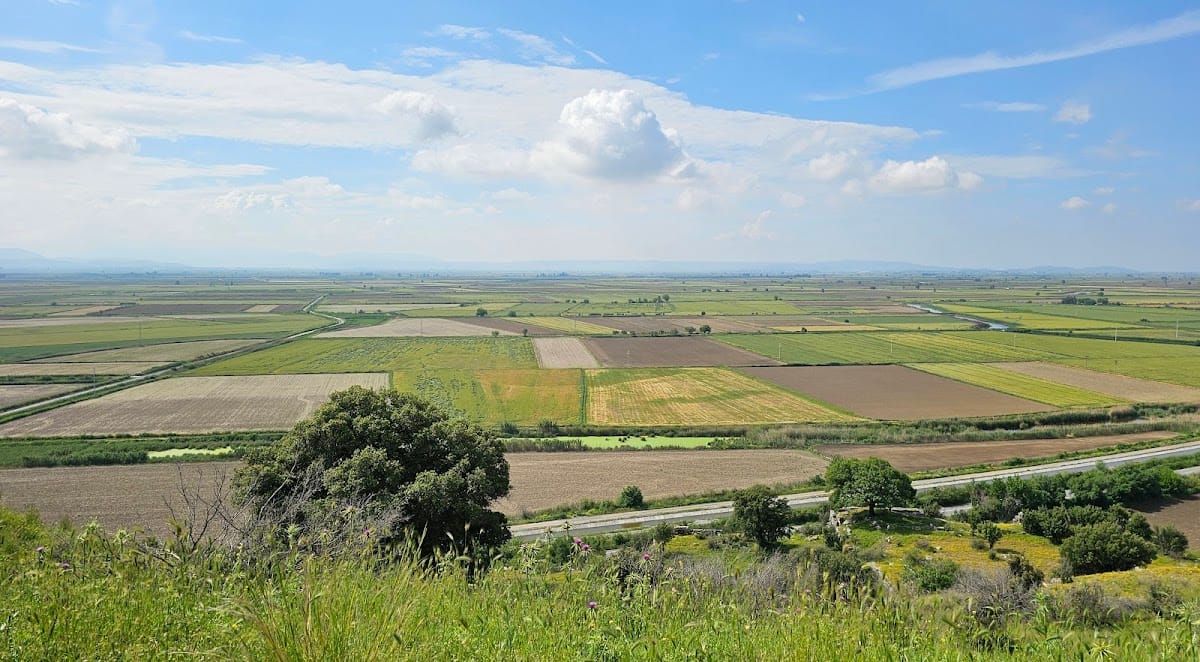
Priene is situated near the modern village of Güllübahçe in the Söke district of Aydın Province, western Turkey. The archaeological site occupies a steep northern slope of Mount Mycale, locally known as Samsun Dağı, overlooking the expansive Maeander River plain. In antiquity, the city faced the Aegean Sea coastline to the west; however, extensive alluvial deposits from the Maeander River have since significantly altered the coastal landscape, pushing the shoreline outward and transforming the original maritime environment.
Archaeological evidence indicates continuous settlement activity at Priene from the Archaic period onward. The city underwent a major urban reorganization in the late fourth century BCE, adopting a characteristic Hellenistic orthogonal street grid. Occupation persisted through the Roman and Byzantine periods, with architectural modifications and epigraphic records documenting ongoing civic life. Scholarly research has linked Priene’s gradual decline to environmental changes, particularly sedimentation that severed its direct access to the sea, impacting its economic and strategic roles.
Systematic excavations commenced in the late nineteenth century under German archaeologists led by Theodor Wiegand. These investigations uncovered the city’s planned street layout, monumental public buildings, and numerous inscriptions, providing valuable insights into Hellenistic urbanism and civic organization. While many artifacts were removed to European museums, significant collections remain in Turkey. Today, Priene is managed as an archaeological park, with visible ruins and active conservation efforts preserving its historical fabric.
History
Priene’s historical trajectory exemplifies the complex interplay of political, environmental, and cultural factors shaping western Anatolia from the early Iron Age through the Byzantine era. Founded by Ionian Greeks, the city’s fortunes were closely tied to its strategic position near the Maeander River delta, which initially afforded maritime access and facilitated participation in regional networks. Over time, shifting imperial dominions and progressive silting of the Maeander altered Priene’s urban and economic landscape, culminating in its eventual decline. The site’s documented roles encompass religious leadership within the Ionian League, democratic governance in the Hellenistic period, and ecclesiastical significance during late antiquity.
Archaic Period (c. 11th–6th century BCE)
Priene was established in the early Iron Age by Ionian settlers, traditionally attributed to Aegiptus, a descendant of Athenian royalty. Subsequent Boeotian settlers led by Filotas contributed to the city’s dual identity, reflected in the alternative name Kadmē, referencing the Theban Cadmea. Initially located as a coastal port near the Maeander River’s mouth, Priene possessed two harbors, including Naulokhon, facilitating maritime commerce. It was a member of the Ionian League (Dodecapolis) and exercised partial control over the Panionion sanctuary, a central religious site for the league’s collective festivals.
During the 7th century BCE, Priene endured incursions by Cimmerian raiders and was conquered by the Lydian king Ardys. Following the defeat of Croesus by Cyrus the Great circa 545 BCE, the city came under Persian rule. Herodotus records that Persian domination was severe, with inhabitants reportedly enslaved, leading to a decline in Priene’s prominence. Despite these hardships, Priene actively participated in the Ionian Revolt (499–494 BCE), contributing twelve ships to the Battle of Lade, underscoring its continued engagement in regional resistance against Persian control.
Classical Period (5th–4th century BCE)
In the 5th century BCE, Priene aligned with the Athenian-led Delian League, appearing in tribute lists from 454/453 to at least 425/424 BCE. The city was involved in territorial disputes with neighboring polities such as Miletus and Samos, which prompted Athenian military intervention in the 440s BCE. In 398/397 BCE, Priene supported Spartan general Dercylidas in campaigns within the Maeander region, reflecting shifting alliances amid Peloponnesian conflicts.
Around 390 BCE, the original settlement was abandoned, with inhabitants relocating temporarily to the nearby port of Naulokhon, which functioned as the polis for a period. The Panionia festival, integral to Ionian identity and originally held at Panionion within Priene’s territory, was briefly transferred to Ephesus but restored to Panionion in the 4th century BCE, possibly in 373 BCE. This restoration indicates the persistence of religious and political ties within the Ionian League despite environmental and political challenges.
Hellenistic Period (c. 350–1st century BCE)
Between approximately 350 and 334 BCE, Priene was refounded on its present site on the southeastern slopes of Mount Mycale. This relocation and urban redesign are attributed either to Mausolus, the Carian satrap, or to developments associated with Alexander the Great’s campaign in 334 BCE. Alexander himself stayed in Priene during his military advance, financing the completion of the Temple of Athena Polias and granting the city tax exemptions, reflecting its integration into the Hellenistic world.
The city was planned according to the Hippodamian grid system, featuring orthogonal streets and fortified walls enclosing about 37 hectares, including approximately 500 houses. Priene operated as a democracy with institutions such as the boule (council) and ekklesia (assembly), with officials like prytanis and grammateus documented epigraphically. The city minted its own bronze coinage depicting Athena and maritime motifs, indicating economic activity linked to trade and naval identity.
Key public buildings from this period include the Temple of Athena Polias, designed by Pytheos, the Temple of Zeus Olympios, sanctuaries dedicated to Demeter and Kore, and a complex honoring Egyptian deities such as Isis and Serapis. The Temple of Athena, an exemplary Ionic structure with eleven by six columns, was completed in the 3rd or 2nd century BCE and bears Alexander’s dedicatory inscription. The acropolis and lower city were fortified with walls and towers, featuring three principal gates controlling access. Public spaces comprised an agora with surrounding stoas, a bouleuterion accommodating several hundred citizens, a prytaneion, a theater with a two-story stage building, and two gymnasia. A stadium dating to the late 2nd century BCE included a 191-meter running track and spectator seating. The city’s water supply system harnessed springs from Mount Mycale, employing aqueducts, cisterns, and drainage infrastructure; approximately one-third of houses had indoor latrines, reflecting advanced urban amenities. Priene’s economy combined maritime trade with agriculture from the fertile Maeander valley, supporting a prosperous and culturally vibrant community.
Roman and Late Antique Period (1st century BCE–7th century CE)
Priene endured a significant fire in the 2nd century BCE but continued to be inhabited throughout the Roman period. Progressive silting of the Maeander River delta extended the coastline, resulting in the loss of Priene’s harbors and a decline in its maritime significance by the 1st century BCE. Under Roman administration, the Temple of Athena was rededicated to Emperor Augustus, and restoration efforts were undertaken, including by Orophernes, a Cappadocian prince who refurbished the temple as a votive offering following Roman intervention in 155 BCE.
Public buildings such as the gymnasia were adapted, with baths added to the Upper Gymnasium during Roman and early Byzantine times. Priene became a bishopric subordinate to the metropolitan see of Ephesus, with several churches constructed, including a 6th-century basilica featuring a baptistery built from reused architectural elements. Archaeological discoveries also reveal an early Byzantine synagogue, attesting to a Jewish community within the city. Byzantine fortifications, including a round tower, were erected on the acropolis and parts of the lower city. By late antiquity, the urban area and population had contracted to approximately half their classical extent, reflecting broader regional demographic and economic shifts.
Byzantine and Medieval Periods (7th–13th century CE)
Priene remained under Byzantine control until the late 13th century CE, during which its urban and demographic profile diminished considerably. Known as “Sampson” in Greek and “Samson’s Castle” in Turkish, the site retained a small Greek Christian population governed by ecclesiastical authorities. Archaeological evidence from this period is limited but includes fortifications and ecclesiastical buildings, indicating continued religious and defensive functions.
Economic activity was largely restricted to subsistence agriculture and local trade, with domestic architecture simplified and incorporating reused materials from earlier periods. Transportation was primarily overland, connecting the reduced settlement to neighboring centers. The city’s political significance waned, functioning as a minor fortified locality under Byzantine administration and local magnates such as Sabas Asidenos, who briefly ruled the city in 1204 before submitting to the Empire of Nicaea. The Greek population persisted until the population exchange between Greece and Turkey in 1923, after which Turkish settlers established the modern village of Güllübahçe nearby.
Modern Rediscovery and Archaeological Excavations (18th century–present)
Priene’s ruins were first systematically studied by the English Society of Dilettanti during the mid-18th and early 19th centuries, with initial excavations focusing on the Temple of Athena in the late 1860s. German archaeologists, including Carl Humann and Theodor Wiegand, conducted extensive excavations from 1895 to 1898, revealing the city’s orthogonal street plan, monumental public buildings, and numerous inscriptions that illuminate Hellenistic urban life and governance. Many artifacts were removed to European museums, while significant collections remain in Turkish institutions.
Subsequent archaeological work by German and Turkish teams has continued since the late 20th century, with ongoing conservation and research efforts. Approximately one-third of the city has been excavated, uncovering well-preserved remains of city walls, temples, the theater, bouleuterion, gymnasia, and residential quarters. Priene is recognized as a paradigmatic example of ancient Greek urban planning and architecture, providing valuable insights into Hellenistic civic organization and infrastructure.
Daily Life and Importance by Period
Archaic Period (c. 11th–6th century BCE)
During the Archaic period, Priene’s population consisted primarily of Ionian Greeks, with later Boeotian settlers contributing to its cultural identity. The city’s economy was based on its coastal port functions, leveraging proximity to the Maeander River delta for maritime trade, fishing, and shipbuilding. Social stratification likely included aristocratic landowners, merchants, artisans, and enslaved individuals, the latter increasing under Persian domination as recorded by Herodotus. Religious life centered on participation in the Ionian League and the Panionion sanctuary, which Priene partly controlled and where the Panionia festival was held, fostering communal identity among the Ionian cities.
Domestic architecture during this period was modest, with simple coastal dwellings. The diet comprised cereals, olives, fish, and locally cultivated produce, consistent with Ionian subsistence patterns. Transportation relied on coastal navigation and overland routes connecting Priene to neighboring cities, facilitating economic and cultural exchange within the Ionian network.
Classical Period (5th–4th century BCE)
In the Classical period, Priene’s population remained predominantly Ionian Greek, with political affiliations shifting through membership in the Delian League and alliances with Sparta. Civic life included magistracies and military participation, as evidenced by involvement in regional conflicts and support for Spartan campaigns. The abandonment of the original city around 390 BCE and relocation to the port of Naulokhon suggest adaptive responses to environmental or military pressures, possibly linked to silting or conflict.
Economic activities continued to focus on agriculture and maritime trade, although harbor accessibility may have been compromised by sedimentation. Domestic architecture during this phase is less well documented, but the temporary relocation implies a focus on port facilities and simpler housing. Religious observances persisted, with the Panionia festival restored to Panionion in the 4th century BCE, underscoring enduring religious and political connections within the Ionian League. Transportation remained primarily maritime and overland, supporting regional interactions.
Hellenistic Period (c. 350–1st century BCE)
The Hellenistic refoundation of Priene marked a significant transformation in urban life and civic organization. The city’s relocation to Mount Mycale’s southeastern slopes introduced a Hippodamian orthogonal grid plan, structuring daily activities around clearly defined public and private spaces. The population remained predominantly Greek, governed by democratic institutions such as the boule and ekklesia, with officials like prytanis and grammateus attested in inscriptions.
Economic life diversified, combining maritime trade, agriculture from the Maeander valley, and artisanal production. Archaeological evidence reveals advanced infrastructure, including aqueducts, cisterns, drainage systems, and indoor latrines in many houses, indicating elevated living standards. Private residences featured vestibules, peristyle courtyards, and decorated interiors, with artifacts such as furniture fragments and oil lamps attesting to domestic comfort. The diet included bread, olives, fish, and local produce. The agora and surrounding stoas functioned as commercial and social centers, facilitating the circulation of local and imported goods. Transportation involved pedestrian movement along paved streets and access to regional trade routes.
Religious life flourished with temples dedicated to Athena Polias, Zeus Olympios, Demeter, Kore, and Egyptian deities, reflecting a syncretic cultural environment. Festivals and rituals at these sanctuaries reinforced civic identity. Public buildings such as the bouleuterion, theater, and gymnasia hosted political, cultural, and athletic events, fostering community cohesion. Priene’s regional significance during this period was that of a prosperous democratic polis integrated into Hellenistic Caria and influenced by prominent figures like Alexander the Great.
Roman and Late Antique Period (1st century BCE–7th century CE)
In the Roman and Late Antique periods, Priene’s population remained Greek-speaking but experienced demographic decline due to ongoing silting that severed maritime access. Social stratification persisted, with local elites, religious authorities, and artisans maintaining civic functions. The city adapted by repurposing civic and religious structures; the Temple of Athena was rededicated to Emperor Augustus, symbolizing integration into the imperial cult. Inscriptions attest to benefactors such as Orophernes, indicating continued elite patronage.
Economic activities shifted toward localized agriculture and crafts, with public buildings modified to include Roman leisure features such as baths in gymnasia. Domestic life retained sophisticated water management and sanitation systems. The diet remained Mediterranean, supplemented by regional trade via overland routes. Religious practices diversified with the establishment of a Christian bishopric under Ephesus, construction of churches including a 6th-century basilica with baptistery, and evidence of a Jewish community through a synagogue. Byzantine fortifications attest to ongoing strategic importance despite urban contraction. Priene functioned as a municipium with ecclesiastical authority, maintaining essential civic and religious roles amid environmental and political transformations.
Byzantine and Medieval Periods (7th–13th century CE)
During the Byzantine and Medieval periods, Priene’s population and urban extent contracted significantly, reflecting broader regional decline. Known as Sampson, the city retained a small Greek Christian community under ecclesiastical governance. Archaeological evidence for daily life is limited but includes fortifications and churches, indicating continued religious and defensive functions.
Economic activity was largely subsistence-based, with simplified domestic architecture incorporating reused materials. Transportation was primarily overland, linking the diminished settlement to nearby centers. Priene’s civic role diminished to a minor fortified locality under Byzantine administration and local magnates such as Sabas Asidenos. The city’s classical urban identity ended with the Turkish conquest and population changes following the 1923 population exchange, after which Turkish settlers founded the modern village of Güllübahçe nearby.
Modern Rediscovery and Archaeological Excavations (18th century–present)
Modern archaeological investigations have profoundly enhanced understanding of Priene’s social and civic history. Excavations have revealed detailed urban layouts, monumental public buildings, inscriptions, and artifacts illuminating domestic life, economic activities, and religious practices across periods. Conservation and research continue to clarify the city’s evolution from an Ionian port to a Hellenistic polis and later Roman and Byzantine municipium, providing a comprehensive picture of its social dynamics and urban development.
Remains
Architectural Features
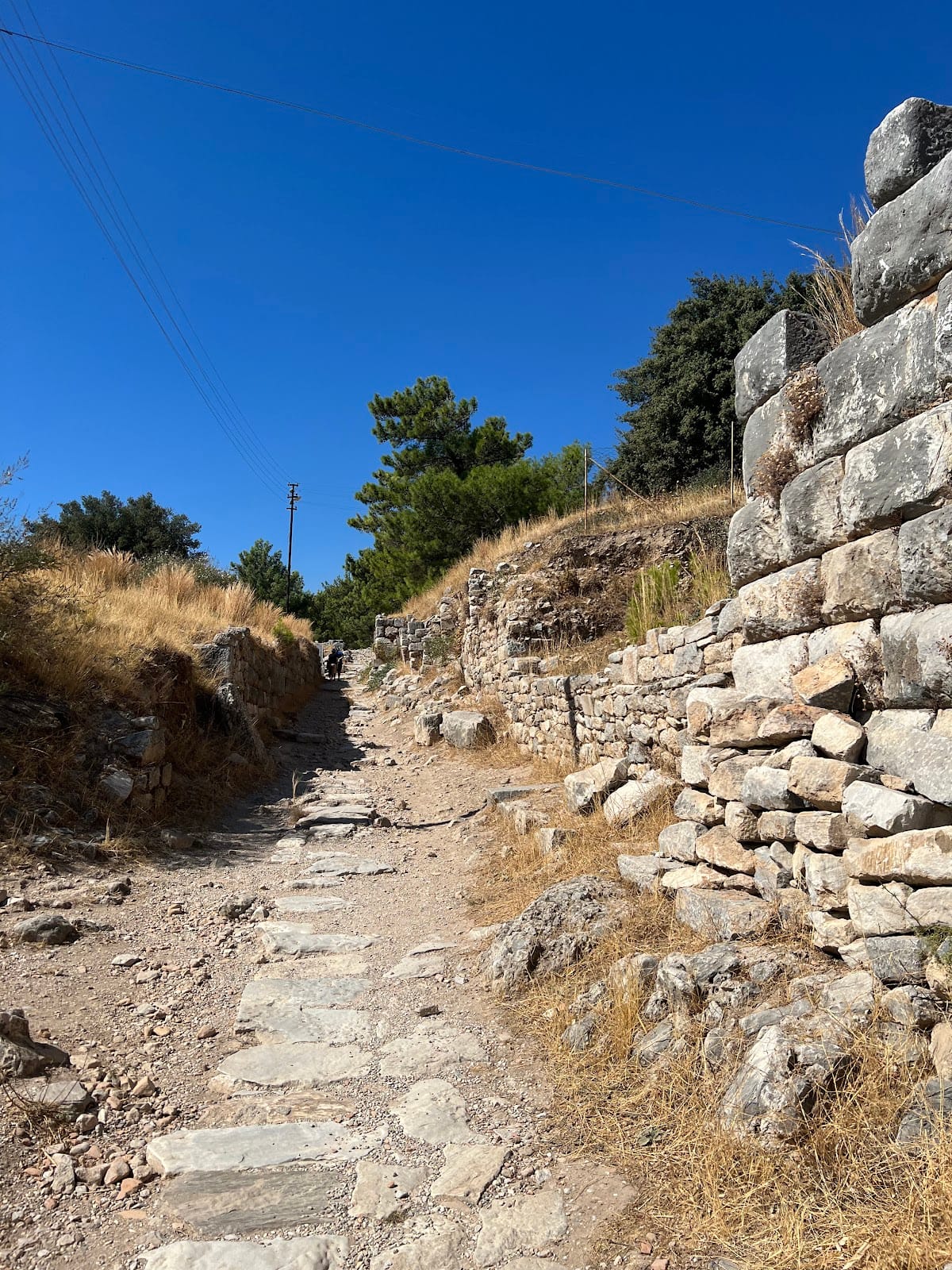
Priene’s urban fabric is characterized by a well-preserved Hippodamian grid plan established in the late 4th century BCE. The city encompasses approximately 37 hectares within fortified walls, with about 15 hectares allocated to residential and public use. The city blocks measure roughly 35.4 by 47.2 meters, each typically containing eight houses. Four principal east-west streets—Theater Street, Athena Street, West Gate Street, and Spring Gate Street—traverse the city, intersected by north-south streets that accommodate the sloping terrain through stepped sections. Main streets were paved with stone, while side streets were often carved from bedrock and equipped with drainage channels. The water supply system harnessed springs from Mount Mycale, distributing water via aqueducts, cisterns, and drainage facilities. Rainwater management included openings in the city walls to prevent water accumulation.
The acropolis, located on the northern slope of Mount Mycale, is enclosed on three sides by walls approximately 2 meters thick, dating to circa 350–340 BCE. These fortifications reach heights of up to 8 meters and incorporate square towers at intervals, some serving as guard rooms. The southern side is a steep natural slope and remains unfortified. Narrow stairways cut into the rock connect the acropolis to the lower city on the eastern side. Byzantine fortifications, including a round tower, were later added to the acropolis. The lower city is enclosed by semicircular walls from the same period, rising to about 8 meters and featuring towers. Three main gates—East Gate, Southeast Gate (also known as Spring Gate), and West Gate—controlled access, with walls terminating at the acropolis slopes.
Key Buildings and Structures
Temple of Athena Polias
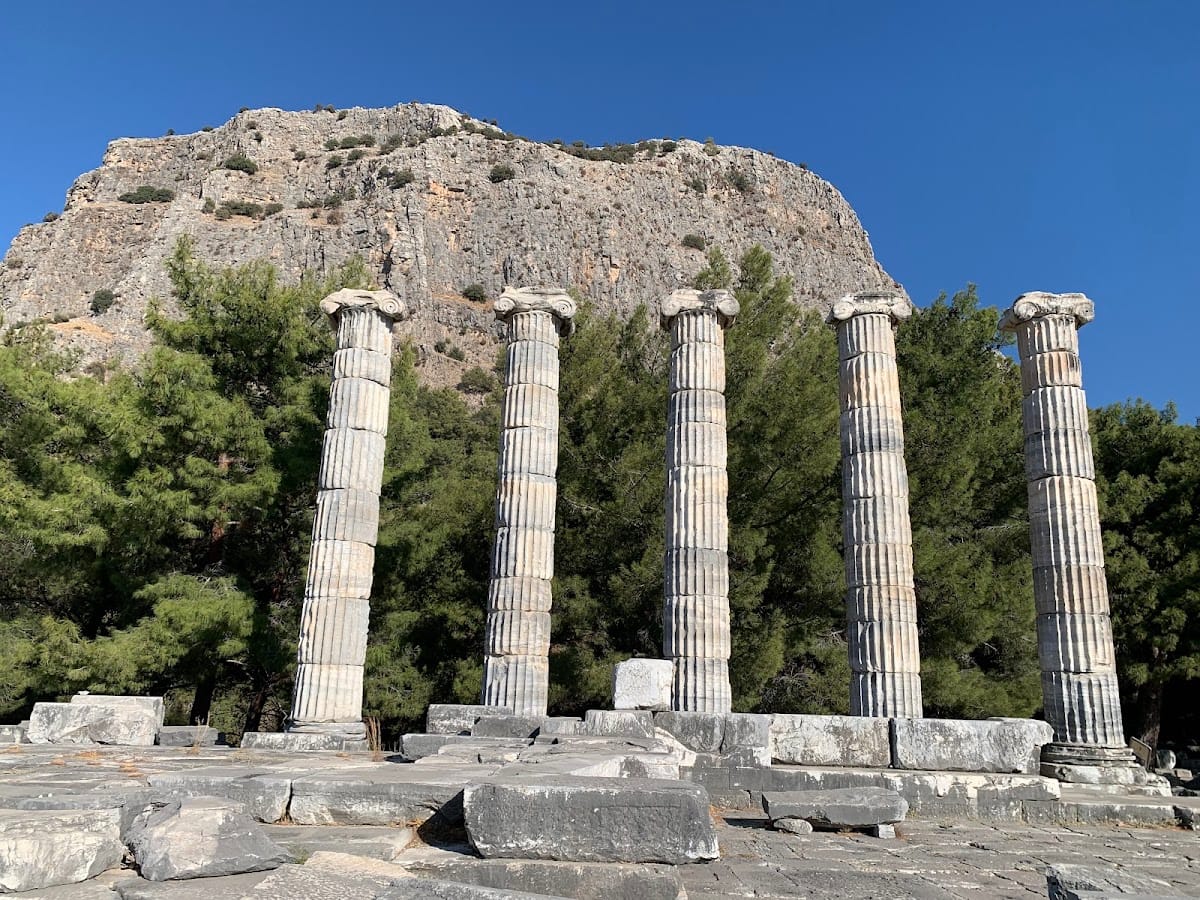
The Temple of Athena Polias, situated on a terrace northwest of the agora, was constructed beginning in the 330s BCE and likely completed in the 3rd or 2nd century BCE. Alexander the Great financed its completion and dedicated it to Athena Polias. Designed by the architect Pytheos, also responsible for the Mausoleum at Halicarnassus, the temple exemplifies Ionic architecture with a peristyle of eleven by six columns. The interior comprises a pronaos (front porch), naos (cella or main chamber), and opisthodomos (rear room). The cult statue of Athena dates to the 1st century BCE. Presently, only the temple’s foundations and five re-erected columns survive. Approximately 12 meters east lies the altar, measuring about 13.2 by 7.1 meters, decorated with reliefs and possibly Ionic half-columns on its sides. The sanctuary’s eastern boundary features a monumental Ionic propylon constructed circa 25 BCE to 1 CE. To the south, a Doric stoa approximately 78.4 by 6.8 meters borders the sanctuary, built around 200 BCE.
Temple of Zeus Olympios
Located east of the agora, the Temple of Zeus Olympios was erected in the late 4th to early 3rd century BCE in Ionic style, bearing architectural resemblance to the Temple of Athena. The temple is tetrastyle prostylos, with four columns at the front, measuring approximately 11.8 by 8.5 meters. Its sacred enclosure (temenos) covers about 30 by 29.7 meters and is surrounded by Doric stoas. Architectural fragments from this temple are preserved in the Pergamon Museum in Berlin. The temple and sanctuary were integrated with the eastern side of the agora.
Sanctuary of Demeter and Kore
This sanctuary is located at the northernmost part of the lower city, at the base of the acropolis’s steep southern slope. Constructed shortly after the city’s re-foundation around 350–300 BCE, it comprises a courtyard with an eastern entrance, a temple on the west side, and an altar in the northeast corner. The temple features a columned pronaos and an irregularly shaped naos. An offering pit is associated with the sanctuary. The altar was added during the Roman period. Artifacts predating the city’s re-foundation have been recovered here, indicating continuity of religious use at this site.
Sanctuary of Egyptian Gods
Situated between Theater Street and Athena Street, east of the theater, this sanctuary dates to the 3rd century BCE and is dedicated to Isis, Serapis, Anubis, and Harpocrates. The complex includes a temenos (enclosure) with a large central altar. The remains consist primarily of foundation walls and altar structures.
Alexandreion
Located in the western part of the city, the Alexandreion is interpreted as a sanctuary dedicated to Alexander the Great. Built between approximately 350 and 150 BCE, it comprises a forecourt and several small rooms arranged similarly to a private residence. The building measures about 20.5 by 35.4 meters. It is believed to have served as Alexander’s residence during his stay in Priene and was later converted into a cult sanctuary.
Sanctuary of Cybele
This small sanctuary dedicated to the goddess Cybele is situated near the West Gate on the western edge of the lower city. It includes an offering pit and foundation remains of a modest structure.
Agora
The agora forms the central public square of Priene, rectangular in shape and measuring approximately 75.6 by 46.35 meters, equivalent to two city blocks. It is bordered on the east, south, and west sides by stoas (colonnaded porticoes) and shops. The north side opens onto West Gate Street. The eastern side later connected to the sanctuary of Zeus. The agora dates primarily to the 2nd and 1st centuries BCE. A central altar, likely dedicated to Hermes, measures about 6.2 by 5.2 meters. Several statue bases and curved benches (exedrae) remain within the square.
Sacred Stoa
Located north of the agora across the street, the Sacred Stoa was constructed around 160–150 BCE. It extends approximately 116 meters in length, with a façade of 49 Doric columns. Inside, 24 Ionic columns divide the stoa into two aisles. The rear section contains 15 rooms. The stoa functioned as the city archive, with numerous inscriptions found on its walls. The roof was likely wooden. Foundations and column bases are preserved.
Bouleuterion
The bouleuterion, serving as the council chamber and possibly assembly hall, is situated on Athena Street north of the Sacred Stoa. Constructed around 200 BCE, it has a nearly square plan measuring approximately 20 by 21 meters. Seating benches arranged on three sides could accommodate 600 to 700 people. A central altar is located within the hall. The roof was supported by pillars. The bouleuterion is exceptionally well preserved, with substantial remains of walls and seating.
Prytaneion
Immediately east of the bouleuterion lies the prytaneion, which served as the meeting place and dining hall for leading city officials. Originally built around 180 BCE, it was remodeled by about 150 CE. The Roman phase included a paved peristyle courtyard. A hearth for the sacred fire of Hestia is located in the southeast corner. The prytaneion’s remains are poorly preserved, with foundation walls and some courtyard paving visible.
Theater
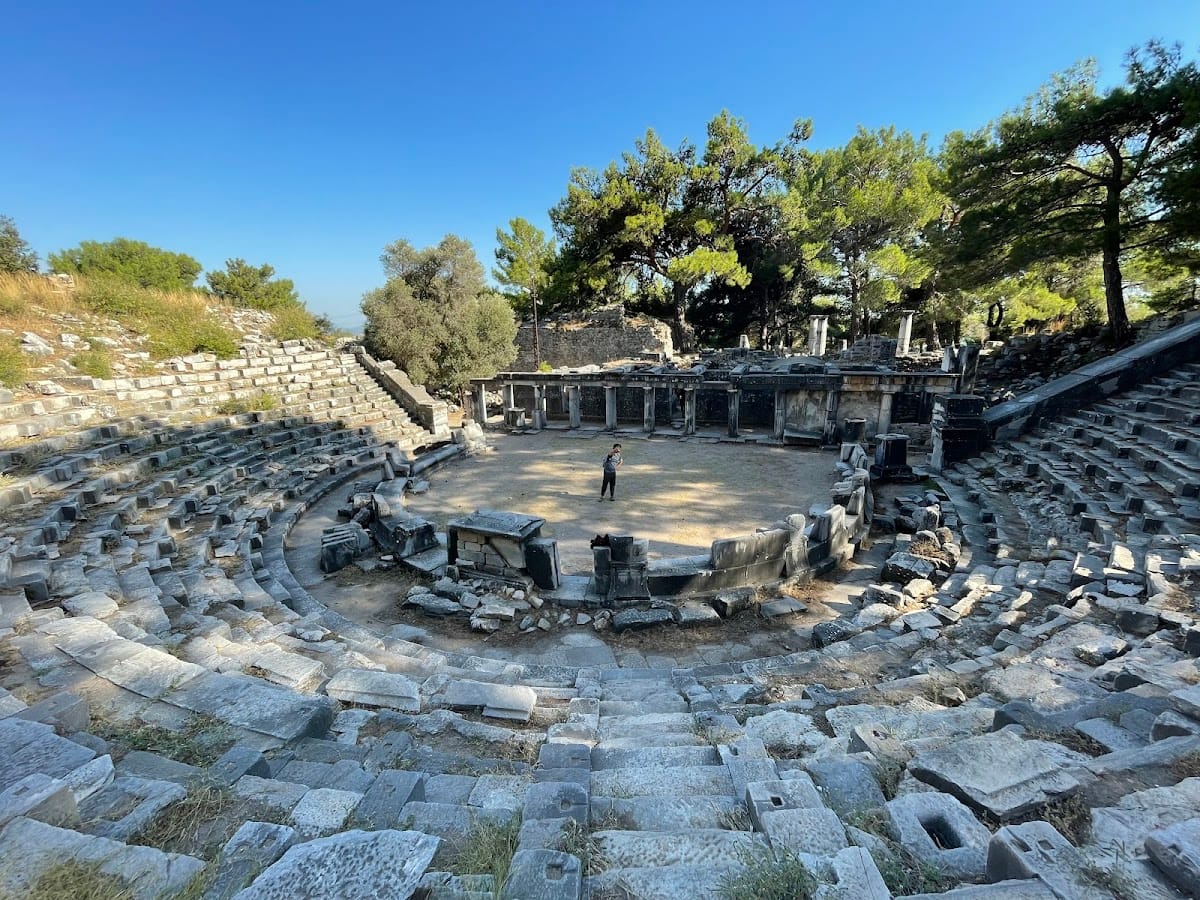
The theater, located along Theater Street, was constructed circa 300 BCE, making it one of the earliest known Hellenistic theaters. It was modified in the 2nd century CE. The seating area (cavea) forms slightly more than a semicircle with 47 rows of seats; the lower 15 rows are better preserved. The front row features marble seats with backrests reserved for dignitaries. A central altar dedicated to Dionysus is situated in the orchestra (performance area). The stage building (skene) was two stories; only the lower story survives. The stage front (proskenion) is exceptionally well preserved, supported by 12 pillars. The theater may have also served judicial functions.
Lower Gymnasium
Located in the southern part of the city just inside the walls, the Lower Gymnasium was built around 130–100 BCE. Its exercise yard (palaistra) measures about 35.1 by 34.4 meters. Surrounding rooms include a lecture hall (efebeion), a dusting room (konisterion), a punching bag room (korykeion), and an oil storage room (elaiothesion). The colonnades feature all three classical orders: Doric, Ionic, and Corinthian. Foundations and colonnade bases remain visible.
Upper Gymnasium
The Upper Gymnasium lies between the bouleuterion and the theater. Constructed in the 4th century BCE, it underwent frequent modifications during the Roman and early Byzantine periods, including the addition of a bathhouse. The complex is surrounded by multiple rooms, with the main entrance on the east side. A shrine dedicated to the imperial cult is located in the northwest corner. The remains are poorly preserved, consisting mainly of foundation walls and partial room outlines.
Stadium
Immediately east of the Lower Gymnasium and just inside the city walls, the stadium was built around 130–120 BCE, possibly replacing an earlier structure. The running track is oriented roughly east-west, measuring about 191 meters long and 20 meters wide. Stone seating is preserved along the central part of the northern side. A starting gate structure is located at the western end of the track. Foundations and seating remain visible.
Private Houses
Numerous well-preserved private houses date mainly to the 3rd and 2nd centuries BCE. Typical layouts include a vestibule, an open peristyle courtyard, a front room, and a main hall surrounded by other rooms. Some houses were two stories high and contained baths and latrines. Entrances face side streets, with few or no windows opening onto the street. Domestic artifacts such as furniture fragments, terracotta pottery, iron and bronze tools, oil lamps, and coins have been recovered. The largest and best-preserved house, located northwest of the Temple of Athena, belonged to a wealthy individual and contained a private altar dedicated to Zeus Olympios.
Byzantine Period Buildings
During the 5th and 6th centuries CE, many ancient building materials were reused in new constructions. A basilica church, likely serving as the city cathedral and bishop’s seat, was built west of the Upper Gymnasium in the 6th century CE. This basilica has three naves and an associated baptistery. Other smaller churches and an early Byzantine synagogue have also been identified within the city. The acropolis continued to function as a fortress, with Byzantine fortifications including a round tower. A fortress was also constructed on the site of the Zeus sanctuary in the lower city. Remains of these structures include foundation walls and reused architectural elements.
Other Remains
Priene originally possessed two harbors, including Naulokhon, now silted and located approximately 12 to 13 kilometers from the modern coastline. The city’s water supply system captured springs and streams from Mount Mycale, feeding aqueducts, cisterns, and drainage channels. Streets were paved with stone on main roads, while side streets were often carved from bedrock and equipped with drainage. Rainwater drainage was well developed, including holes in the city walls to prevent water accumulation. The city plan remained largely unchanged through the Roman and later periods, preserving its Hellenistic character.
Archaeological Discoveries
Excavations at Priene have uncovered numerous inscriptions, many found on the walls of the Sacred Stoa and other public buildings. These inscriptions provide detailed information on the city’s political and social life, including dedicatory formulas and official decrees. Coins minted in Priene, primarily bronze, feature images of Athena and maritime symbols, reflecting the city’s economic connections during the Hellenistic period.
Pottery finds include a variety of amphorae, tableware, and storage jars dating from the Archaic through the Byzantine periods. Domestic objects such as oil lamps, cooking vessels, and furniture fragments have been recovered from residential areas. Tools made of iron and bronze, related to agriculture and crafts, have also been found. Religious artifacts include statuettes, altars, and ritual vessels associated with the city’s sanctuaries, including those dedicated to Athena, Demeter and Kore, Egyptian deities, and Cybele.
Preservation and Current Status
The acropolis walls and towers are exceptionally well preserved, with some sections reaching heights of up to 8 meters. The lower city walls and gates also survive to a significant extent. The Temple of Athena Polias retains foundations and five re-erected columns, while other temples and sanctuaries survive mainly as foundations and partial architectural elements. The bouleuterion is notably well preserved, including seating and structural walls. The theater’s lower seating rows and stage front remain visible, though upper structures are fragmentary. The Sacred Stoa’s foundations and column bases survive, with inscriptions preserved on its walls.
Many private houses retain foundation walls and courtyard layouts, with some interior features such as baths and latrines identifiable. Byzantine buildings, including the basilica and synagogue, survive in fragmentary form, primarily as foundation remains and reused materials. Excavations have been ongoing since the late 19th century, with conservation efforts managed by Turkish heritage authorities. Approximately one-third of the city area has been excavated, with some areas stabilized but not fully restored to preserve original materials.
Unexcavated Areas
About two-thirds of Priene’s urban area remains unexcavated. Surface surveys and historic maps indicate the presence of additional residential quarters, workshops, and possibly further religious structures. No detailed geophysical studies or modern excavation plans have been published specifying future excavation zones. Conservation policies currently limit extensive excavation to protect the site’s integrity. Some areas are inaccessible due to modern land use and vegetation cover.
Nearby sites


