Velia: An Ancient Greek Polis and Roman Municipium in Italy
Site at a Glance
- Rating
- 4.4
- Popularity
- Medium
- Country
- Italy
- Primary era
- Classical
- External website
- Open
- Eras represented
- Classical, Medieval
- Civilizations
- Ancient Greek, Roman
- Site type
- City
On this page18 sections
History
Velia is an ancient Greek and Roman city in Italy, located at Ascea on the Cilento coast. Phocaean settlers founded it in the second half of the sixth century BC, probably around 540–535 BC, creating a polis, or independent Greek city-state, in Magna Graecia, the Greek-settled regions of southern Italy and nearby coasts. The city developed on a promontory near the sea and became known for maritime commerce, distinctive coinage, and the Eleatic school of philosophy.
Foundation as Hyele and Elea
The settlers came from Phocaea in Ionia while fleeing Persian military pressure. After reaching the western Mediterranean and Rhegium, they moved north to the future site of Velia, probably after the Battle of Alalia. Foundation tradition says that they acquired the promontory from the Oenotrians, while another tradition places a pre-existing non-Greek settlement, possibly Lucanian, there before the Greek foundation.
The first name of the city was Hyele, reportedly taken from a spring behind the promontory. Later Greek and Latin forms included Ele, Elea, and Velia. The Romans were using Velia by at least the time of Cicero. These variations reflect differing renderings and pronunciations of the ancient name, including the survival of an archaic sound in local and Latin usage.
Prosperity and the Eleatic school
By the fifth century BC, Elea maintained flourishing commercial relationships and an effective system of government. The surrounding land was not well suited to agriculture, so maritime trade and fishing were central to the city’s economy. Elea also issued its own coinage, including silver pieces that circulated in different parts of southern Italy.
The city became an important intellectual center through the Eleatic school, a pre-Socratic philosophical tradition concerned with being, reality, and the possibility of change. Its foundation was attributed to Xenophanes or Parmenides in different traditions. Parmenides, Zeno of Elea, and Melissus of Samos were among its principal representatives, and Zeno became particularly known for his paradoxes. Tradition also associated Parmenides with the city’s laws. An uncertain account describes the tyrant Nearchus or Diomedon ordering Zeno’s death because of a plot against the ruler.
Conflict and relations with Rome
Elea successfully fought against Poseidonia and the Lucanians. In the fourth century BC, after the Lucanians had occupied Poseidonia and threatened Elea, the city joined a league opposing their advance. In 387 BC it also participated in a league of Magna Graecian cities directed against Dionysius of Syracuse, the powerful tyrant of the Greek city of Syracuse.
Elea maintained close relations with Rome. It supplied ships during the Punic Wars, the prolonged conflicts between Rome and Carthage, and served as a defensive stronghold against the forces of Hannibal, the Carthaginian commander in the Second Punic War. The city also provided young priestesses from local aristocratic families for the cult of Demeter, the Greek goddess associated with agriculture and grain.
In 88 BC, Elea was enrolled in the Romilia tribe, one of Rome’s voting and administrative divisions, and became a Roman municipium. This status incorporated the community into the Roman state while allowing it to retain a degree of local civic identity and administration. Under the name Velia, it kept the right to use Greek and to mint its own coins. During the late first century BC, the city served as a naval base for Marcus Junius Brutus in 44 BC and for Octavian in 38 BC. Brutus also maintained a villa there.
Roman transformation and late antiquity
Velia remained prosperous during the first century AD. Villas, smaller settlements, public buildings, and baths were added as the city developed within the Roman world. Its fortunes later declined as the harbor gradually filled with sediment. The Via Popilia, begun in 132 BC as a road linking Rome with southern Italy, bypassed the city and contributed to its increasing isolation and impoverishment.
During late antiquity, advancing marshland pushed the remaining inhabitants toward the upper Acropolis, the elevated and fortified part of a Greek city. Velia became a bishopric during the early Christian period and still held that status in AD 599, during the pontificate of Pope Gregory the Great. The settlement was probably abandoned permanently in the seventh or eighth century, possibly in connection with Saracen attacks. Its bishopric was later united with that of Capaccio, successor to the bishopric of Paestum.
Medieval settlement and archaeological rediscovery
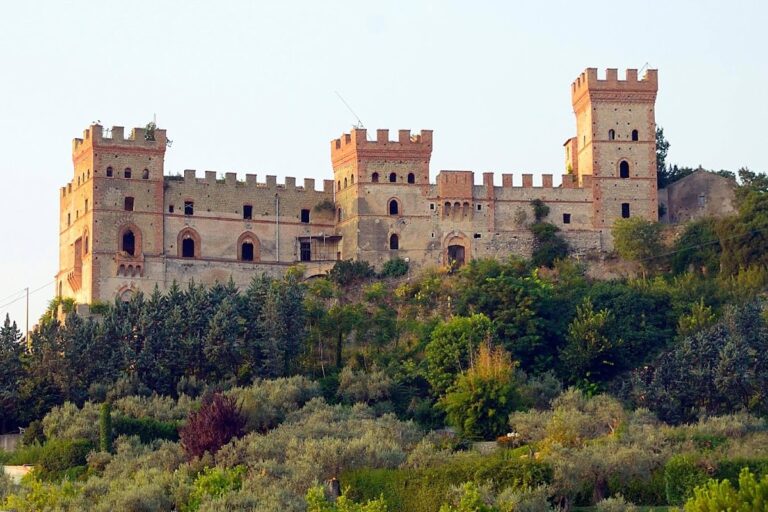
A medieval fortress was later built over the ancient city. The settlement appeared under names including Castellammare della Bruca. In 1420 it became a fief of the Sanseverino family, a prominent Neapolitan noble house, and was subsequently given to the Royal House of the Annunciation of Naples. By 1669, the settlement had ceased to have recorded inhabitants, and the ancient remains had disappeared beneath marshes.
In the nineteenth century, François Lenormant recognized the historical and cultural importance of the site. Excavations and research continued thereafter, revealing the ancient city while also almost completely destroying the surviving medieval settlement that had developed from the medieval period through the seventeenth century. In 2022, excavation on the Acropolis brought an archaic temple dedicated to Athena to light. Velia forms part of the UNESCO World Heritage property that also encompasses the Cilento and Vallo di Diano National Park, the archaeological sites of Paestum and Velia, and the Certosa di Padula. The property was inscribed in 1998 under criteria iii and iv.
Remains
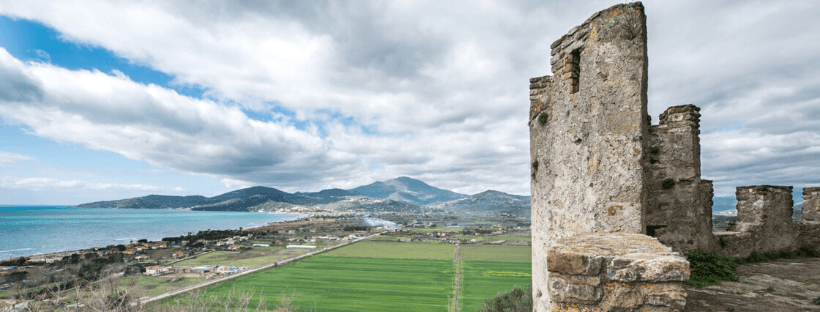
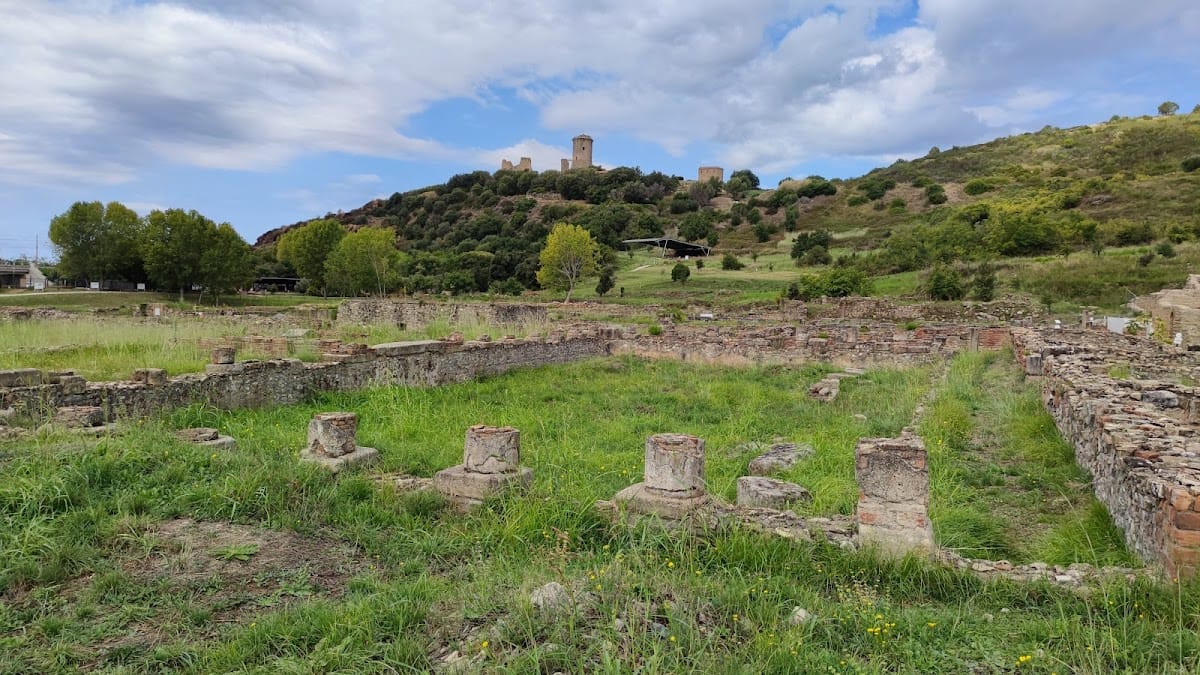
The archaeological area covers about 6,000,000 square meters across the summit and slopes of a promontory that once projected toward the sea. The urban center stood less than a kilometer inland, while the lower city extended toward the harbor and coastal plain. River sediment from the Alento and Palistro to the north and the Fiumarella di Santa Barbara south of the Acropolis gradually filled the waters in front of the city. The former promontory is now an inland hill, and the Acropolis is separated from the sea by the advancing coastline.
Defences and the Acropolis
City walls
A complex defensive system enclosed approximately 64 hectares, including an Acropolis of about 9 hectares. Built soon after the city’s foundation, around 520 BC, the walls used local crystalline limestone and can be traced for approximately four kilometers. Three circuits enclosed the southern and eastern city, the northern sector, and the Acropolis with the southeastern city. This arrangement allowed one sector to be abandoned while the others remained defensible. The best-preserved stretch runs northeast from the Acropolis along the ridge, where one gate and several towers survive.
Acropolis sanctuaries
The Acropolis contained a large sanctuary area whose earliest structures date from the sixth century BC, along with the oldest known settlement remains of the city. A temple in Ionic style, probably dedicated to Athena Polias, Athena as the city’s protecting deity, had foundations measuring approximately 32.5 by 18.4 meters and belongs to the Classical period. A separate archaic temple of Athena, dated to approximately 540–530 BC, was identified during excavations in 2022. The temple visible today on the Acropolis belongs to the Hellenistic period.
The archaic Athena sanctuary yielded two well-preserved bronze Greek helmets with Etruscan design and fragments of metal weapons. They are thought to have been offerings to Athena after the Battle of Alalia. Possible inscriptions inside the helmets remained under examination and could help establish their history and identify their wearers.
Later structures on the hill
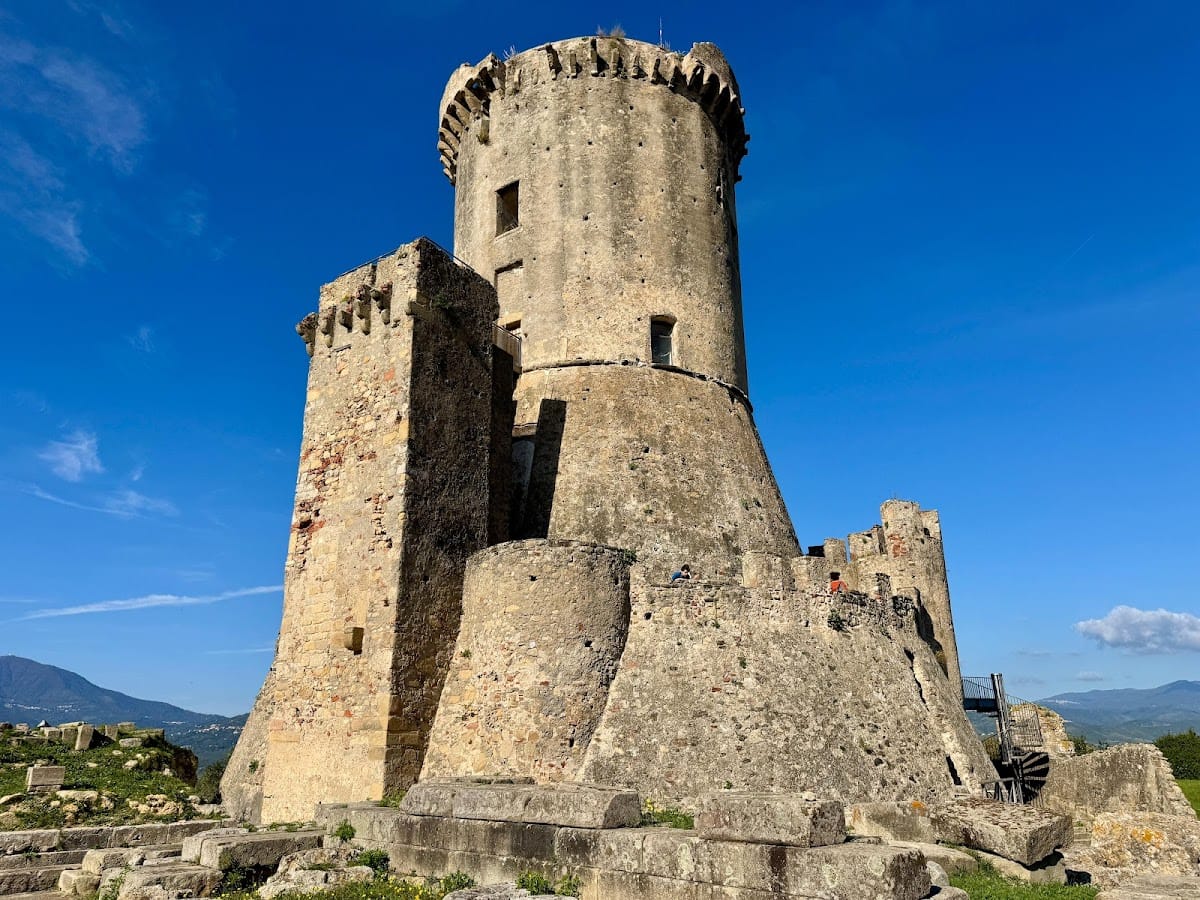
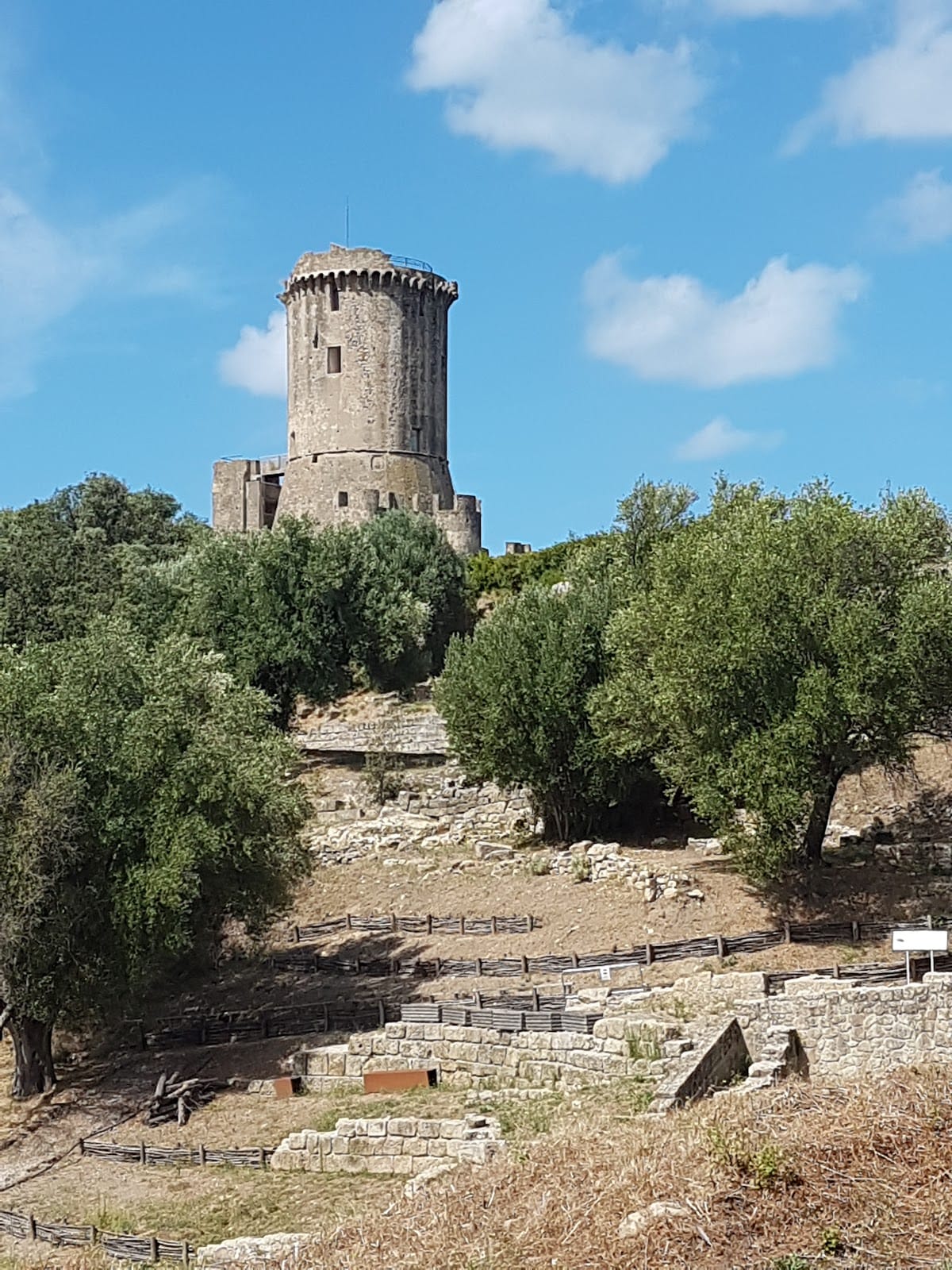
The Acropolis also held a sanctuary of Poseidon Asphaleios, a protective aspect of Poseidon, and the city theater. A medieval tower partly overlies the ancient temple and was constructed with stones taken from ancient structures. The Capella Palatina and Santa Maria, two medieval churches on the hill, likewise incorporate ancient building material.
Lower city and civic areas
Agora and main street
The lower city spread broadly toward the harbor, with its central zone southeast of the Acropolis. The agora, the principal civic and public gathering place, was surrounded by colonnades. The Porta Rosa road, the city’s main street, dates approximately to the fourth or third century BC. The archaeological areas associated with the lower city include the Port Area, Porta Marina, Porta Rosa, the Southern Quarter, and the Archaic Quarter.
Cryptoporticus and public buildings
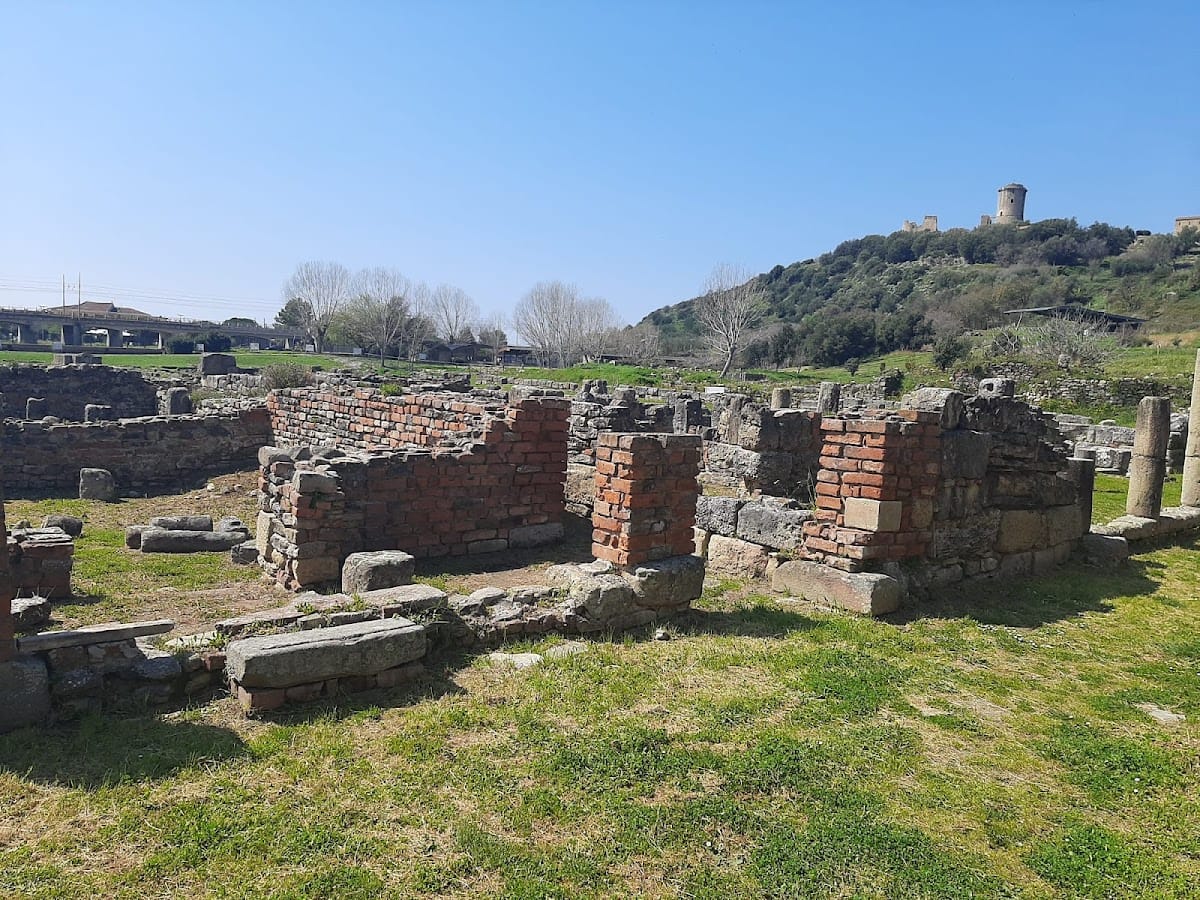
A cryptoporticus, a partly underground or enclosed covered passage, was built around the beginning of the Common Era and rebuilt in the second century AD. Its function remains interpreted as a meeting place for a medical association, a palaestra for athletic training, or a small sanctuary. Other lower-city remains include a second sanctuary of Poseidon Asphaleios, sanctuaries of Zeus and Asklepios, and the public building known as Masseria Cobellis, which included a nymphaeum, a monumental fountain or shrine associated with nymphs.
Baths, houses, and water installations
A Roman bath complex and numerous private houses survive in the lower city. The wider ancient settlement also contained villas and smaller settlements, especially during the Roman period. Cisterns remain within the archaeological area, while later construction used bricks bearing Greek stamps of an unusual form, with two rectangular channels on one side.
Harbor and archaeological finds
Harbor landscape
The earliest harbor occupied the mouth of a river. A later harbor was an artificial basin built near the river mouth. Offshore, the Enotrian islands of Isacia and Pontia provided landing places before sedimentation from the rivers filled the waters in front of the city. Their disappearance formed part of the wider environmental change that transformed the ancient coastal setting.
Offerings and coinage
A bothros, a pit used for depositing votive offerings, contained a large quantity of objects dedicated in ritual contexts. Velia’s coinage illustrates the city’s long monetary history. Examples include a drachma dated approximately 535–510 BC, a stater from approximately 334–300 BC, and a silver coin from about 280 BC bearing Athena on the front and a lion devouring a stag on the reverse.