Portland Castle: A Tudor Coastal Defense Fortification in the United Kingdom


Visitor Information
Google Rating: 4.4
Popularity: Medium
Google Maps: View on Google Maps
Official Website: www.english-heritage.org.uk
Country: United Kingdom
Civilization: Unclassified
Remains: Military

History
Portland Castle is located in Castletown, Portland, in the United Kingdom. It was constructed by the English during the reign of King Henry VIII as part of a national effort to strengthen coastal defenses.
The castle was built between 1539 and 1541 under Henry VIII’s directive, forming part of the King’s Device programme aimed at protecting England from possible invasions by France and the Holy Roman Empire. Its primary purpose was to defend the Portland Roads anchorage, a key naval harbor, alongside the nearby Sandsfoot Castle. Initially, the fort was equipped with eleven artillery pieces and staffed by a small garrison that grew from six men to thirteen by 1545. Despite its military readiness, Portland Castle did not engage in combat during the reigns of Henry VIII or Elizabeth I.
During the English Civil War in the mid-17th century, the castle’s control shifted. It was first held by Parliamentary forces but was taken by Royalists in 1643 through a ruse. The castle endured two sieges by Parliamentarian troops before surrendering in 1646. Following this, it served as a prison and remained garrisoned during the Interregnum period. The castle also saw military activity during the First Anglo-Dutch War, reflecting its continued strategic importance.
Throughout the 18th century, Portland Castle remained in military use, although it suffered from neglect and damage caused by sea erosion. Its armament and garrison size varied over time. During the Napoleonic Wars, the castle was rearmed but was noted to be in poor condition. After the defeat of Napoleon in 1815, the castle was disarmed and passed into private hands, becoming a residence for the Manning family.
In 1869, amid renewed concerns about invasion threats, the War Office reclaimed the castle. However, rather than rearming it, the site was used primarily for accommodation connected to newer fortifications nearby. In the 20th century, Portland Castle served as a storage site for weapons and as living quarters during both World Wars, housing British and American forces. A concrete pillbox was constructed nearby during the Second World War but has since been demolished.
The War Office ended its control of the castle in 1949. Restoration efforts began to return the structure to its 16th-century appearance, and it was opened to the public in 1955. Later, the Captain’s House and surrounding gardens were made accessible after military use ceased in 1999. Today, Portland Castle is recognized as a well-preserved example of Henry VIII’s coastal defenses.
Remains
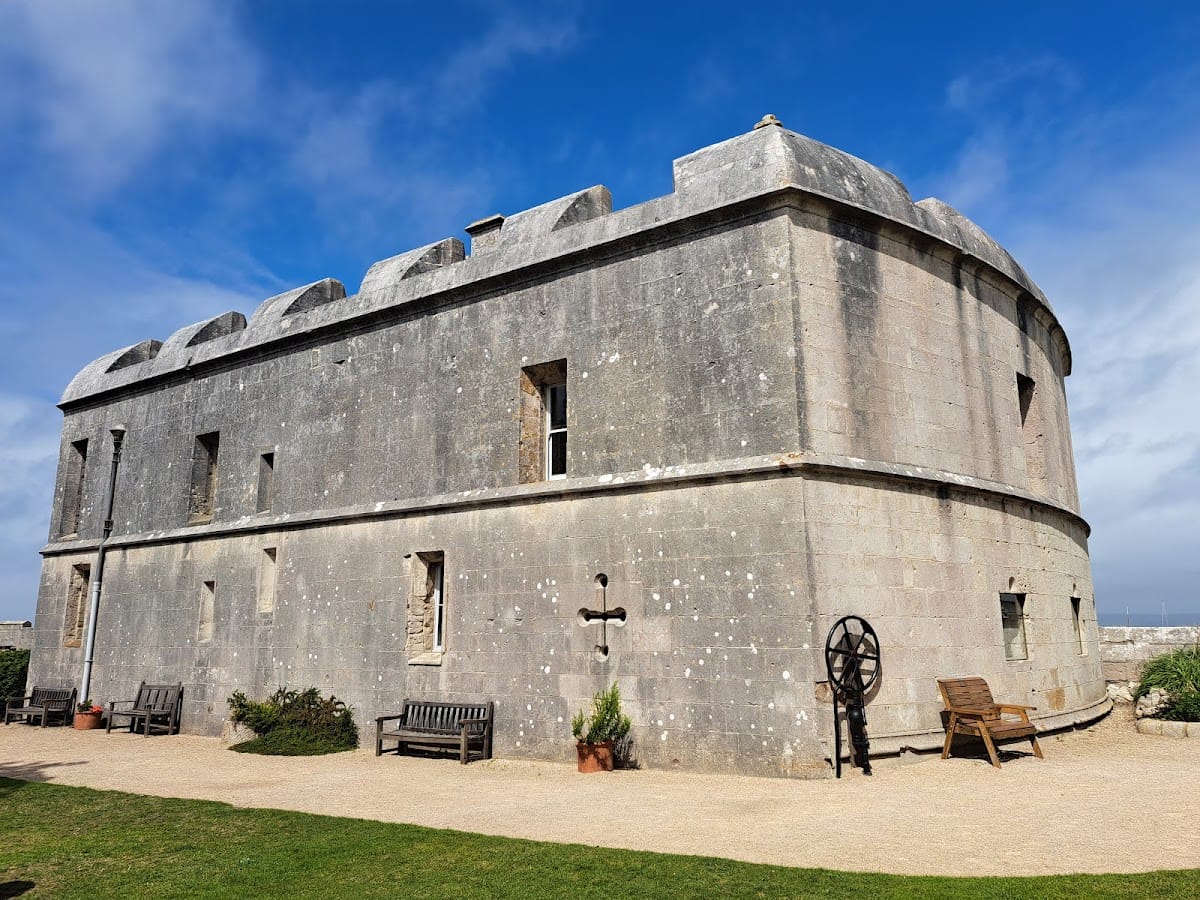
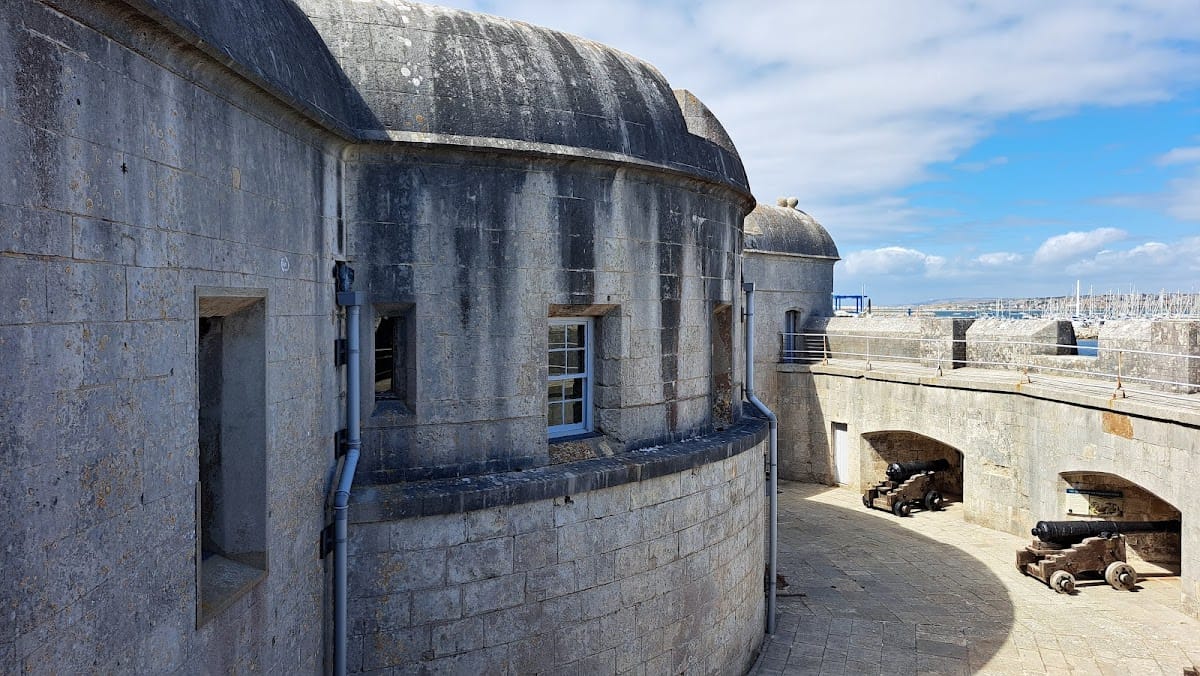
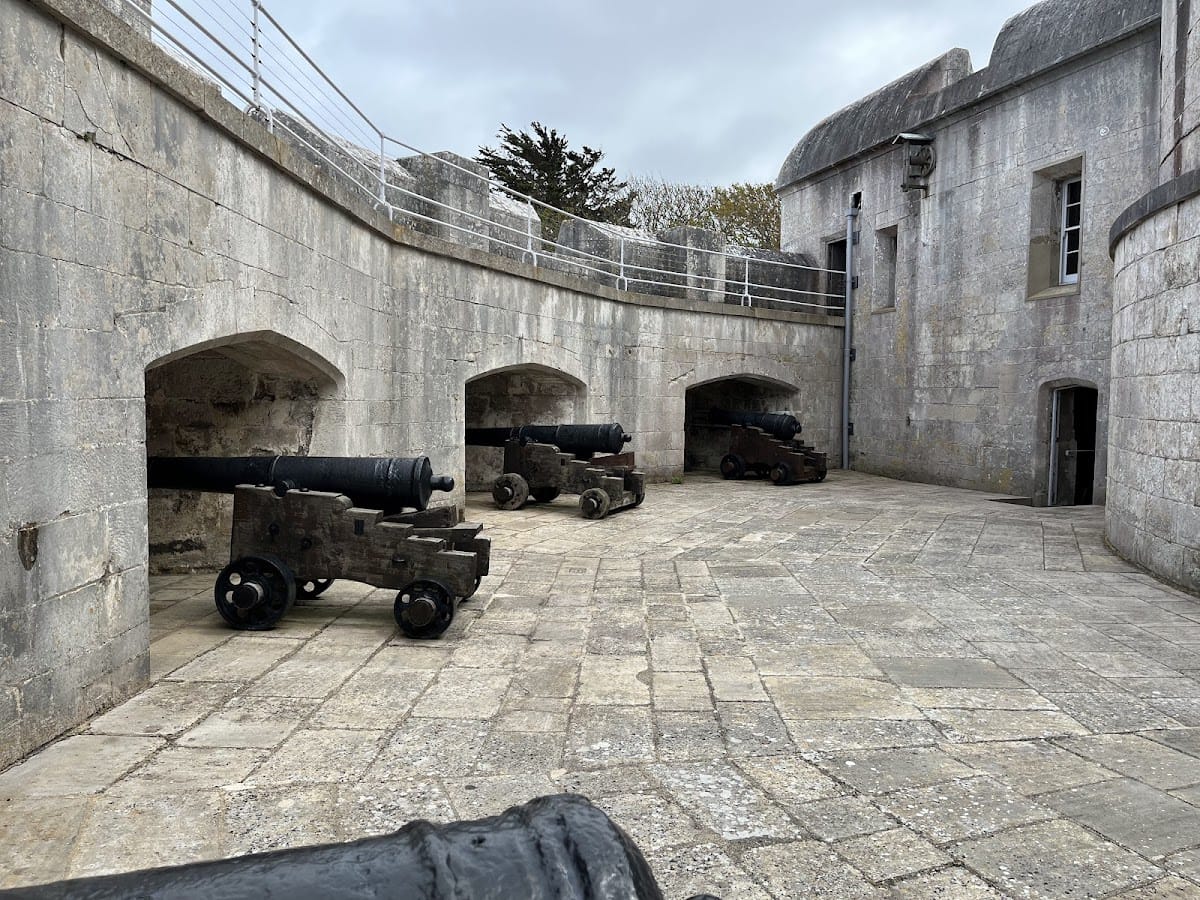
Portland Castle is built in a fan-shaped design, measuring about 120 feet (37 meters) across. Its core consists of a curved central tower flanked by two angular wings, with a gun battery facing the sea. This main structure is enclosed within a walled courtyard approximately 170 by 90 feet (52 by 27 meters) in size. The courtyard includes two gun platforms positioned on either side, enhancing the castle’s defensive capabilities.
The western side of the courtyard houses the Captain’s House, while beyond the eastern wall lies the Governor’s Garden, a modern addition created in 2002. This garden features circular patterns inspired by maritime themes and uses local Portland stone, reflecting the castle’s architectural style. The main entrance to the castle is located on the southern side and is marked by an outer gateway topped with the coat of arms of King Charles II.
Constructed from finely cut ashlar Portland stone, the castle’s two-storey keep contains an octagonal great hall on the ground floor. This hall originally served as living quarters for the garrison and now features large Victorian-era windows. Adjacent wings provided accommodation for the gunners and included a kitchen with a large fireplace dating back to the 16th century.
The front of the keep contains the gun room, which was originally a two-storey battery. It had embrasures—openings in the walls—for five guns on the ground floor and four on the upper floor. The ground-floor embrasures were equipped with vents to allow smoke from the cannons to escape. Over time, the wooden roof and internal partitions of the gun room were removed, leaving the space open to the air. Today, this area displays cannons from the 18th and 19th centuries.
The first floor of the keep includes an upper hall and the captain’s chamber, which served as living and working space in the 16th century. In the 19th century, this chamber was adapted into dining and bedroom areas. On the opposite side of the floor, two additional bedrooms likely housed the lieutenant.
Originally, the castle was protected by a moat with a drawbridge, though the moat has since been filled in, leaving only the slots where the drawbridge once operated. For added defense, a moated earthwork measuring 89 by 47 feet (27 by 14.4 meters) was constructed at the rear of the castle at a later date.
Situated on the Isle of Portland, the castle overlooks the harbors of Portland and Weymouth. It stands about four meters above sea level on flat terrain, with the sea lying to the southeast, providing a strategic vantage point for monitoring naval activity.
Nearby sites