Pontivy Castle: A Historic Fortress in Brittany, France

Visitor Information
Google Rating: 4.1
Popularity: Low
Google Maps: View on Google Maps
Official Website: www.tourisme-pontivycommunaute.com
Country: France
Civilization: Medieval European
Remains: Military

History
Pontivy Castle, located in the town of Pontivy in modern-day France, was constructed by the noble Rohan family during the 15th and 16th centuries. Its origins lie on a site with a history stretching back to the medieval period in Brittany.
Originally, the area was home to a 12th-century feudal stronghold known as Château des Salles, owned by the Porhoët family. This early castle endured a significant siege in 1342 amid the Breton War of Succession when English troops under William de Bohun attacked and likely destroyed it. Following this event, the old castle was abandoned, and in 1456, the site was granted to the Franciscan Cordeliers friars.
By the late 14th century, the Rohan family shifted their principal seat from the town of Rohan to Pontivy, recognizing its more central location within their fiefdom. Around that time, Jean II de Rohan, who held titles including viscount of Rohan and count of Porhoët and served as governor of Brittany under King Charles VIII, initiated the construction of a new castle. Instead of rebuilding on the old site, he selected a hillside overlooking the town to the east, above the Blavet River, where extensive earthworks created a hollow to control the main access to Pontivy.
Construction progressed throughout the late 15th century, with the castle likely habitable by 1485. However, during the conflicts surrounding the autonomy of Brittany, troops loyal to Duke François II captured the castle in 1488. After political shifts, it was restored to the Rohan family in 1490.
In the 16th century, the castle took on a unique religious role. In 1572, it hosted a provincial synod for Protestant leaders, making its chapel one of the earliest Protestant places of worship in France. This phase was brief, as in 1589 Catholic League forces laid siege to the castle, which surrendered and returned the chapel to Catholic hands.
The 17th century brought further changes. Beginning in 1621, modifications were made, including the addition of a terrace at the southern corner, which foreshadowed later structural alterations. Over time, the castle adapted to new functions as political and social conditions evolved.
Following the French Revolution, Pontivy Castle ceased to be a noble residence and served various civic and military purposes. It became the seat of the sub-prefecture and hosted a civil tribunal. In 1801, it was notably used as a military headquarters by General Bernadotte. The 19th century saw the castle repurposed as a girls’ school and boarding house from 1841 to 1884. Later in the century, it housed a Breton museum, reflecting regional cultural interests. Into the early 20th century, parts of the castle accommodated sports clubs and private families.
During World War II, the castle was occupied by Polish troops as well as Breton nationalist groups. In July 1940, it became the birthplace of the Breton National Committee and the site where Breton independence was declared. This political movement ultimately failed, though the castle briefly served as barracks for an emerging Breton national army.
Recognizing its cultural importance, Pontivy Castle was designated a historic monument in 1925. Protections expanded in 1953 to include its facades, roofs, courtyards, and moats. A comprehensive restoration was undertaken between 1955 and 1972 under architect René Lisch, preparing the site for limited public exhibitions. Later volunteer efforts helped maintain the castle from 1985 to 1998.
In 2014, storm damage caused part of the southern curtain wall to collapse, prompting a major restoration beginning in 2016. Archaeological work during this period uncovered ovens in the courtyard, shedding light on the castle’s daily functions. The restoration, costing around 3 million euros, was completed to allow renewed public access by 2019. Ownership changed hands in 2015 when Josselin de Rohan carried out a symbolic sale transferring the castle to the city of Pontivy.
Remains
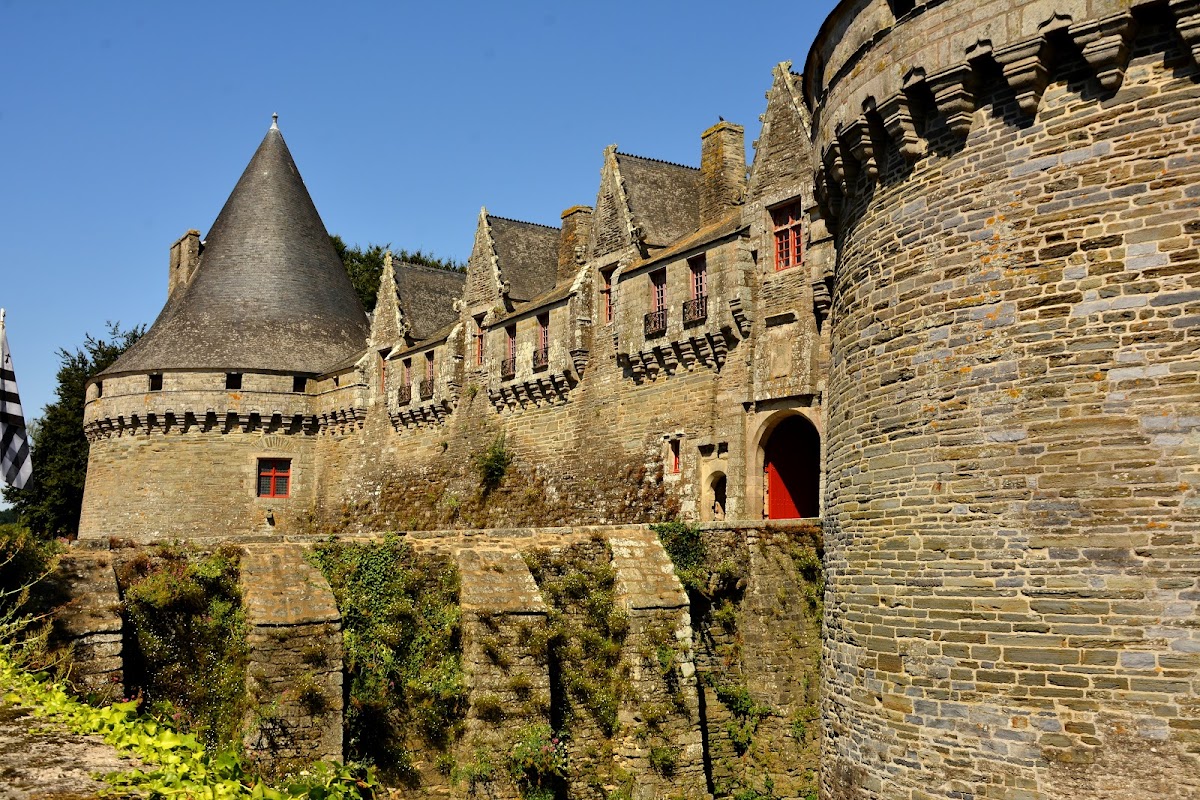
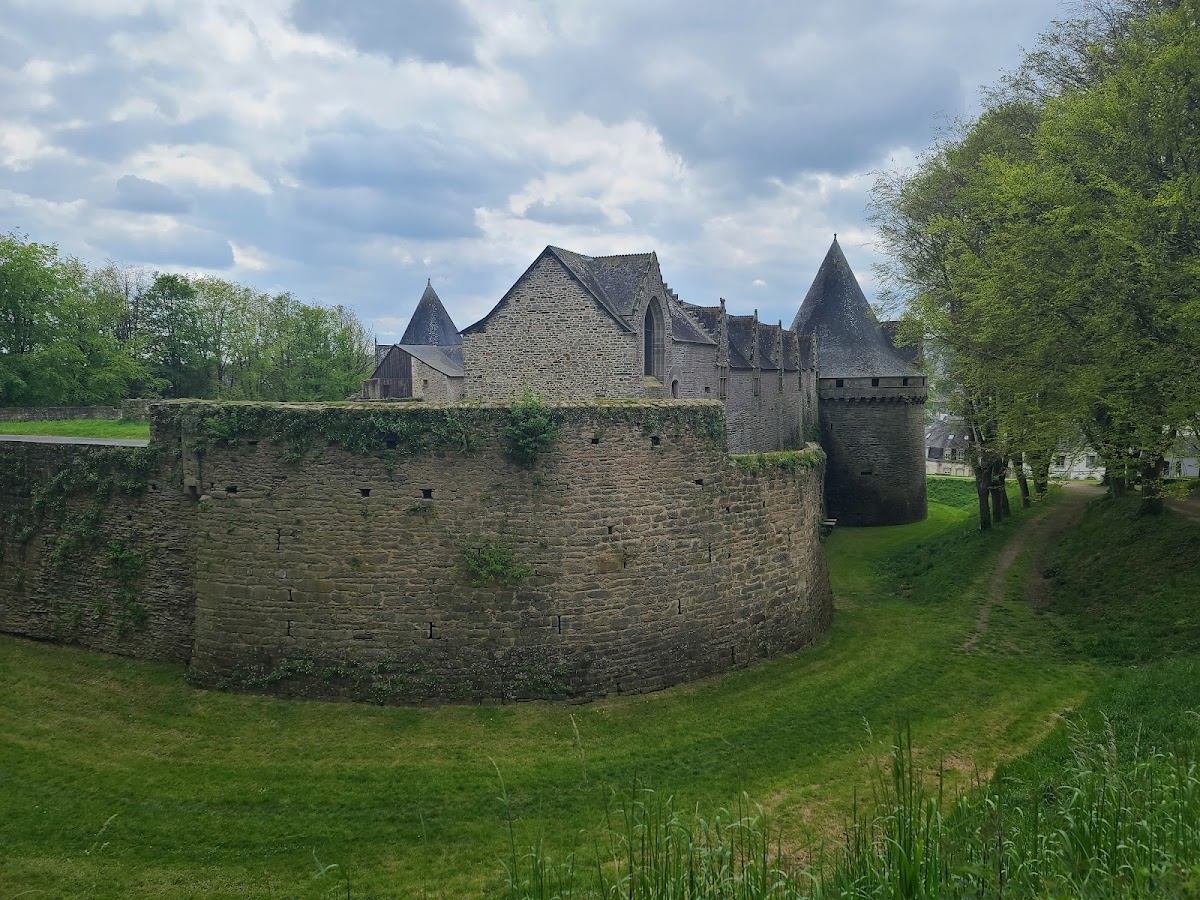
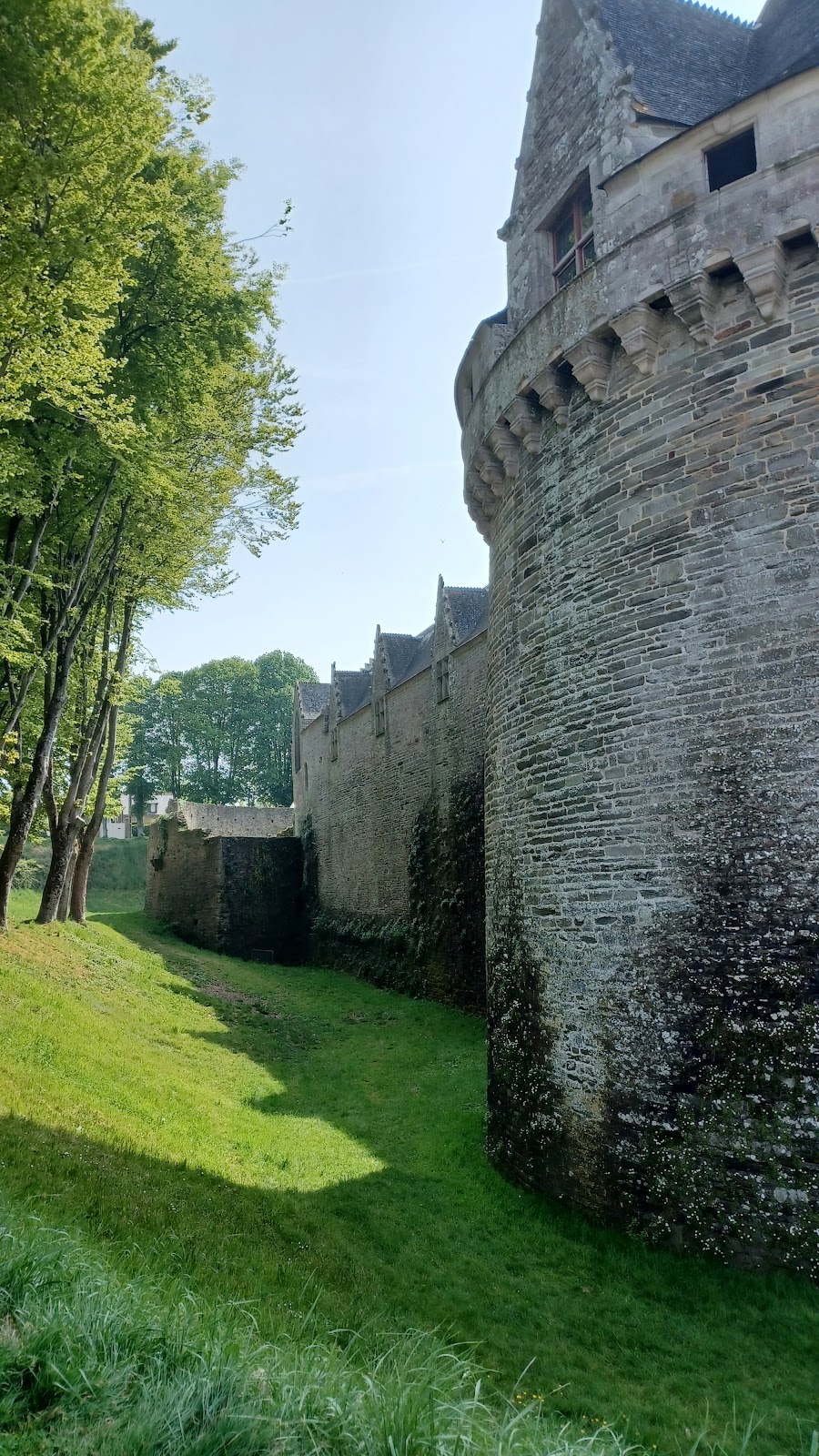
Pontivy Castle occupies a roughly rectangular area measuring about 90 meters by 75 meters, enclosed by thick walls and four circular towers at its corners. The defensive walls rise approximately 20 meters high and were built to withstand artillery, with some sections over five meters thick. The construction utilized local Briovérien schist stone rubble up to the level of the machicolations—projecting parapets with openings through which defenders could drop objects on attackers—which were carved from durable granite quarried nearby in Pontivy.
The upper walkway along the wall, known as the chemin de ronde, is crenellated (featuring battlements) and covered. Early in the 16th century, this walkway was enhanced by the addition of dormer windows with pointed pediments, providing light and shelter. Access into the castle’s inner courtyard is gained by crossing a fixed stone bridge called a pont dormant. This bridge replaced two former drawbridges that spanned dry moats, which were never filled with water. The counterscarp, or outer slope of the ditch, was leveled during the early 20th century, with the earth used to partially fill the moat.
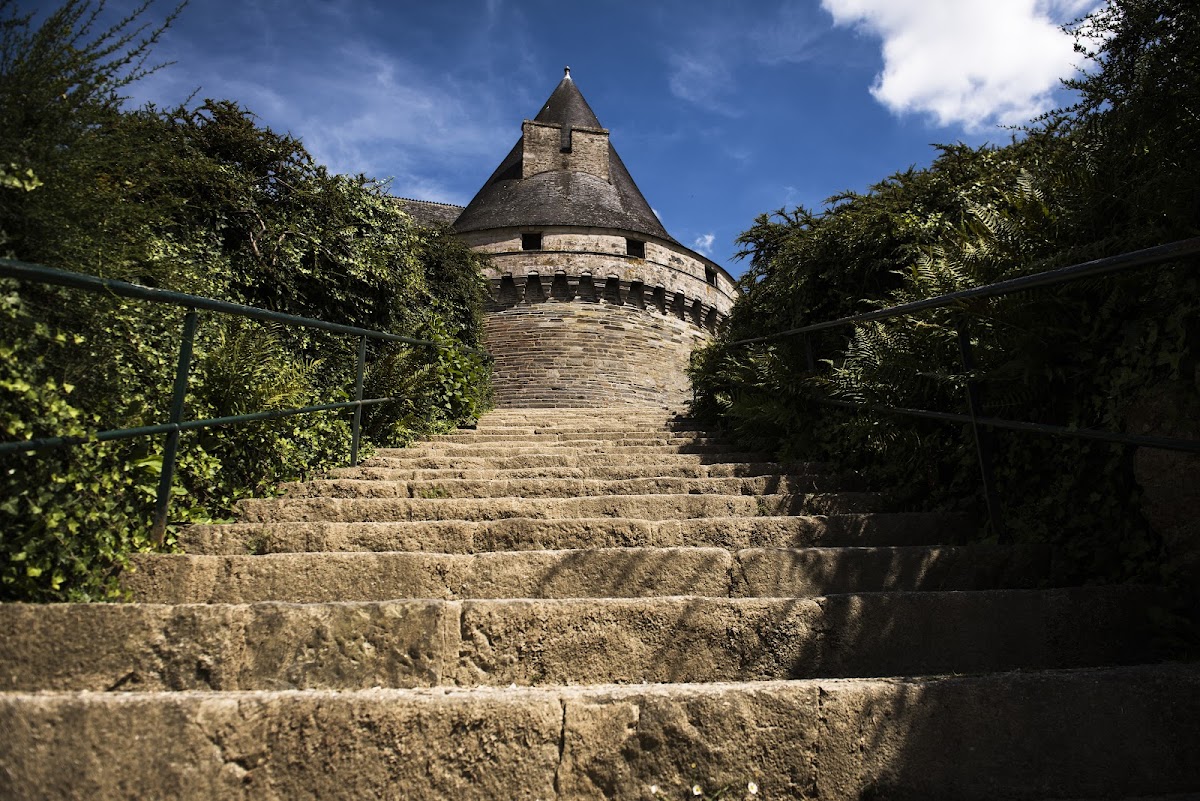
Two main residential wings remain intact today, located on the west and north sides of the courtyard. The western wing is flanked by two large circular towers featuring machicolations and distinctive pepperpot-style roofs. These towers are unusually broad rather than tall, with the northern tower measuring nearly 60 meters in circumference and the western one around 48 meters. The rear pair of towers collapsed in the 18th century but have since been stabilized using buttresses to prevent further deterioration. The existence of a fourth tower on the southeast side of the castle remains uncertain.
On the west side gallery, a collection of stone statues depicts various saints originally from the Saint-Laurent chapel in the nearby village of Moustoir-Remungol. Among these figures are the Virgin Mary standing on a crescent moon, Saint Maurice on horseback, Saint Catherine, Saint Germain, Saint Margaret, Saint Isidore, Saint Louis, and Saint John the Baptist.
The northern residential wing underwent remodeling in the 18th century, gaining stepped gables characteristic of the period and a double staircase with wrought iron railings in the Louis XV style. Below the main staircase, a niche houses a 20th-century statue of Saint Mériadec, a saint particularly venerated by the Rohan ducal family, sculpted by Daniel Le Vaillant.
Originally, the eastern wing contained residential or defensive structures, but during the 18th century it was transformed into an artillery terrace. Later, this area was converted into a decorative garden space, reflecting changing functions and tastes.
Inside the castle, notable spaces include the guardroom used for security, various first-floor chambers opening onto the wall walk, the ducal chamber featuring an ornate ceiling, and the chapel. Two colorful stone fireplaces from the 16th century, bearing Latin inscriptions and heraldic coats of arms, were installed here in 1961 after being relocated from the Château de Coët-Candec.
Throughout the castle, decorative motifs reference the Rohan family heritage. One prominent symbol is the macles, or lozenge-shaped heraldic charge, carved in granite on water spouts and walls. These often appear with the collar of Saint Michael and a crowned letter “A,” representing the family motto “A plus,” meaning “without superior.”
During the recent restorative excavations, two ovens were discovered within the courtyard. One was a large oven likely used for baking bread, while a smaller oven nearby may have been intended for pastries. These finds add to the understanding of the castle’s domestic and daily activities.
Situated on a hillside approximately 65 meters above sea level on the left bank of the Blavet River, the castle is founded on permeable yellow soils of greenish-gray Briovérien schist. Nearby veins of dolerite rock were historically mined for iron, indicating the close relationship between the castle, its natural environment, and local resource use.
Nearby sites