Paphos Sanctuary: The Roman Sanctuary of the Paphian Aphrodite in Cyprus


Visitor Information
Google Rating: 4.6
Popularity: Very Low
Google Maps: View on Google Maps
Country: Cyprus
Civilization: Roman
Remains: Religious

History
The Roman Sanctuary of the Paphian Aphrodite, located in ancient Paphos on the island of Cyprus, was constructed by the Romans on a site long revered for its association with the goddess Aphrodite. This sanctuary occupied a legendary location believed to be the birthplace of Aphrodite, emerging from the sea, a myth deeply embedded in local and wider Mediterranean religious traditions. The cult at Paphos combined elements from both Aegean and Eastern religious practices, reflecting the island’s position as a cultural crossroads.
The origins of the sanctuary trace back to the Late Bronze Age, with its religious significance established before the Homeric era. Ancient texts such as the Odyssey and the Homeric Hymns reference the cult, indicating its longstanding prominence. The sanctuary’s religious leadership was held by the Cinyradae, descendants of the Phoenician figure Cinyras, who exercised priestly authority under the supervision of a senate and popular assembly. The site also functioned as an oracle, further emphasizing its spiritual importance.
During the Roman period, the sanctuary underwent significant reconstruction following destruction caused by an earthquake. Emperor Vespasian ordered its rebuilding, resulting in the phase known as Sanctuary II. This Roman iteration preserved the traditional open court layout characteristic of the Paphian cult. The sanctuary remained active until the 4th century AD, when it was closed amid the late Roman Empire’s suppression of pagan religions. Over time, the sanctuary’s ruins gained recognition for their historical and cultural value, culminating in their designation as a UNESCO World Heritage site in 1980.
Ancient authors including Pausanias, Strabo, Tacitus, and Apuleius documented the sanctuary, highlighting its religious significance and the presence of a distinctive aniconic black stone cult object. This object, central to worship, symbolized fertility and was unique in its non-anthropomorphic form, distinguishing the sanctuary from typical Greco-Roman temples.
Remains
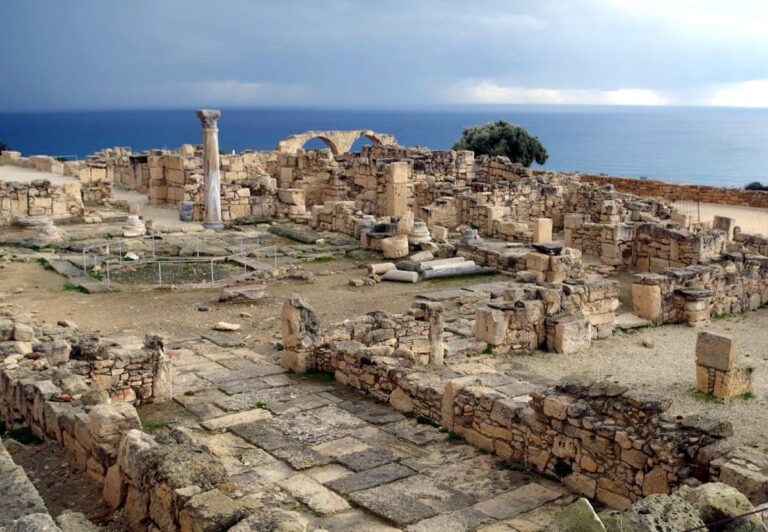
The sanctuary’s Roman phase, known as Sanctuary II, covered an area approximately 79 by 67 meters and retained the traditional open court sanctuary design. The complex consisted of a large open enclosure surrounded by various halls and auxiliary buildings. These structures housed numerous altars, statues, votive offerings, and religious monuments, reflecting a synthesis of Eastern and Western architectural influences.
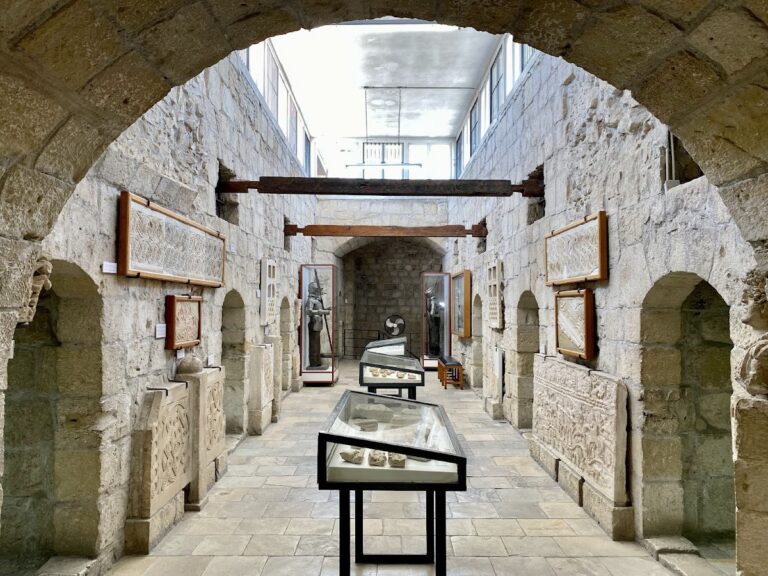
Architectural fragments recovered from the site include Roman and Doric capitals, which are displayed near the entrance on a pediment. These elements illustrate the blending of cultural styles present in the sanctuary’s construction. The buildings were arranged on a gently rising terrain, progressing from the Late Bronze Age temenos floor to the North Hall floor, creating a striking visual effect for visitors approaching by sea or land.
No substantial remains of the innermost shrine or holy-of-holies have been found, supporting the interpretation that this sacred space was likely a lightweight structure composed of pillars and awnings rather than a conventional enclosed temple. The sanctuary notably lacked a classical Greco-Roman temple or anthropomorphic cult statue. Instead, worship centered on a conical fertility symbol, which appears on Hellenistic seals and Roman coins, and was probably housed within the open court or temenos area.
Today, the sanctuary’s remains are fragmentary but provide valuable insight into the religious practices and architectural styles of the period. The site’s layout and surviving elements confirm its role as a major cult center dedicated to Aphrodite Paphia, preserving a unique blend of cultural and religious traditions.
Nearby sites