Põltsamaa Castle: A Historic Fortress and Noble Residence in Estonia



Visitor Information
Google Rating: 4.6
Popularity: Medium
Google Maps: View on Google Maps
Official Website: poltsamaaloss.ee
Country: Estonia
Civilization: Medieval European
Remains: Military

History
Põltsamaa Castle stands in the town of Põltsamaa in modern-day Estonia and was originally built by the Livonian Order, a military religious order active in the Baltic region during the Middle Ages. Established in 1272, the castle was intended as a crusader fortress guarding strategic crossing points along the Põltsamaa River and serving as the administrative center of the surrounding region.
In its early centuries, the castle was repeatedly damaged and rebuilt due to ongoing conflicts in the area. During the Livonian War in the late 16th century, from 1570 to 1578, it gained prominence as the residence of Duke Magnus of Holstein, who was declared King of Livonia by Russia’s Ivan the Terrible. This period underlined the castle’s military and political importance as it became connected to several regional power struggles.
In the early 17th century, under Swedish rule, King Gustavus Adolphus transferred the estate to Field Marshal Herman Wrangel. Wrangel initiated significant changes, shifting the castle’s role from a purely defensive stronghold toward a more comfortable Renaissance-style residence. He enhanced living spaces and added household buildings, adapting the fortress for peacetime habitation while retaining some defensive features.
The castle endured substantial destruction during the Great Northern War in the early 18th century, with Russian troops setting fire to it in 1703. Afterwards, Tsar Peter the Great granted the estate to reformer Heinrich von Fick, who sought to develop the grounds into an exemplary settlement. Mid-century, ownership moved to Woldemar Johann von Lauw, who transformed the ruins into a majestic rococo palace, blending the medieval remains with new construction and lavish interior decoration. Von Lauw also founded a porcelain manufactory in 1782, although financial troubles caused its closure during his lifetime.
Throughout the 19th and early 20th centuries, noble families, including the Russian princely Gagarins, held the castle. By World War I, the building served military purposes but suffered heavy damage and looting. Following Estonia’s 1919 land reforms, the noble ownership of the estate ended.
In 1940, the Soviet Red Army occupied the site, and just a year later most of the castle was destroyed by bombing during World War II. Only stone ruins and the church survived this devastation. After the war, the grounds remained under Soviet military control for some years before archaeological excavations and restoration efforts began in the 1970s and 1980s. More recently, a significant restoration project completed in 2023 has revived much of the historic complex, preserving its layered heritage for the future.
Remains
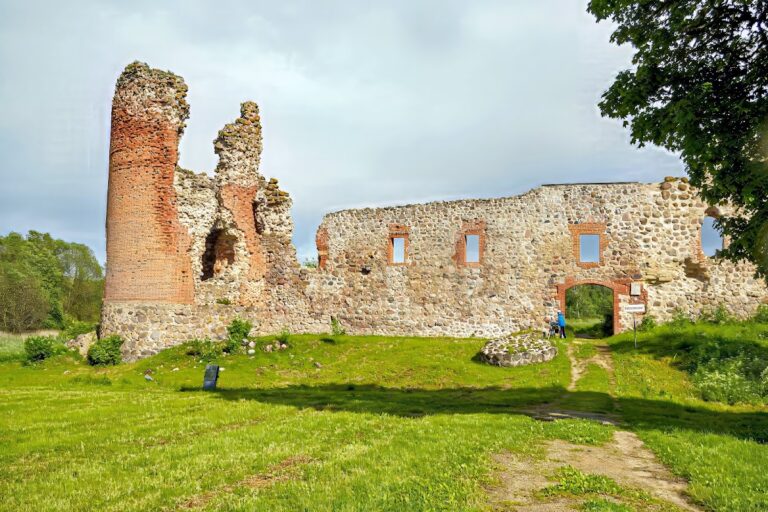
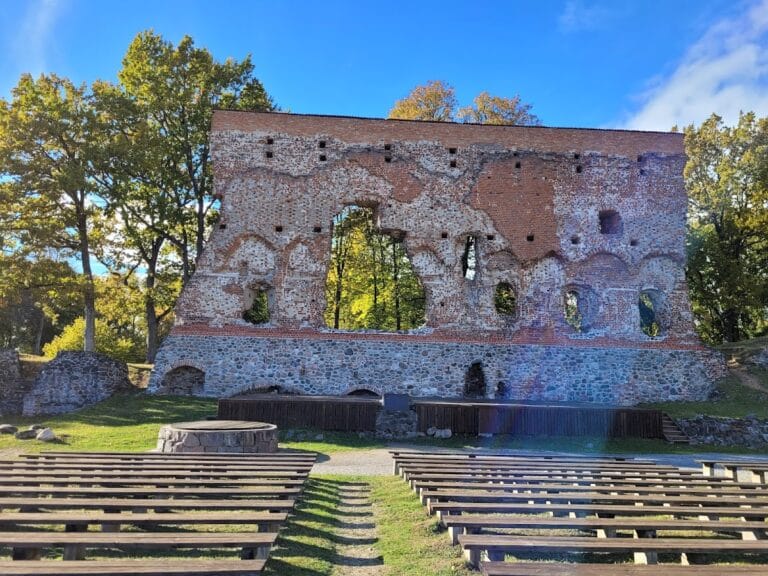
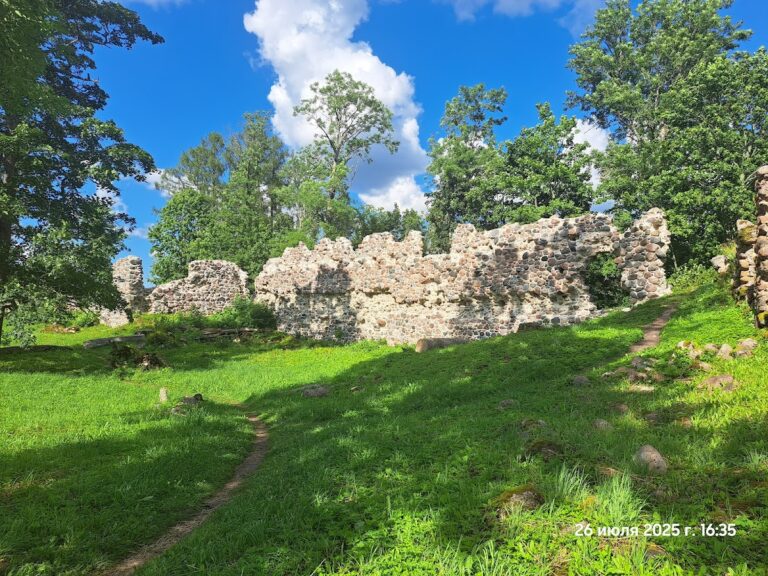
Põltsamaa Castle’s remains reveal a complex structure that evolved from a medieval fortress into a noble residence. The original castle occupied a roughly square area of just over one hectare, enclosed by thick walls built from local limestone and fieldstone. Initially about three meters high, these walls were gradually heightened, reaching up to eleven meters by the 15th century. A broad moat connected to the Põltsamaa River surrounded the site, reinforcing its defensive character.
The fortress was accessed through three main gates located on the northwest, northeast, and southeast sides. The southeast gate functioned as the principal entrance and was defended by a gatehouse resembling a dansker—a type of covered passage over a moat—along with a ravelin (a triangular fortification) equipped with a cannon tower added in the 16th century. A similar cannon tower guarded the northwest gate, reflecting the castle’s adaptation to artillery warfare during this time.
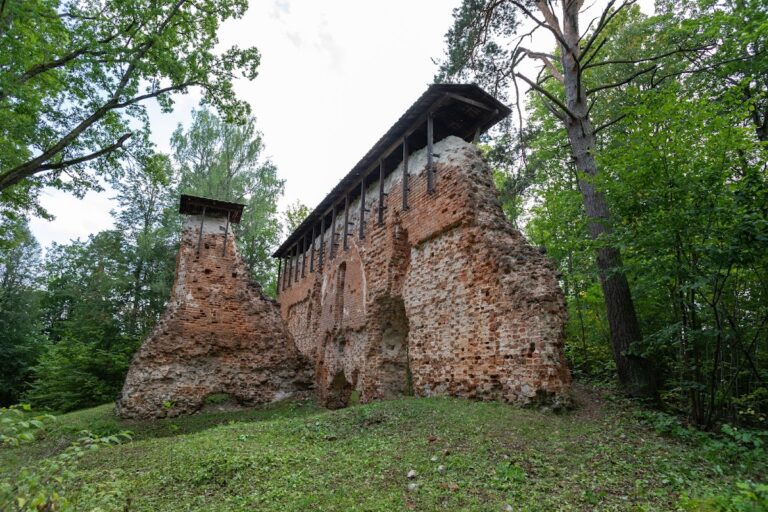
A protected walkway, or parapet, ran along the walls, supported by stone pillars dating back to the late 13th century. In the 14th century, battlements made of brick with large openings for guns were introduced, adapting the defenses for the increased use of firearms. At three corners, small rectangular towers provided additional lookout points and firing positions.
Within the curtain walls, the castle’s convent building extended over roughly one-third of the site. This multi-storied structure enclosed an inner courtyard and included a distinctive tower in its southwest corner used as a watchtower. The second floor housed essential facilities such as the chapter hall, refectory, dormitories, and the castle church located in the southeast wing. A narrow, steep brick staircase inside the convent tower led to the third floor, which served as a defensive platform.
In the 16th century, further military enhancements were made, including the addition of a bastion and artillery defenses such as a caponier—a covered passage for troops—positioned between the ravelin and cannon tower. These improvements reflected changing military technology and tactics of the period.
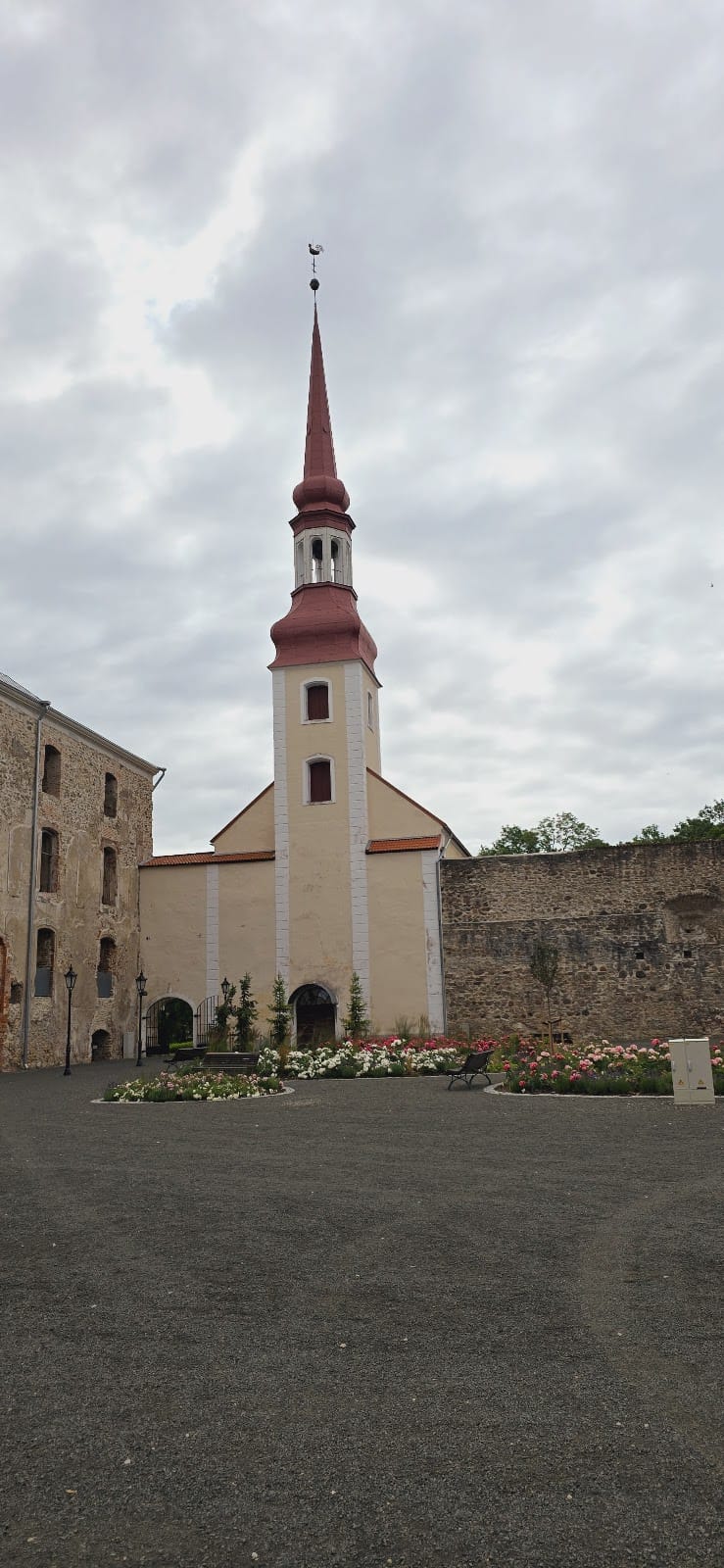
Under Field Marshal Herman Wrangel’s ownership in the 17th century, many parts of the fortress were converted to more domestic uses. Enlarged windows and doors, fireplaces, tiled stoves, and an extra floor improved comfort. Notably, the southern cannon tower was transformed into a church, which has survived as a historic building with ongoing restoration.
The 18th-century rococo palace constructed by Woldemar Johann von Lauw integrated the medieval convent and castle ruins into a cohesive architectural ensemble. Its interiors included elaborate stucco work attributed to Johann Michael Graff, representing some of Estonia’s finest examples of this decorative style. The site also housed a porcelain factory established in 1782, producing white and blue painted porcelain and possibly figurines, though the manufactory closed after financial difficulties.
By the 20th century, the castle’s condition had deteriorated significantly. During World War I, it served as barracks capable of accommodating thousands of soldiers, further altering its interiors. The bombing in 1941 destroyed most structures except for surviving stone walls and the church, which was later restored with furnishings salvaged from other churches.
Recent conservation and restoration efforts have stabilized and partially rebuilt key sections, including the gatehouse dedicated to exhibitions, the convent building with access to a seven-story tower offering views linked to the former Struve Geodetic Arc, and the central courtyard. Today, these restored spaces maintain the medieval defensive layout with the moat, walls, and courtyard arranged along the original footprint of the castle.