Helme Castle: A Medieval Livonian Order Fortress in Estonia


Site at a Glance
- Rating
- 4.6
- Popularity
- Very Low
- Country
- Estonia
- Primary era
- Medieval
- Eras represented
- Medieval
- Civilizations
- Crusader, Livonian Order
- Site type
- Military
- Remains
- Castle
On this page7 sections
History
Helme Castle is a medieval fortress in Helme, Estonia, built by the Livonian Order during the first half of the fourteenth century. The Livonian Order was a Catholic military order that controlled territory in medieval Livonia, including parts of present-day Estonia and Latvia. The castle occupied an important position in the historical region of Sakala and later formed part of the state ruled by the Order.
Earlier stronghold and Livonian foundation
The site may have been occupied before the stone castle by a Sakala hillfort, a fortified settlement or stronghold built on a naturally defensible elevation. Helme and Karksi have also been identified as possible Sakala strongholds burned by the Livonian leader Kaupo in 1211. The chronicler Henry of Latvia recorded the places under the names Ovele and Purke, although the identification with Helme and Karksi remains a historical suggestion rather than a certainty.
A Lithuanian attack on Helme in 1329 was followed by the construction of a stone Livonian Order castle protected by two moats. The masonry and ground plan indicate that the building work took place during the first half of the fourteenth century. The fortress subsequently served as a residence and base for masters of the Livonian Order. A charter signed by Master Konrad von Vietinghoff at Helme on 24 June 1412 confirms the presence of the Order’s leadership there. In 1471, Order brothers imprisoned Master Wolthuss von Herse at Helme before transferring him to Cēsis Castle, where he died.
War and political change
A major battle between Livonian Order and Muscovite forces took place near Helme in November 1501 during the Russian–Livonian War. The castle itself survived the Livonian War, a conflict fought from 1558 to 1583 among Livonia, Muscovy, Poland–Lithuania, Sweden, and Denmark. The decisive Battle of Härgmäe occurred nearby in 1560.
During the Muscovite campaign toward Pärnu in 1575, Muscovite forces offered Helme terms of surrender in February. After Pärnu fell, Helme surrendered in July to Magnus, the Danish prince proclaimed King of Livonia during the war. Under Polish rule, the castle became the administrative centre of the Helme starosty, an administrative district governed by a starost, within the Pärnu Voivodeship of the Duchy of Livonia. During the reign of Stefan Batory, the Polish king and Grand Duke of Lithuania from 1576 to 1586, the castle and Helme Manor belonged to the brothers Stanislaus and Peter Nonhard.
Destruction and later preservation
Helme escaped the destruction that affected several other parts of southern Estonia during the Swedish–Polish wars of the seventeenth century and early 1620s. In 1624, King Gustav II Adolf of Sweden granted the castle and surrounding manors to Count Jakob De la Gardie, who served as Governor-General of Livonia. During the Russo-Swedish War, however, Swedish forces lacked the strength to defend Helme. On 25 May 1658, acting on the orders of Colonel Glasenapp, they blew up the castle. It was never rebuilt.
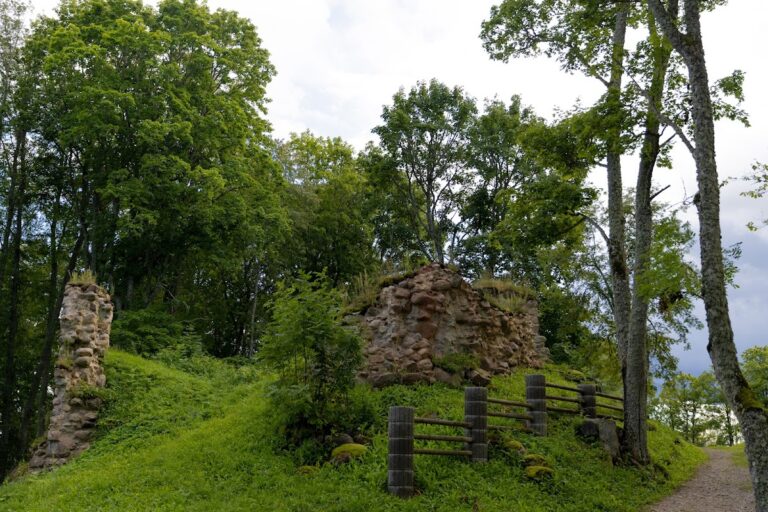
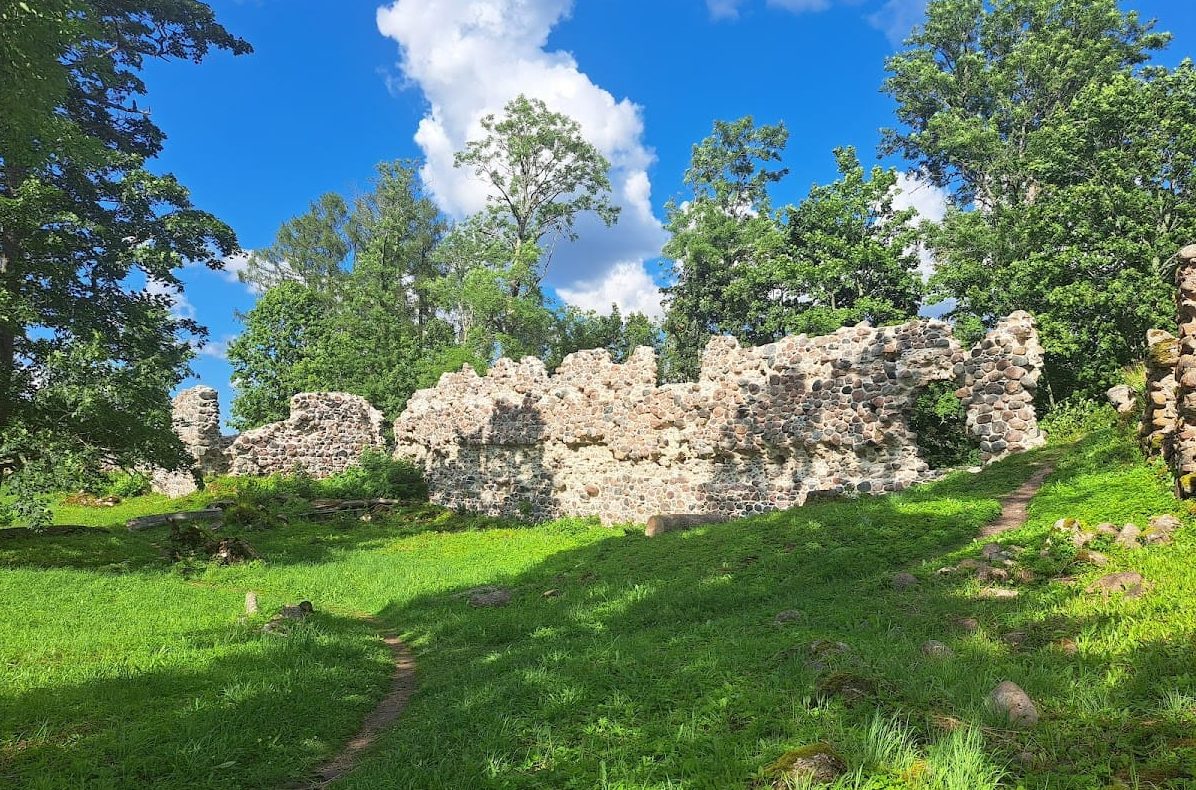
The ruins continued to deteriorate and gradually collapse. Drawings by Johann Christoph Brotze from 1798, 1799, and 1800 show the remains at a time when substantially more walling survived, including relatively intact window openings. The surviving masonry is now much more limited than it was in the late eighteenth and early nineteenth centuries and in early twentieth-century photographs. Conservation began in 2011 and has continued intermittently as state development-plan funding became available. The principal work has focused on the stone wall facing the highway, while brush has been cleared from the overgrown ruins. Helme Castle has been protected as an Estonian architectural monument since 1999 and is listed as cultural heritage monument number 23078.
A local legend tells of a girl named Anne who was walled into the castle after unknowingly answering a builders’ trick question about who would hold its keys. According to the story, enemies could not defeat the fortress while Anne’s name remained secret. When an old woman revealed the name under threat, the protective mist disappeared, and the castle was captured and destroyed. Lehte Hainsalu used this tradition in her ballad The Sacrifice.
Remains
Promontory and castle layout
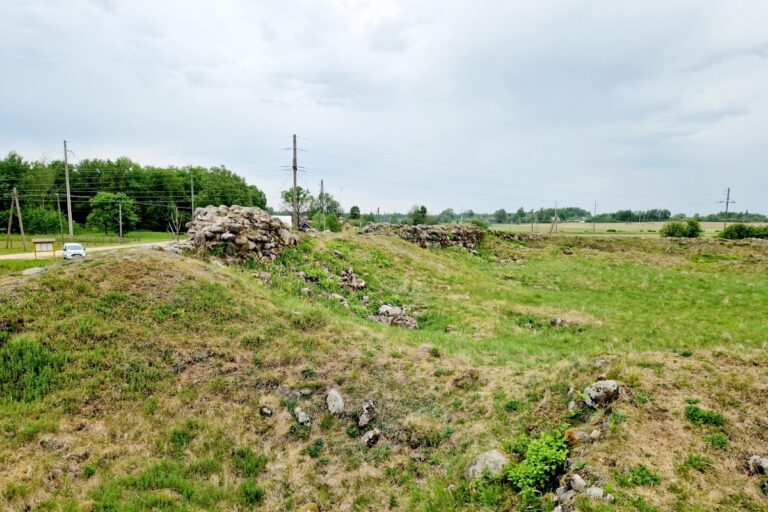
Helme Castle stood on a natural promontory beside a river, with two moats separating it from the surrounding land. Parts of the promontory rise as much as 20 metres above the river. The irregular stone-built fortress followed the natural outline of this elevated site. The main castle formed an elongated oval aligned from north to south, measuring approximately 120 metres by 60 to 70 metres.
A single entrance opened toward the south and was protected by a moat. In front of the main gate, the southern part of the promontory, known as Sillamäe or Keldrimäe, served as an outer defensive position. A bridge crossed the moat from this area. The surrounding wall enclosed the castle, and rooms were arranged along its entire inner side.
Central structure and surviving masonry
The oldest and most distinctive element is considered to have been a tower-like structure positioned in the centre of the enclosure. Its central location set it apart from the rooms built along the surrounding wall and formed part of the castle’s earliest architectural arrangement.
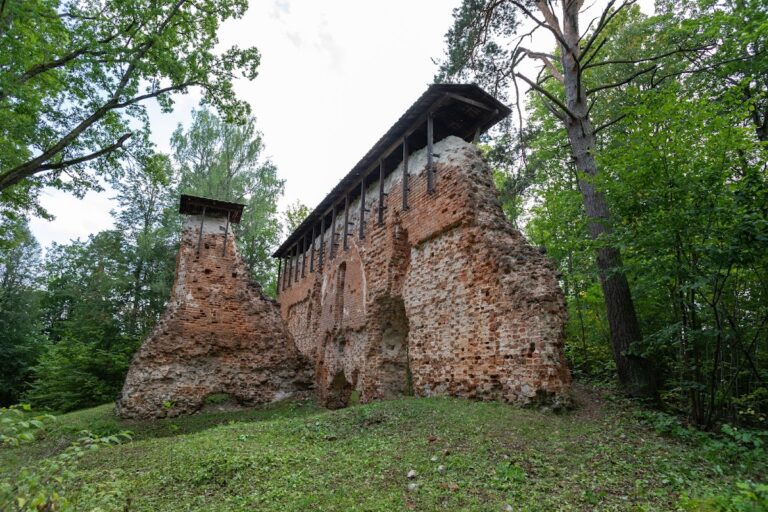
Today, the castle survives as scattered sections of wall and other fragmentary ruins. The masonry on the side facing the road has undergone major conservation, while the broader remains are substantially less extensive than those shown in historical drawings and early twentieth-century photographs.
Nearby sites