Příkopy Castle: An Early Medieval Bohemian Fortress in the Czech Republic


Visitor Information
Google Rating: 4.5
Popularity: Very Low
Google Maps: View on Google Maps
Country: Czechia
Civilization: Unclassified
Remains: Military

History
Příkopy Castle, also known as Starý Rýzmberk, is located near the village of Podzámčí within the municipality of Kdyně in the modern Czech Republic. This medieval fortress was constructed during the early medieval period by the Bohemian civilization, which was establishing its influence in Central Europe at that time.
Archaeological evidence indicates that the castle originated in the 11th century, making it one of the earliest noble fortifications in the region. Pottery fragments uncovered during excavations in 1959 by Rudolf Turek date the initial fortifications to this era. The castle likely played a role, albeit briefly, in the turbulent conflicts between Prince Břetislav I of Bohemia and the German King Henry III, possibly even serving as a site related to the Battle of Brůdek fought in the mid-11th century. While no contemporaneous written documents mention the site, its strategic location on a promontory above Kravař hill suggests military importance.
Following this initial phase, later archaeological findings have revealed ceramics dating from the early 13th century, suggesting that the site saw continued or renewed occupation during that period. Although the castle’s prominence may have diminished over time, these discoveries indicate its persistence as a noble stronghold or administrative site before eventual decline. Some historians propose that Příkopy Castle preceded the nearby Rýzmberk castle in Drslavice, emphasizing its significance as potentially one of Bohemia’s oldest preserved noble castles.
Remains
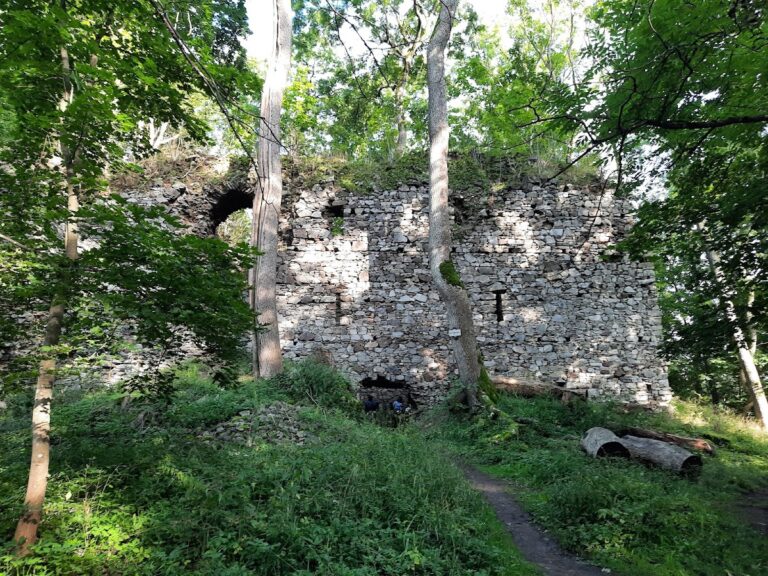
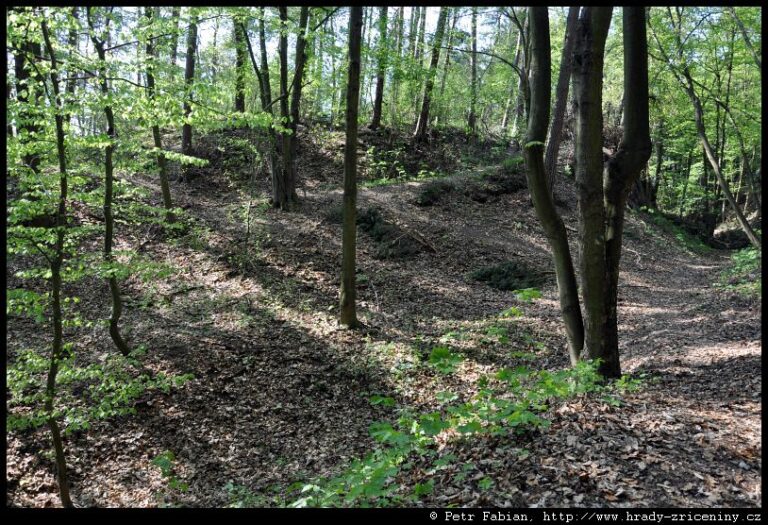
The layout of Příkopy Castle reveals a pentagonal shape defined by a system of double earth embankments and ditches, a common defensive design in medieval fortifications relying on natural terrain and earthworks. This defensive arrangement included a southern bailey—a courtyard area—and a northern core, or main part of the castle, which was further enclosed by additional embankments and moats. The castle core covers an area approximately 38 by 22 meters, where traces of former structures are visible on the uneven terrain.
Construction at the site primarily involved earthworks rather than stone masonry, with ramparts and deep ditches shaped to create defensive barriers adapted to the slope of Kravař hill. Remnants of embankments can also be found on the western and southern sides of the fortification, outlining the original perimeter. Today, these features remain as substantial raised earth banks and trenches that define the castle’s former enclosure.
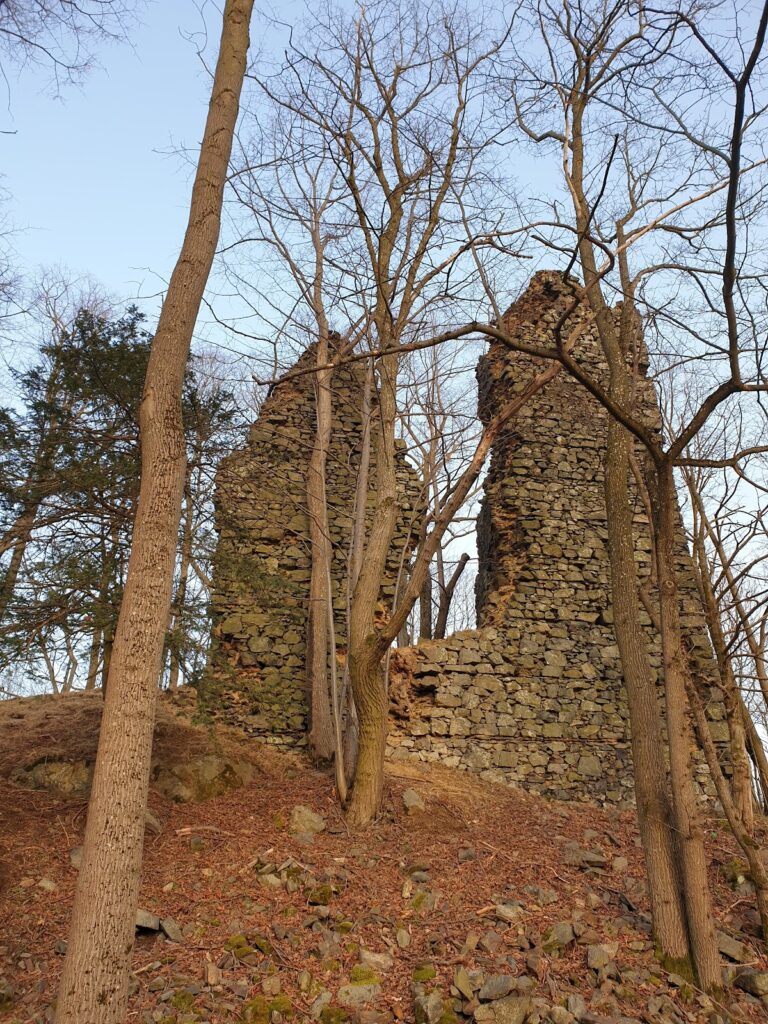
No masonry buildings or decorative architectural elements survive on the site; instead, the remains are limited to these large-scale earth structures. The castle’s location on a raised promontory enhances its natural defensive qualities, an aspect reinforced by the man-made embankments and ditches discovered during archaeological investigation. The presence of pottery shards and ceramic fragments also contributes to understanding the phases of occupation, though the physical remains are confined to these earthworks rather than constructed buildings.
Nearby sites