Chodský hrad: A Royal Frontier Castle and Museum in Domažlice



Site at a Glance
- Rating
- 4.6
- Popularity
- Low
- Country
- Czechia
- Primary era
- Medieval
- External website
- Open
- Eras represented
- Medieval, Early Modern
- Civilizations
- Holy Roman Empire, Kingdom of Bohemia
- Site type
- Military
- Remains
- Castle
On this page10 sections
History
Chodský hrad is a medieval castle in Domažlice, Czechia, built in the 1260s under King Ottokar II Přemysl during the foundation of the town. It served as the seat of royal burgraves, officials who administered the castle and royal interests, and supervised the Chods, privileged free peasants who guarded the Bohemian frontier against the Bavarian Nordgau.
A royal frontier stronghold
The castle formed part of a wider system of border defense. Cham Castle on the Bavarian side was regarded as its counterpart, while Bavarian authorities also relied on free peasants for frontier protection. Chodský hrad additionally provided lodging for Bohemian rulers travelling abroad, including King John of Bohemia in the 1330s.
Over time, the castle was associated successively with the Chods, the royal chamber, and the Laminger family. It deteriorated and underwent several repairs before being damaged by the great fire of Domažlice in 1592. After the Battle of White Mountain in 1620, a decisive Habsburg victory that brought extensive political and property changes in Bohemia, ownership was disputed for years between Wolf Maximilian Laminger of Albenreuth and the city. In 1671, the castle passed to Domažlice in exchange for a parcel of land.
Saltworks and civic uses
Between 1726 and 1728, the city converted the castle into a saltworks, an industrial installation for processing or refining salt, following plans by Kilian Ignaz Dientzenhofer, a major Bohemian architect of the late Baroque period. The saltworks continued operating until the beginning of the nineteenth century, and the building record dates another rebuilding to 1822.
After industrial production ended, the building served as a municipal office and then as a school from 1850. The city library moved into it in the early twentieth century, followed by the Choden Museum in 1931. The museum gradually expanded through the building, establishing Chodský hrad as its continuing home.
The Choden Museum
Founded in 1883, the Choden Museum is the oldest museum in Domažlice. It initially combined a library and city archive with historical, natural-science, and industrial collections. Early exhibitions concentrated on bourgeois domestic life, peasant culture, regional clothing, lace-making, and embroidery.
The collections were first housed in the Augustinian monastery and later in the new town hall. The move to Chodský hrad in 1931 created space for objects that had previously remained inaccessible because of limited room. Museum displays came to include prehistory and early history, mineralogical and geological material, coins and medals, religious and military objects, craft and trade, prominent inhabitants of Domažlice, urban civilization, local history, Choden culture, and an ethnographic institute. The Jaroslav Vrchlický Hall and a Domažlice Hall were also among its exhibition spaces.
War, restoration, and renewed use
During the Second World War, museum activity was first restricted and then suspended. Extensive restoration followed the war, but large parts of the collections disappeared under unclear circumstances. The museum was initially administered by the local national committee and, from 1955, by the district national committee. Its exhibitions were reshaped by contemporary political priorities, including the construction of socialism and the history of the Communist Party of Czechoslovakia.
After the Velvet Revolution of 1989, the museum was reorganized and the building was restored. A fire in 1995, during or shortly after the restoration, damaged many rooms and collections. Repairs were completed in 1998, and the museum reopened in the castle in 1999 with exhibitions on prehistory and the Middle Ages. Chodský hrad has been protected as a cultural monument in the Czech Republic since 1964, under registration number 36934/4-2331 and catalogue number 1000148826.
Remains
Fortification and surviving structure
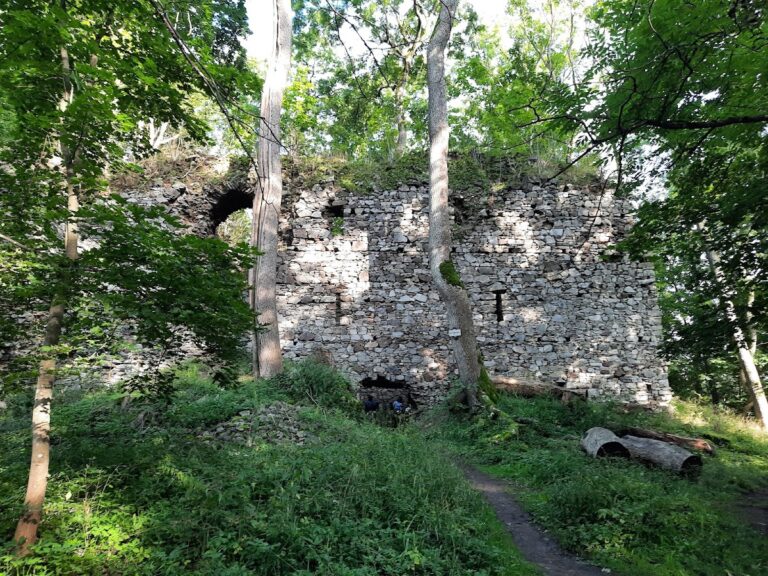
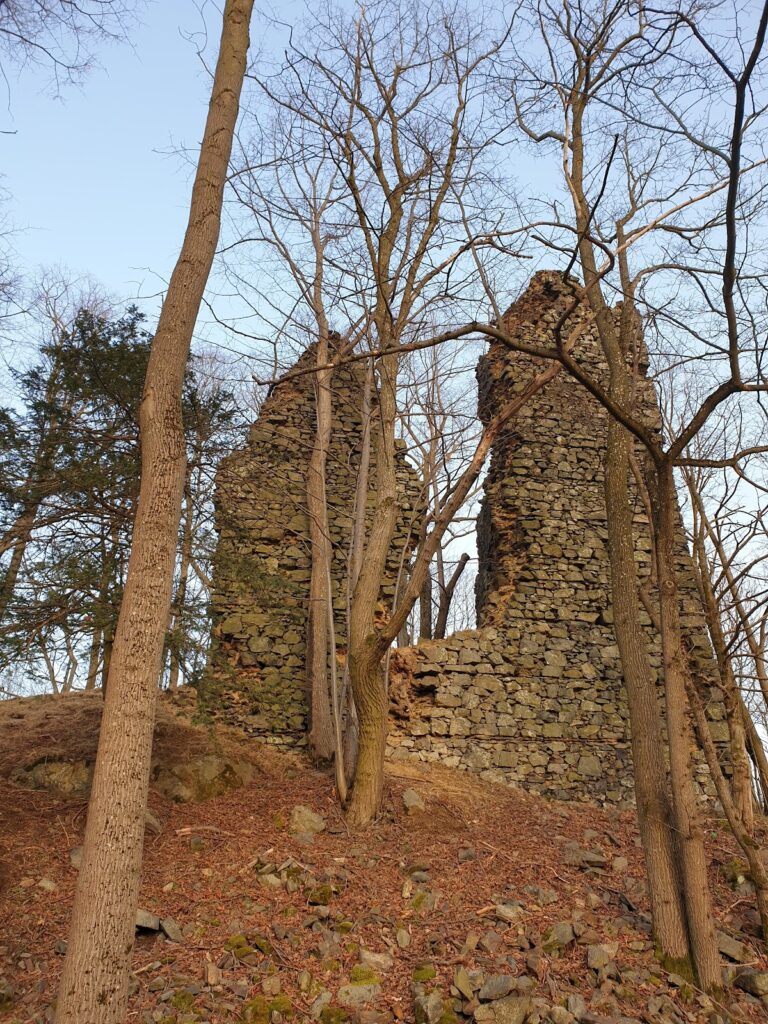
Chodský hrad stands in the southwestern corner of Domažlice’s old town, on the southern side of Chodské náměstí. Its southern edge is enclosed by a castle wall, beyond which the Zubřina stream flows, and the site lies in a shallow valley at about 420 metres above sea level. The former fortification extended considerably beyond what survives, with 22 towers and deep ditches. On the town-facing side, it probably included a ditch and an outer defensive enclosure between the principal defenses and an additional barrier.
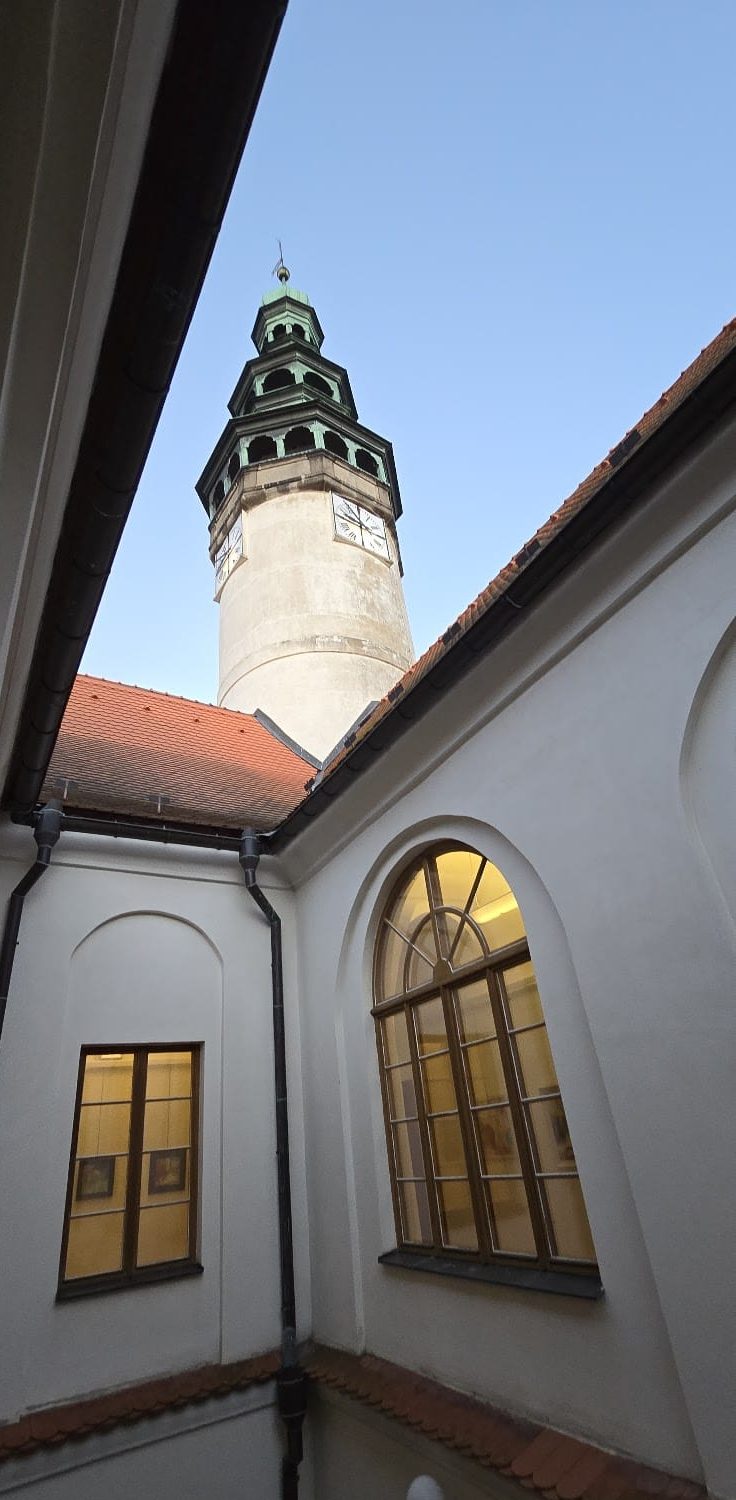
The town-facing part of the castle had a rectangular corner, while the opposite side followed a quarter-round plan. A drawing made in 1592 shows three palace wings. The principal surviving elements are a section of the outer perimeter wall and a round tower rising from a square base. The tower has a separate access point within the museum.
Cellars and lapidaria
Castle cellar
The castle cellar became accessible after the 1992 renovation. One wall is Gothic, while the other walls are brick and date from the eighteenth century. Two cellar rooms contain a lapidarium, a display of architectural and sculptural stone fragments, arranged over a brick pavement. The stone elements recovered during archaeological investigations and building alterations include a Calvary group, milestones, fragments from a church in Valtýř, Baroque pedestals, and other architectural remains.
Museum courtyard
The museum courtyard contains another lapidarium and a reconstruction of a Choden wedding scene. The courtyard collection was re-established after the 1995 fire and the restoration that followed. Comprehensive renovation of the building took place in 1992, while repairs after the fire were completed in 1998.