Rýzmberk Castle: A Medieval Border Fortress in Czechia

Site at a Glance
- Rating
- 4.5
- Popularity
- Low
- Country
- Czechia
- Primary era
- Medieval
- Eras represented
- Medieval, Early Modern, Modern
- Civilizations
- Holy Roman Empire, Kingdom of Bohemia
- Site type
- Military
- Remains
- Castle
On this page16 sections
History
Rýzmberk Castle is a medieval fortress in Czechia, above Kdyně, founded in the second half of the thirteenth century by Bohemian noblemen to guard the trade route through the Všerub Pass toward Regensburg. Its establishment is associated with the Drslavic lineage and with a request by King Ottokar II Přemysl, the Přemyslid ruler of Bohemia from 1253 to 1278. The first written reference to the castle dates from 1279.
A border fortress and noble seat
The castle’s German name, Riesenberg, means “Giant Mountain” or “Giant’s Mountain.” It refers to the fortress’s position above Kdyně on a broad, high hill. The original Lords of Rýzmberk retained the castle until 1407, when they sold it to their relatives, the Janovský family of Janovice. The new owners adopted the name Janovský of Rýzmberk and held the estate for several generations, until 1497.
Because the Janovský family occupied Rýzmberk permanently, they undertook extensive building work. A destructive fire in 1448 led to a major rebuilding and enlargement carried out for Racek II Janovský of Rýzmberk. This campaign gave the castle much of the form that shaped its later history. Descendants of the first founders, the Švihovský family of Rýzmberk, regained the castle in 1508 after an interval of 101 years. They strengthened and enlarged it, but heavy debts forced them to sell the estate to the Janovský family in 1535. The Janovskýs sold it again in 1543 to the Lords and Imperial Counts of Gutštejn.
Gutštejn ownership and the Thirty Years’ War
The Gutštejn family administered the estate successfully and expanded it to include properties such as Kout na Šumavě. They continued to occupy Rýzmberk and remodel it in the Renaissance style. Their ownership ended in 1622 as a consequence of the failed Bohemian Estates Revolt, the Protestant uprising against Habsburg rule that began in 1618 and was defeated after the Battle of White Mountain in 1620.
The castle had already been seized in October 1620 during the Thirty Years’ War, the European conflict of 1618–1648 that combined religious, dynastic, and political struggles and caused widespread destruction in Bohemia. An Imperial Catholic army commanded by General Baltasar de Marradas captured Rýzmberk by stratagem, after which it became an Imperial stronghold. In 1622, Emperor and King Ferdinand II formally confiscated the castle from the Protestant Gutštejn family.
Ownership changed several times after the confiscation. A brief period under the Habsburgs was followed by holdings of the Kracové of Šarfenštejn, the Collonnové of Fels, and the Černínové of Chudenice. After the Gutštejns left, the castle was no longer a regular noble residence. Estate officials, a military garrison, foresters, and servants used the complex instead.
War damage and abandonment
On 1 July 1641, Swedish forces under Major General Pful captured Rýzmberk after a short siege. The assault damaged the castle so severely that it became largely uninhabitable. Repairs were made, and in 1643 it again served as an Imperial garrison, with approximately 20 to 30 soldiers stationed there.
The Thirty Years’ War left the fortress seriously damaged. After the conflict, restoration was gradually abandoned because the work would have been too expensive and the site was remote. Its owners also preferred more comfortable residences in Bohemia or Germany. An order issued by Emperor and King Ferdinand III to demolish Bohemian fortresses was intended to include Rýzmberk, but the order was not carried out.
By 1676, Rýzmberk was described as predominantly ruined. Occupation was then limited to the lower, second courtyard, where an inn operated. The Lamingen family of Albenreuth acquired the semi-ruined castle and incorporated the former Rýzmberk estate into their neighboring Trhanov estate, creating the Kout-Trhanov estate. In 1697, Baron Jiří Jindřich of Stadion purchased the estate and the ruined castle.
Repairs and preservation
The Stadion family, later raised to the rank of counts, retained the Kout-Trhanov estate until the family became extinct in 1908. After 1834, they repaired the castle’s cellars and several walls, landscaped the castle hill, and undertook archaeological investigation. These measures slowed the deterioration of the ruins and helped establish the site as an excursion destination.
After the Stadion family ended, the Club of Czech Tourists from nearby Kdyně acquired the ruin. The club had sought ownership since 1902 and became the owner again in the 1990s. A permanent open-air stage was built beside the castle in 1935–1936 and modernized in 1958. The ruined fortress has also served as a setting in Consuelo, a novel by the French writer George Sand.
Remains
Castle core and courtyards
Rýzmberk stands on a high, wooded hill near Kdyně. Its original plan extended through three courtyards arranged one above another. The complex combined a central castle core with a fortified outer bailey, an enclosed area outside the principal residential and defensive core.
Palaces and defensive tower
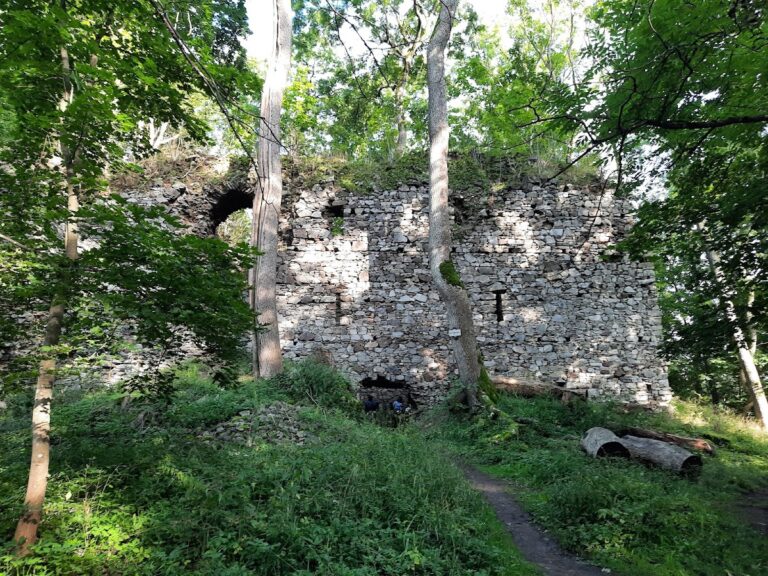
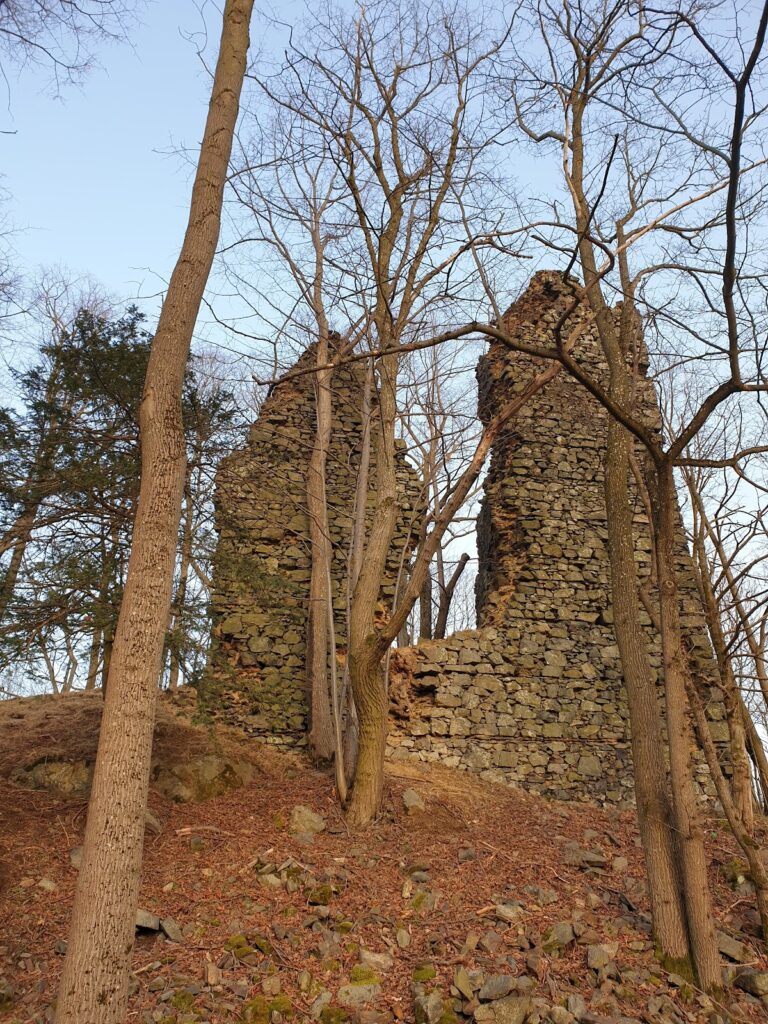
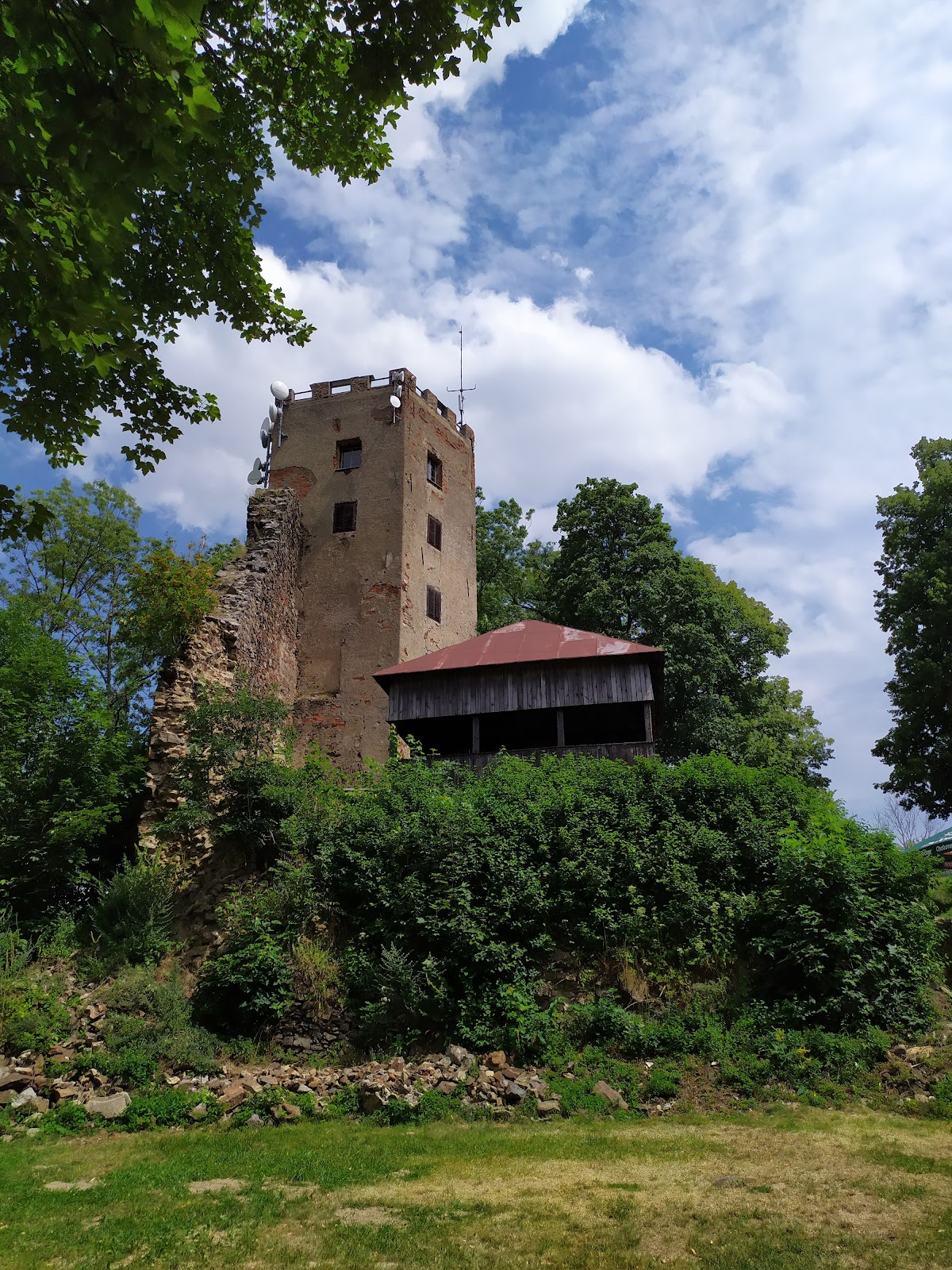
The central core contained an older palace with underground cellars, a keep with a defensive tower, and a residential palace on the opposite side. A second large palace was added in the core during the Janovský rebuilding after the fire of 1448, occupying the former third courtyard. Parts of the older palace and its cellars survive among the ruins. Sections of the younger Gothic palace are more fragmentary, although a later observation tower incorporates some of its medieval masonry. The tower’s construction altered the original arrangement of the castle core.
Former third courtyard
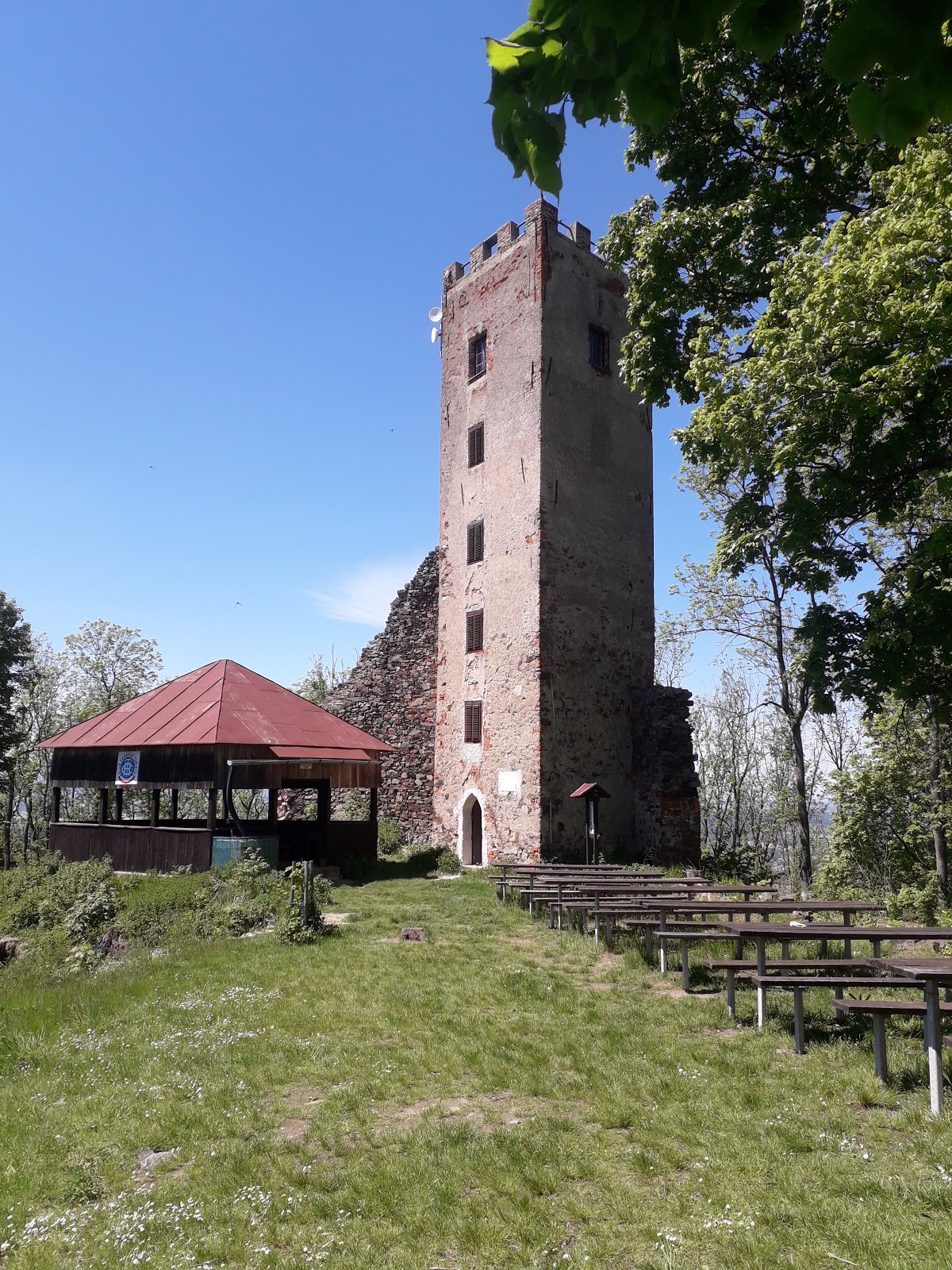
The former third courtyard now contains a wooden refreshment hut beside the observation tower and a wooden shelter between the hut and the tower. A row of wooden benches and tables stands above the hut. These later structures occupy part of the courtyard shaped by the castle’s medieval and early modern building phases.
Fortifications and outer bailey
Walls, ditches, and bastions
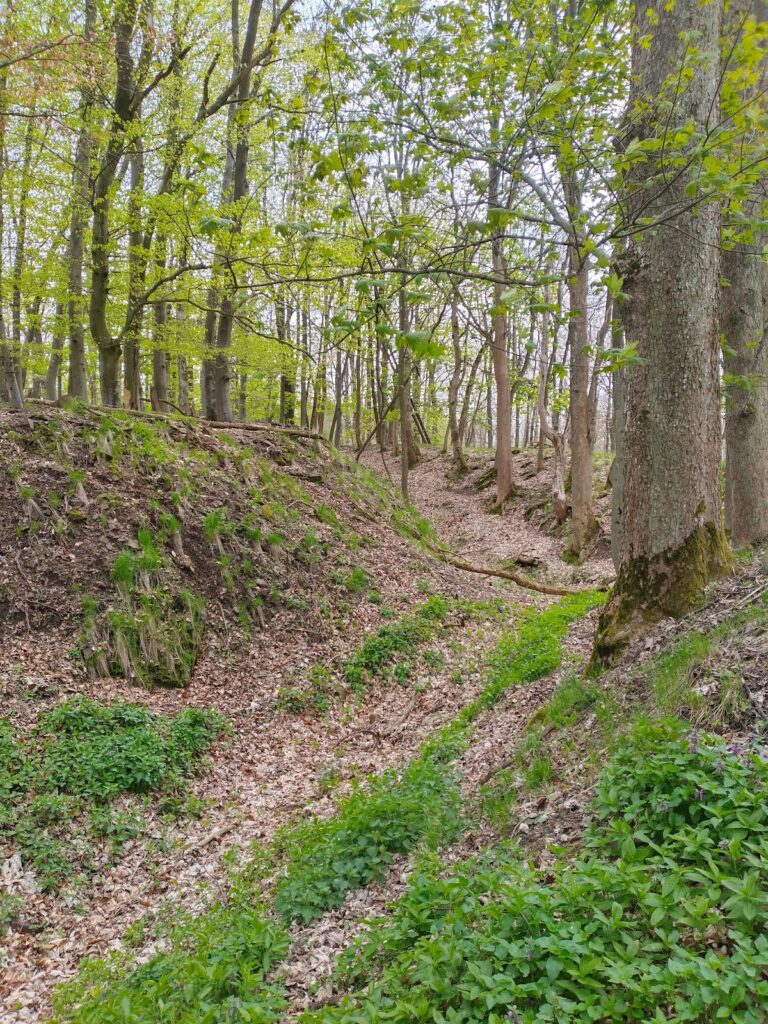
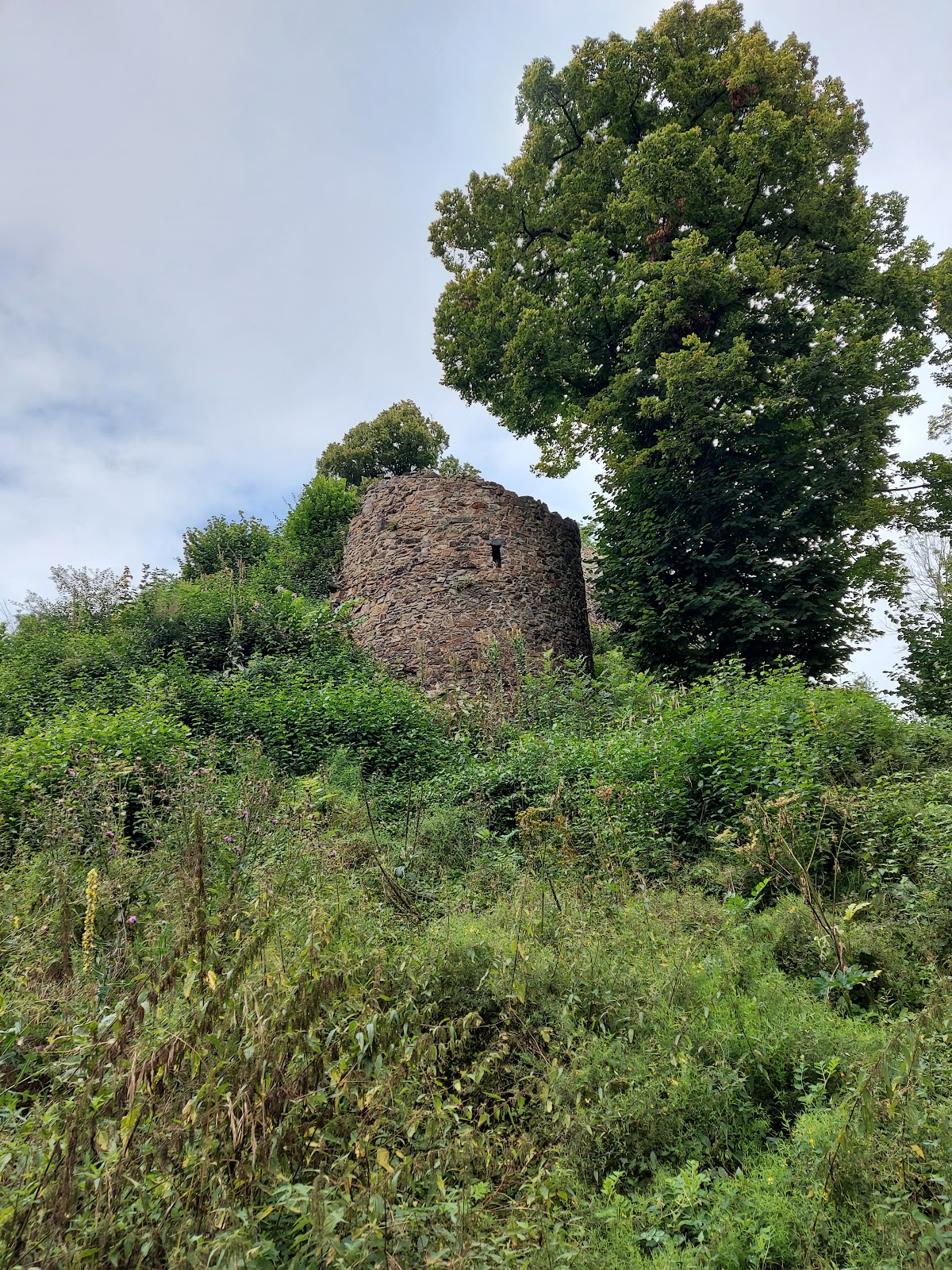
Surviving sections of the fortification walls preserve bastions, which are projecting defensive structures that strengthened the flanks of the walls. Clearly recognizable ditches remain around the complex. The fortified outer bailey originally included two towers, flanking bastions, and an additional palace wing.
First courtyard and defensive turrets
The Janovský rebuilding created a large outer bailey corresponding to the first courtyard. Its defenses included a line of defensive turrets. Together with the surviving walls, bastions, and ditches, these remains show how the castle’s outer defenses were expanded after the fifteenth-century fire.
Observation tower and later structures
Neo-Gothic tower
The Counts of Stadion built the Neo-Gothic observation tower in 1846–1847 on the site of the younger Gothic palace. Neo-Gothic was a nineteenth-century revival of medieval Gothic forms. The slender, prismatic tower rises about 19 metres and partly incorporates the palace’s medieval masonry. It has become a defining feature of the surviving castle.
Open-air amphitheatre
A wooden amphitheatre was constructed immediately below the castle complex on the slope in 1935–1936. It was first used for amateur theatre performances and was modernized in 1958. The structure remains associated with the later cultural use of the castle grounds.
Gate remains
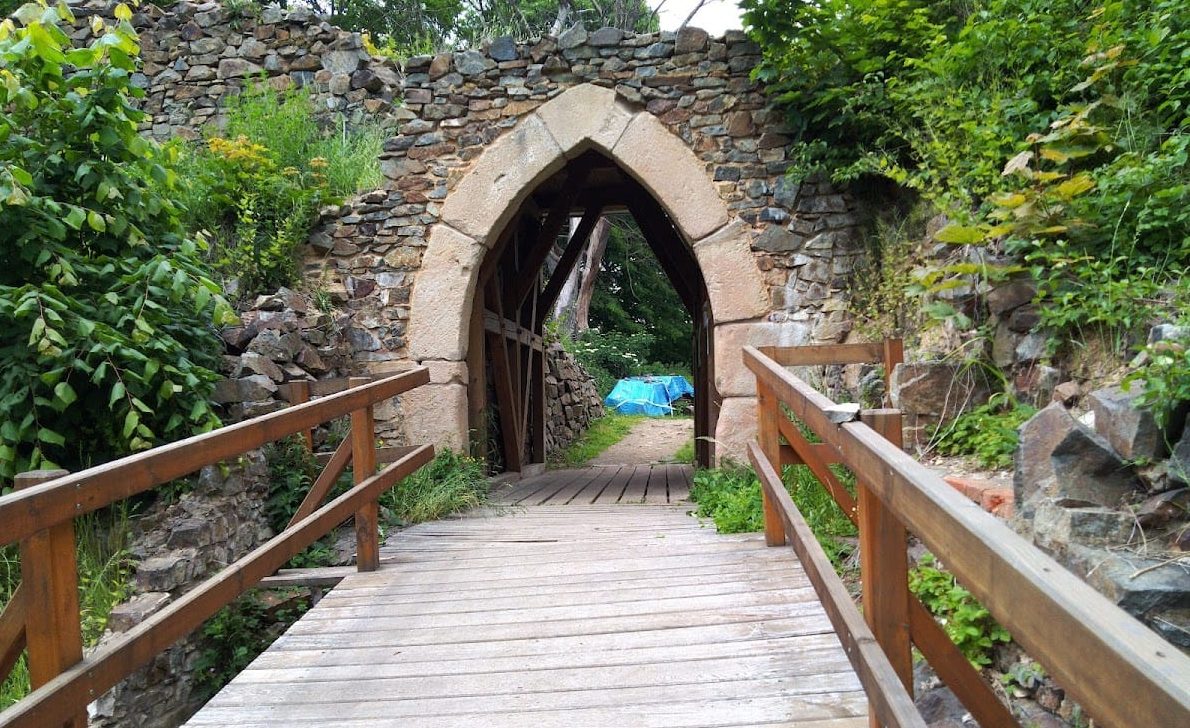
An arch from the former second gate was rediscovered, reassembled, and installed in its original position in 2004. It provides a surviving architectural element of the castle’s former entrance arrangement and complements the preserved defensive walls and courtyard plan.