Nazzano Castle: A Medieval Fortress in Rivanazzano Terme, Italy



Visitor Information
Google Rating: 4.3
Popularity: Low
Country: Italy
Civilization: Unclassified
Site type: Military
Remains: Castle

History
Nazzano Castle stands on a hill in the village of Nazzano, within the modern municipality of Rivanazzano Terme, Italy. The fortress was established by medieval builders, likely in the 11th century, though some records indicate that a defensive structure occupied this site before the year 1000.
In 1164, Emperor Frederick I, also known as Barbarossa, granted the castle to the Malaspina family, who controlled the surrounding valley. This gift acknowledged their authority in the region. However, by 1191, Frederick’s successor, Henry VI, integrated the castle into the domains of Pavia in the Oltrepò area. At this time, the castle served as the seat for a podesteria, an administrative office headed by a podestà, or local magistrate, responsible for governance and justice.
During the 13th century until the early 1400s, ownership passed to the Sannazzaro family, noted Guelph lords who held considerable influence in Oltrepò. Their tenure was marked by frequent disputes with the Beccaria family and the neighboring town of Voghera, reflecting the regional tensions between noble houses and municipalities in medieval Lombardy. Following the Sannazzaro period, the castle came under the control of the Pusterla family.
Recognizing the strategic position of the castle, Gian Galeazzo Visconti, Duke of Milan, undertook significant strengthening of its defenses in 1360. The castle’s location was crucial due to its proximity to the Lombard salt road, a key commercial route linking the Staffora valley to the sea ports of Genoa through the Giovà pass and Monte Antola.
In the early 17th century, the castle was transferred to the Mezzabarba counts of Pavia in 1613. Later on, in 1712, it was sold to the Roverato family, who were marquises. The Roverato lineage completed an extensive restoration of the castle in 1905, preserving its structure and adapting certain features. To this day, the castle remains under the ownership of the Roverato family.
Remains
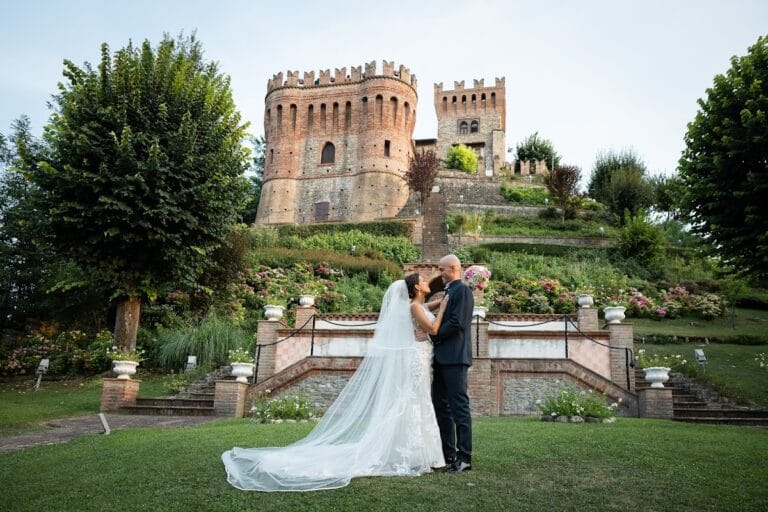
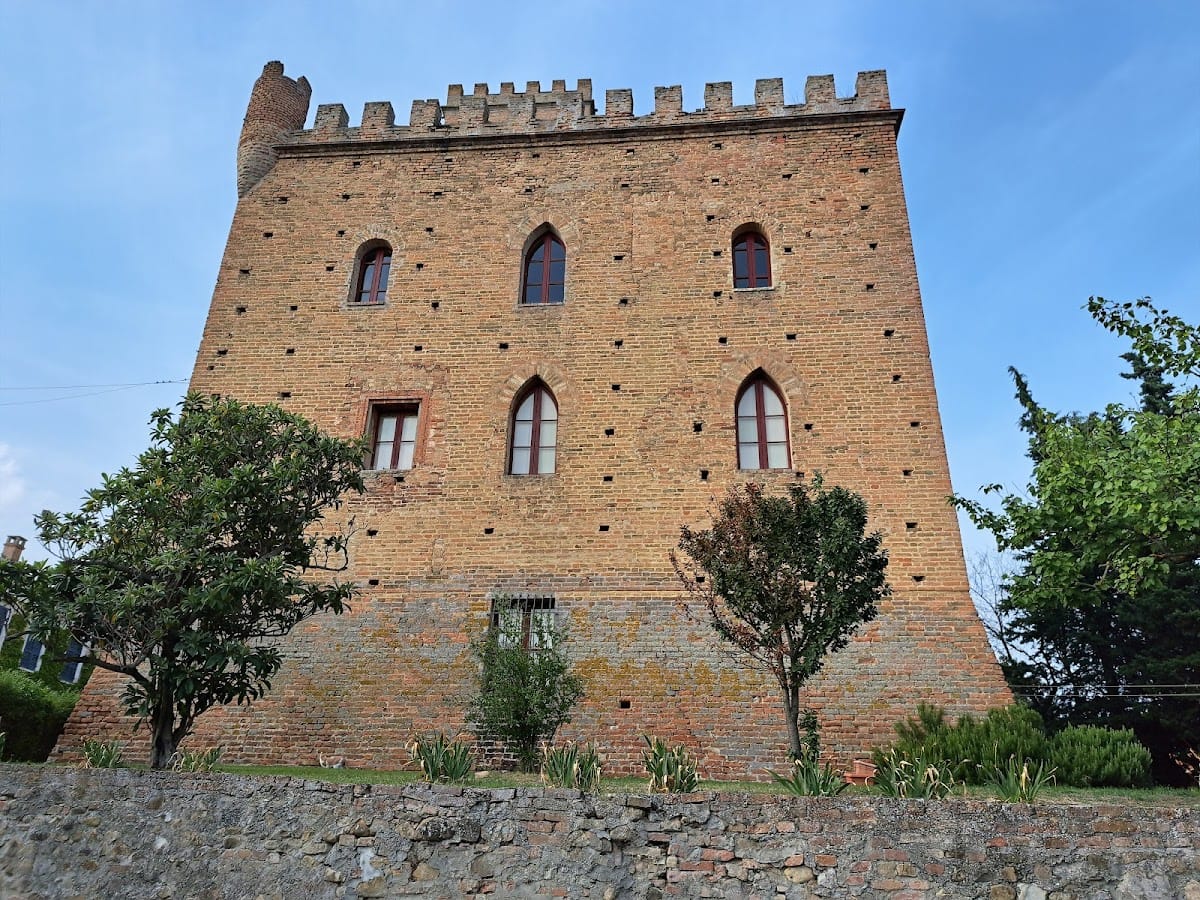
Nazzano Castle presents as a primarily brick-built fortress with a clear layout centered on a rectangular main body. This structure has the appearance of a small fortress, often referred to as a “rocchetta,” a diminutive fortress common in the region. Attached to this main block is a tall, square tower characterized by battlements—defensive parapets typical of medieval military architecture designed for protection and firing positions.
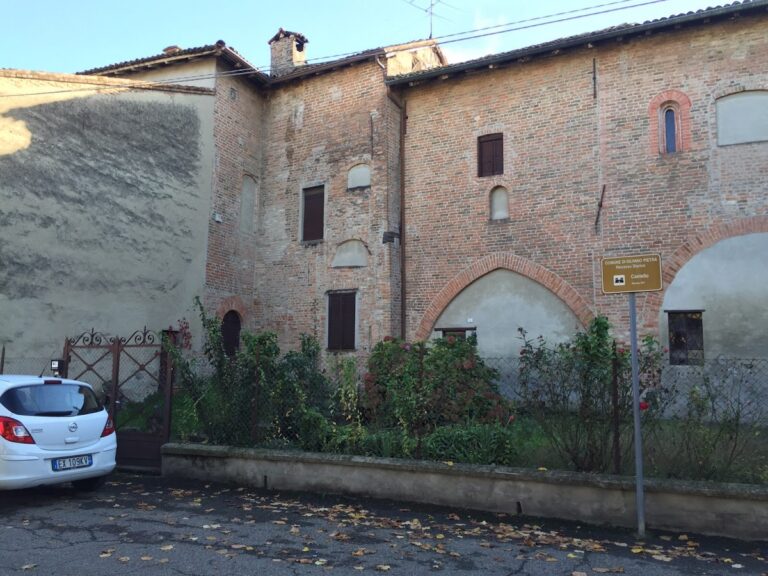
A distinctive feature on the castle’s front facade is a large blind ogival arch. This means that the pointed arch (ogival) shape frames the exterior wall without passing through it, enclosing the castle’s entrance and a prominent, similarly shaped window above. This design element is unusual for the Lombardy region, setting the castle apart through its architectural form.
The restoration carried out in 1905 by the Roverato family introduced stylistic changes inspired by the neocastellano style, which aimed to emulate medieval castle aesthetics with neat masonry work and standardized details. These alterations refined the castle’s appearance, smoothing the stonework and modifying several elements, though they respected the original fortress form.
The castle’s hilltop site offers commanding views over the plain where the Staffora valley opens. This elevated position played a strategic role historically, overseeing the movement along the salt road at the base of the hill. The surviving structures stand largely restored and maintain their imposing presence, speaking to centuries of adaptation and stewardship without evidence of destruction or ruin in the available records.
Nearby sites