Lucus Feroniae: An Ancient Sanctuary and Town in Capena, Italy


Visitor Information
Google Rating: 4.6
Popularity: Low
Google Maps: View on Google Maps
Official Website: sabapviterboetruria.cultura.gov.it
Country: Italy
Civilization: Roman
Remains: City

History
Lucus Feroniae is an ancient site located in the municipality of Capena, Italy. It was originally established by the Sabines, an Italic people, within territory influenced by the Etruscans.
The earliest phase of Lucus Feroniae dates back to the reign of the Roman king Tullus Hostilius (672–640 BC). At this time, the site functioned primarily as a sanctuary dedicated to the Sabine goddess Feronia. Situated near the Etruscan city of Capena, the sanctuary became a religious and commercial hub, drawing diverse groups such as Sabines, Etruscans, Latins, and Faliscans. Annual festivals and fairs held here fostered cultural exchange and trade among these peoples.
By the 2nd century BC, the sanctuary had evolved into a structured town featuring a rectangular street plan with insulae, or housing blocks. The settlement grew around the sanctuary and later developed a forum, serving as a civic center. Lucus Feroniae held the status of a municipium, a self-governing town within the Roman system, and occupied a strategic position at the crossroads of two important roads: the Via Tiberina and the Via Capenate.
In 46 BC, following Julius Caesar’s land redistribution law, the town was transformed into a Roman colony named Colonia Julia Felix Lucus Feroniae. This reorganization aimed to settle army veterans in the area. A wall was constructed to separate the town from the original sanctuary, and the ancient cult of Feronia was discontinued. In its place, the worship of Salus Frigifera, a deity associated with health and protection, was introduced, marked by a small temple at the end of the forum.
During the reign of Augustus (27 BC–14 AD), Lucus Feroniae underwent significant urban development. Major construction projects included the building of an aqueduct, a basilica (a public hall), an amphitheatre, and the restoration of shops around the forum. Augustus’s successor, Tiberius, added the Augusteum, a richly decorated hall dedicated to the imperial family. Later, under Emperor Trajan (98–117 AD), the town saw further restoration efforts, including the construction of public baths near the forum and two small temples. These improvements contributed to the town’s prosperity from the Julio-Claudian through the Flavian periods and into the 3rd century AD.
The settlement remained inhabited until the late 4th century AD but was abandoned by the early 5th century. After its desertion, the site became a source of building materials, with stones and other elements quarried for reuse elsewhere.
Archaeological excavations began in 1952 and continued through the 1970s, uncovering key structures such as the forum, sanctuary, baths, amphitheatre, and residential buildings. Further investigations took place during the construction of the nearby A1 motorway. The site lies adjacent to the Villa dei Volusii archaeological area, linking it to a broader historical landscape.
Remains
Lucus Feroniae presents a well-organized urban layout centered on a long rectangular forum, which served as the town’s main public space. The forum’s west side is lined with a portico opening onto tabernae, or shops, some of which feature mosaic floors and ancient painted advertisements. At the northern end of the forum stands a basilica, a large public hall with side aisles (ambulacra) and bases that once supported honorary statues. Behind the basilica lies the Augusteum, an apsidal (semi-circular) hall lavishly decorated with opus sectile, a technique using cut marble pieces to create intricate floor patterns. This hall housed a distinguished collection of statues honoring Emperor Augustus and his family.
On the forum’s eastern side, the enclosure wall of the sanctuary of Feronia remains visible. This wall supported channels and lead pipes that carried water from the Aqua Augusta aqueduct, constructed during the Augustan period. Adjacent to the forum’s north side is the civic altar dedicated to Feronia, with the original altar now preserved in the local museum. Nearby stands a small temple featuring a round altar, part of the sanctuary complex. Both the Augusteum and basilica were repaved and enhanced during Trajan’s reign, reflecting ongoing investment in public architecture.
The forum baths, the largest bathing complex in the town, were built over a former residential block near the forum. These baths include monochrome mosaic floors decorated with laurel wreath motifs. They contained separate facilities for women, including a frigidarium (cold room) and calidarium (hot room). Repairs and new mosaic decorations were added during the reign of Caracalla (198–217 AD). In the 5th century, a church was constructed within the atrium of these baths, indicating continued use of the site into late antiquity.
Another set of baths, located along the Via Capenate and fully excavated, dates to the Trajanic period. Built over an earlier house and shop, these baths feature marble-lined walls and were restored in the 4th century using opus vittatum, a masonry technique involving alternating rows of tuff and brick.
The amphitheatre at Lucus Feroniae is notable for being the smallest known Roman amphitheatre, with a seating capacity of approximately 5,000 spectators. It was financed by M. Silius Epaphroditus, a freedman, demonstrating the involvement of local benefactors in public works.
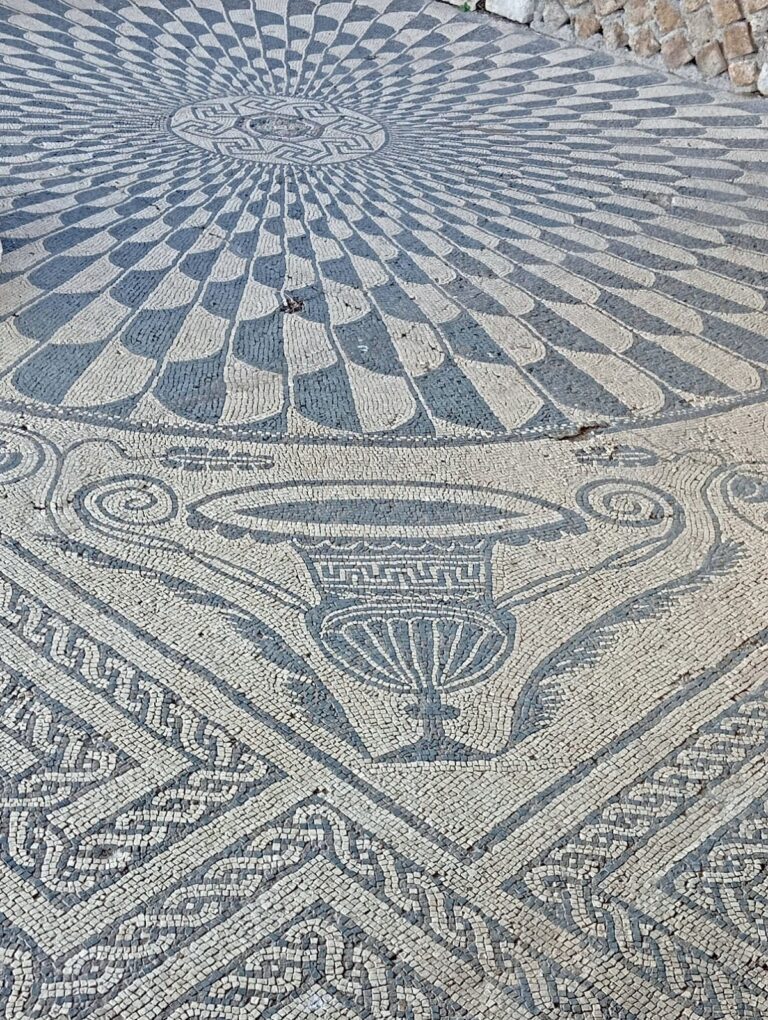
Southwest of the forum, archaeologists uncovered a late Republican domus, or private house, which was later adorned with colorful polychrome mosaics during the imperial era. Earlier floors in this residence were made using opus signinum, a waterproof mortar commonly used in Roman construction. The domus aligns with the town’s urban grid and connects to the sanctuary area.
The sanctuary, or lucus (sacred grove) of Feronia, lies just behind the forum’s eastern wall. Access to this area was provided by a small portico built during the Augustan period by the duumvir A. Ottavius, who also undertook reconstruction of the forum. This portico marks the transition from the civic center to the religious precinct.
Additional structures include tabernae and the so-called “Menandro” baths, which feature geometric mosaic floors. These baths remained in use until the early medieval period, as indicated by inscriptions found on site.
The Antiquarium, a museum built in 1977, houses many of the artifacts recovered from Lucus Feroniae. Among its exhibits is a life-size reconstruction of the Sacellum of the Augustales, a small shrine containing a cycle of statues dedicated to the imperial cult. The museum also displays a funerary monument with gladiatorial relief from nearby Fiano Romano, along with a wide range of objects spanning from prehistoric times through the Roman imperial period.
Today, visitors to the archaeological area can see partial pavement slabs of the forum, the western portico, a long water basin connected to the aqueduct, and remains of the basilica, Augusteum, shops, baths, amphitheatre, and domus. These preserved elements show the complex urban and religious life of Lucus Feroniae across many centuries.
Nearby sites