Lorca Castle: A Historic Fortress in Murcia, Spain


Visitor Information
Google Rating: 4.5
Popularity: Medium
Google Maps: View on Google Maps
Official Website: lorcatallerdeltiempo.es
Country: Spain
Civilization: Medieval European
Remains: Military

History
Lorca Castle is located in the city of Lorca, in the Murcia region of southeastern Spain. Archaeological evidence shows that the site has been inhabited since the Neolithic and Bronze Ages, with an Argaric culture settlement featuring homes, funerary sites, and a protective wall beneath the current fortress and town. The first written mention of a castle at Lorca appears in 9th-century Muslim sources, which refer to the city as Lurqa, an important town within the Cora of Tudmir, an administrative district of Al-Andalus.
Under Muslim rule, the castle served as a formidable fortress divided by the Espaldón Wall into two main sections: the western alcazaba, or citadel, and the eastern barrio de Alcalá, part of the medina or town. Its defensive walls extended beyond the castle itself to protect nearby neighborhoods and markets, reflecting its role as a key military and urban center in the region.
In 1244, the castle was captured by the Castilian Infante Don Alfonso, later King Alfonso X. Following the conquest, the fortress became a strategic frontier stronghold against the Nasrid Kingdom of Granada for more than two and a half centuries. Alfonso X ordered the construction of several towers, including the Alfonsina, Espolón, and Guillén Pérez de Pina towers, and reinforced the walls. Most Muslim-era structures were replaced or rebuilt during this period, with only the Espaldón Wall and some foundations remaining from the earlier phase.
During the 14th century, a Jewish quarter, or Judería, developed within the alcazaba. This neighborhood remained active until 1492, when the Catholic Monarchs ordered the expulsion of Jews from Spain. After this event, the Jewish quarter was abandoned, marking a significant social and demographic change within the castle precinct.
Following the conquest of Granada in 1492, Lorca Castle lost its military importance as the frontier moved south. Over the following centuries, the fortress was gradually neglected and fell into ruin by the 18th century. It saw a brief revival in the early 19th century during the Spanish War of Independence, when repairs and modifications were made, including the addition of artillery batteries and stables.
In the 20th century, the castle gained official recognition for its historical value. On June 4, 1931, the Alfonsina Tower and the castle were declared a National Historic Monument. Later, in 1964, the historic center of Lorca, including the castle, was designated a Historic-Artistic Group. The castle suffered serious damage during the 2011 Lorca earthquake, particularly to the walls and the Espolón Tower. Restoration work was completed by 2012, although the tower’s battlements were not reconstructed due to insufficient historical evidence.
Remains
Lorca Castle covers an extensive area of about 52,000 square meters, enclosed by walls stretching approximately 1,426 meters in length. The fortress measures roughly 640 meters long and 120 meters wide at its broadest point, making it one of Spain’s largest castles. Its walls once extended down the slopes to enclose surrounding neighborhoods, markets, and suburbs, forming a comprehensive fortified complex.
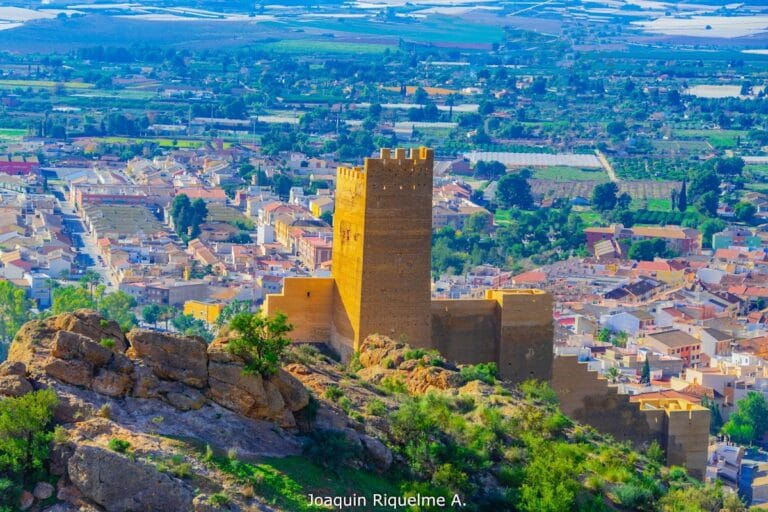
The Alfonsina Tower, built by Alfonso X on the foundations of a smaller Islamic tower, is a prominent feature. It has a rectangular plan measuring 22.7 by 19.4 meters, with walls four meters thick and a height close to 30 meters. The tower contains three floors and a terrace, accessed by staircases embedded within the walls. Each floor is about eight meters high and covered by brick vaults with diamond-shaped panels acting as pendentives, which are architectural elements that support the vaults at the corners. The tower’s lighting comes from arrow slits on the lower floors and large pointed-arch windows framed by decorative moldings on the upper floor.
At the western end of the castle stands the Espolón Tower, contemporary with the Alfonsina Tower. It has a square plan of 13 meters per side and two floors with brick ribbed vaults supported by stone ribs. The tower includes a battlemented terrace and a basement cistern for water storage. Internal access is provided by a staircase built into the walls. The Espolón Tower was heavily damaged in the 2011 earthquake and restored by 2012, but its battlements were not rebuilt due to lack of historical documentation.
Within the alcazaba lies the Jewish quarter, covering about 5,700 square meters. Archaeological excavations uncovered twelve rectangular homes arranged irregularly on four terraces that adapt to the terrain. These houses feature multiple rooms, elevated bedrooms, built-in benches, kitchens, storage spaces for earthenware jars, and cupboards. The synagogue, the most significant building in the Jewish quarter, is semi-subterranean to increase interior height while remaining discreet externally. It is accessed through a patio with two entrances and has a separate external entrance to the women’s gallery, or matroneum, located above the vestibule.
Inside the synagogue, the niche for storing the Torah scrolls, called the hejal, is decorated with Gothic-style plasterwork. The remains of the bimah’s plinth, the platform from which the Torah is read, are preserved. A continuous bench runs along the prayer hall’s perimeter for male worshippers, with a segregated space for women, reflecting traditional practices.
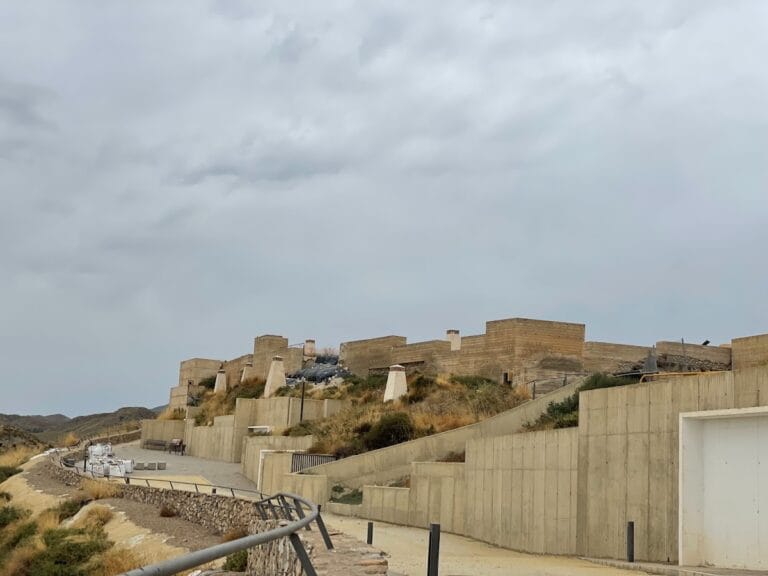
The castle precinct also includes the Parador de Turismo hotel, which integrates archaeological remains discovered during excavation, including parts of the Jewish quarter and synagogue. Overall, the site presents a layered history visible in its structures, from prehistoric settlements to medieval fortifications and religious spaces.
Nearby sites