Lielstraupe Castle: A Historic Fortress and Residence in Latvia


Visitor Information
Google Rating: 4.6
Popularity: Low
Google Maps: View on Google Maps
Official Website: www.tourism.straupe.lv
Country: Latvia
Civilization: Medieval European
Remains: Military

History
Lielstraupe Castle is located in the municipality of Cēsis in modern-day Latvia. It was originally constructed in the late 13th century by the von Rosen family, who were local nobles serving as vassals to the Archbishopric of Riga. The castle served as a fortified residence within an archiepiscopal fief and played a role in the defense and administration of the surrounding region.
The earliest reliable record of the castle comes from 1310, when it was mentioned in connection with a Lithuanian siege. Though the fortress is traditionally said to have been founded in 1263, this date is based on later inscriptions rather than contemporary documents. By the 14th century, the adjacent settlement of Roop grew into a small fortified town known as a Hakelwerk. The von Rosen family divided their holdings in the area into three estates: Groß-Roop (Great Roop), Klein-Roop (Little Roop), and Hochrosen (High Rosen). Around the year 1500, the castle underwent expansion that included the addition of a residential wing and a Gothic church integrated within its defensive walls. Before 1512, the site was called “hoff to Rope,” and after that year, it was referred to as “dat sloth rope” (the castle of Roop).
In the early 17th century, during the Northern Wars, the castle sustained heavy damage. By 1624, it was largely roofless and unused. The following year, King Gustav Adolf of Sweden confiscated the property after its owners sided with Poland during the conflict. Ownership of Lielstraupe Castle passed through several noble families in the decades that followed, including the von Albedylls and the von Stackelbergs.
Further destruction occurred in the Great Northern War (1700–1721), after which Count Peter von Lacy acquired the castle. By 1743, he had transformed the fortress in the Baroque style, adding mansard roofs, a redesigned tower hood, and a new entrance portal. Subsequent owners included Peter von Vietinghoff, Georg Graf Browne, and the Counts of Solms and Tecklenburg, each maintaining the estate through the 18th and 19th centuries.
In 1857, Baron Johann Gustav von Rosen repurchased the castle, restoring it to the von Rosen family lineage. He established a fideicommissum—a hereditary trust—to preserve the estate within the family as of 1866. At this time, the property encompassed approximately 800 hectares, largely covered by forest.
The castle suffered severe fire damage during the 1905 Russian Revolution. Restoration work took place between 1906 and 1909 under the architect Wilhelm Bockslaff. This renovation is recognized as Latvia’s first scientifically guided restoration. The architect introduced new elements such as a second floor on one wing and added half-timbered structures, blending historical respect with contemporary design.
Hans von Rosen, the last family member to possess the castle, was expropriated in 1920 following agrarian reforms, although he retained around 50 hectares including the castle itself. He lived there until 1939 when he was resettled due to the political changes preceding World War II.
In the post-war period, the castle’s uses shifted dramatically. It housed a tractor repair workshop before becoming a state clinic in 1963, a role it fulfilled until 2017 when the building’s condition led to closure. Since 2018, Lielstraupe Castle is managed by the local Pārgauja municipality. An important religious component of the site, the chapel embedded in the castle complex, remains active and functions as Straupe Church under the Evangelical Lutheran Church of Latvia.
The castle grounds occupy the former site of the medieval town of Straupe, destroyed during the 17th century, and include a cemetery where plague victims from the 16th century were interred up until 1775. This history underlines the castle’s close ties not only to local noble families but also to the religious and communal life of the region across centuries.
Remains
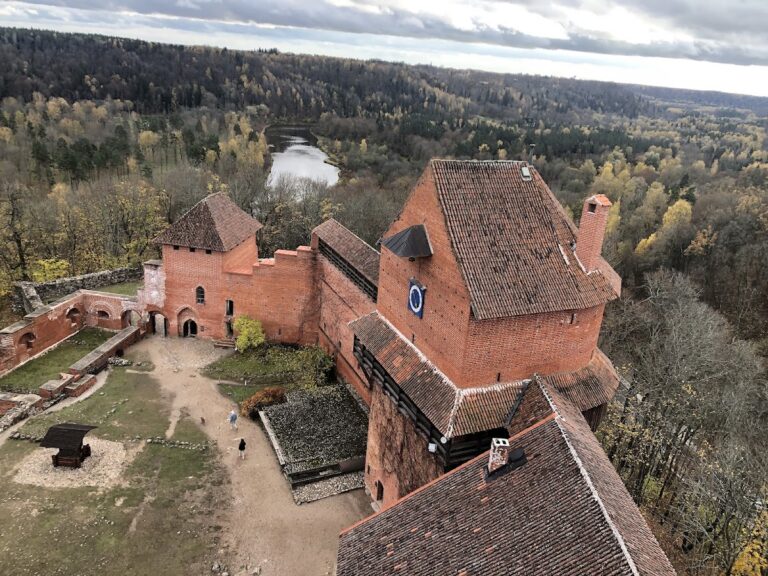
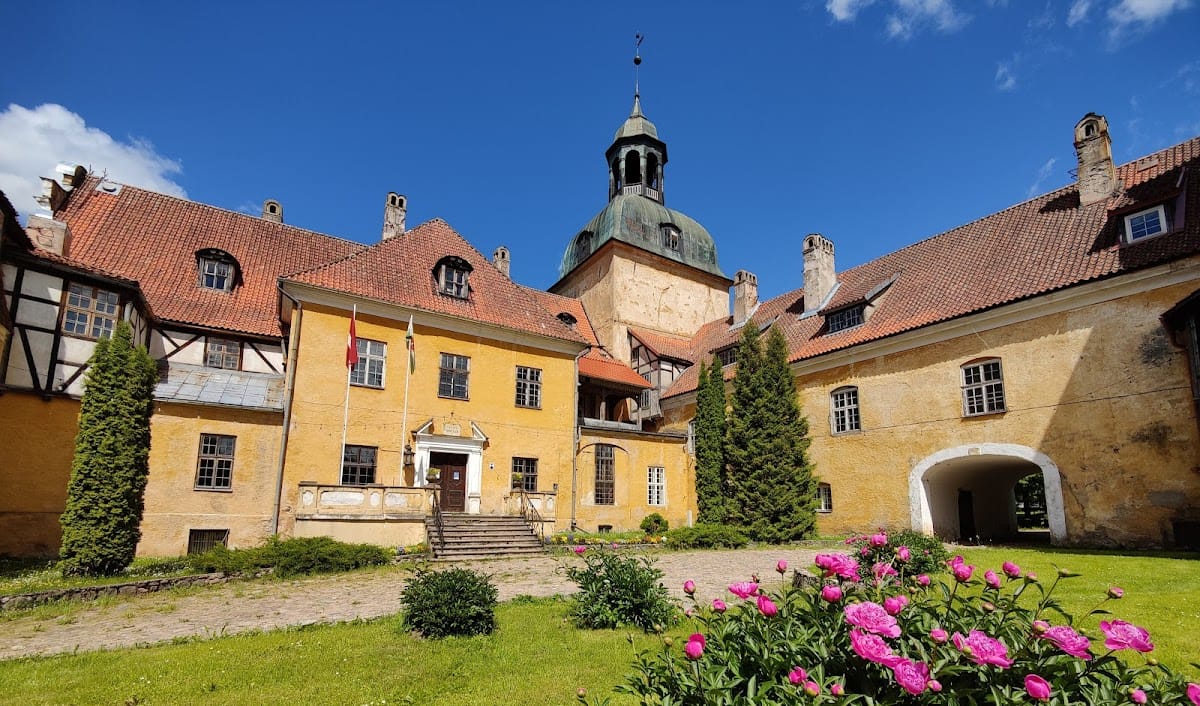
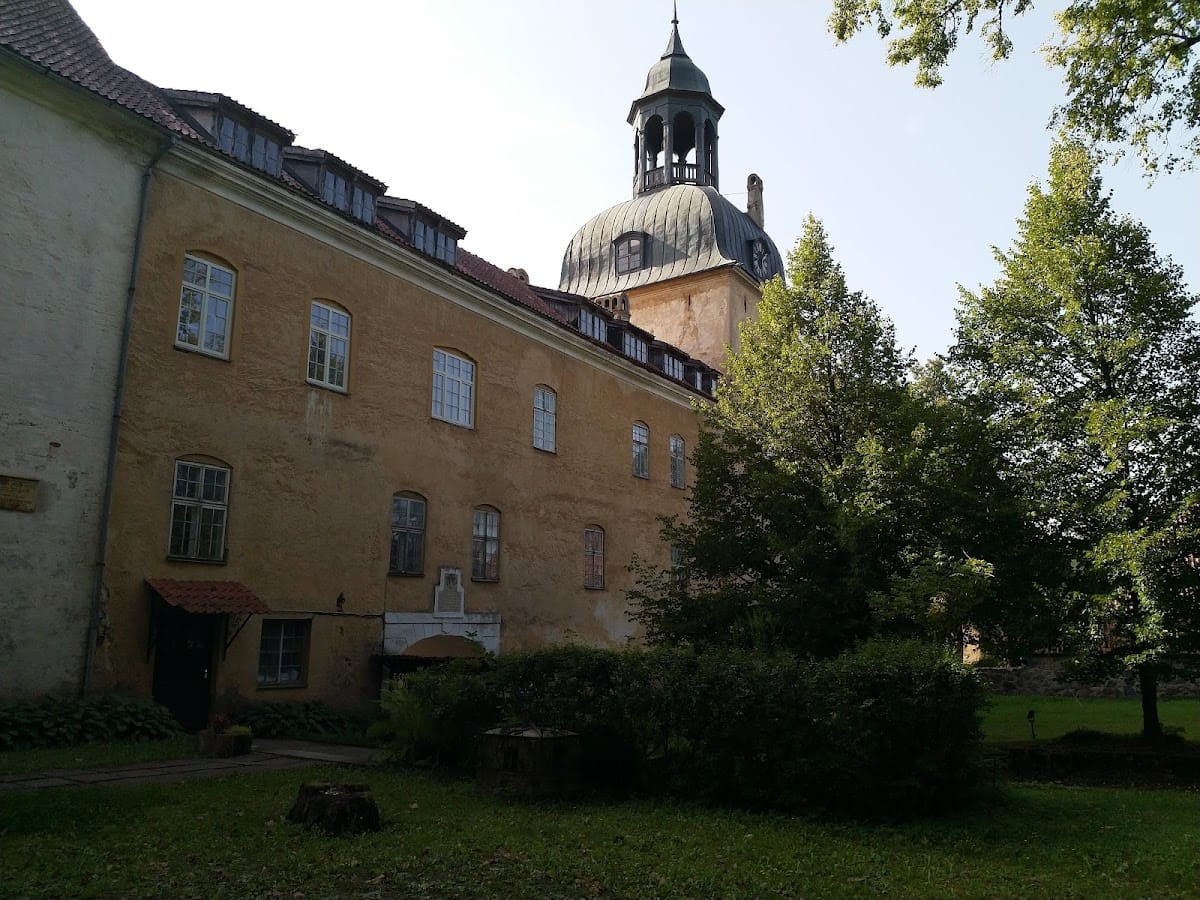
Lielstraupe Castle is arranged as a two-winged structure with the wings meeting at nearly a right angle, together enclosing an inner courtyard on two sides. The defensive character of the original fortress is especially evident along the southwest and southeast sides of this courtyard, where fragments of the medieval ring wall still stand, preserving the sense of fortified enclosure that characterized the site in the Middle Ages. The building primarily uses brick construction with walls plastered in yellow and white, typical of local architecture adapted over centuries.
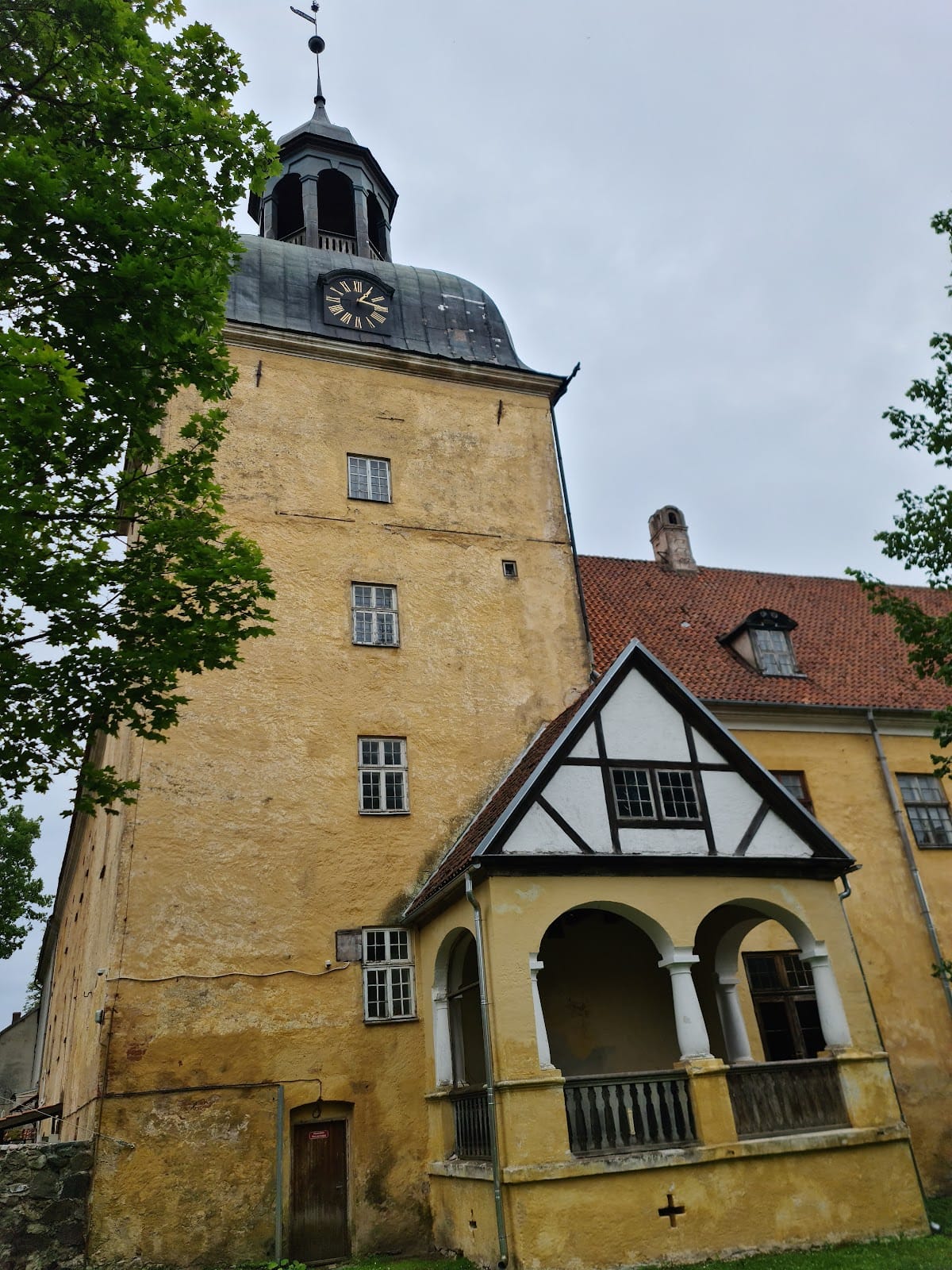
Dominating the junction of the two wings is a nearly square tower measuring about 9 by 9.45 meters, featuring walls up to four meters thick. This massive tower is considered the oldest surviving element, dating back to the original 13th-century fortress. It rises four floors high and is crowned by a Baroque curved roof topped with an open lantern and a weather vane dated 1743. Each side of this roof carries a clock face installed by a local craftsman, incorporating timekeeping into the castle’s silhouette. Remarkably, the tower’s clock mechanism includes wooden components, a detail preserved through restoration.
The northwest wing stretches 27 meters in length and originally measured 9 meters in width. Historically, it served as the primary residential area. Its southern gable echoes the 1727 gable of Riga Cathedral, reflecting aesthetic ties to regional ecclesiastical architecture during the 18th-century Baroque renovation. During this period, the wing was expanded and enhanced by the addition of a broken gable over a courtyard-facing portal and an adjoining vestibule. This portal bears a 1909 inscription marking restoration efforts following damage inflicted by the 17th-century fire.
Connected to the southwest corner of the northwest wing is a two-story rectangular building topped with a tiled hipped roof, known historically as the Knights’ Hall. The ground floor of this hall incorporates part of the medieval ring wall, demonstrating how defensive structures were repurposed into living and communal spaces as the castle evolved away from pure fortification.
The northeast wing, slightly longer at 27.8 meters and two stories tall, contains the main gate that opens onto the courtyard. Above this entrance is the von Rosen family coat of arms, alongside an inscription claiming a 1263 founding date. This inscription dates from the 19th century or later, reflecting later historicizing efforts rather than contemporary records.
Adjoining the northeast wing to the east is the castle’s Gothic church, a substantial structure 32.4 meters in length. Originally designed as a three-aisled building with vaulted ceilings, the church has been altered to a single nave, preserving vaulting only in the choir area. Architectural details such as wall pillars and remnants of shield arches remain as evidence of the former vaulted nave. Inside, the church features a painted pulpit dating from 1739 and stained glass windows in the apse designed by artist Sigismunds Vidbergs, installed between 1940 and 1941. The church also functions as a burial place for the von Rosen family, with gravestones including that of Georg von Rosen, who died in 1590.
The castle park covers the space once occupied by the medieval town of Straupe and its ancient cemetery. The park includes a pond and is planted with a mixture of native and exotic trees, including winter jasmine and balsam fir. In the far corner stands a wooden bell tower constructed in 1848, a distinctive landmark within the grounds. The surrounding cemetery holds historical significance as the burial site for plague victims from the 16th century up to 1775. Barons and pastors were interred separately in the church, with some baronial gravestones displayed in the church garden.
Inside the castle, much of the early 20th-century restoration work remains visible. Oak staircases, original door leaves, parquet floors, and glazed tile stoves survive, providing insight into the historic interior character upheld during the restoration following the 1905 fire. Together, these elements reflect the layered history of Lielstraupe Castle, showcasing its transformation from a medieval fortress to a noble residence, religious center, and modern institution.
Nearby sites