Landštejn Castle: A Medieval Fortress in the Czech Republic


Visitor Information
Google Rating: 4.7
Popularity: Medium
Official Website: www.hrad-landstejn.cz
Country: Czechia
Civilization: Medieval European
Site type: Military
Remains: Castle

History
Landštejn Castle is a medieval fortress constructed by the Bohemian civilization in the area of Landštejn, within the municipality of Staré Město pod Landštejnem in the present-day Czech Republic. Positioned strategically near the border with Austria, the castle was established as a key stronghold safeguarding important trade connections.
The fortress was probably founded in the early 1200s, most likely under the direction of King Přemysl Otakar I. Its construction aimed to secure the border territory against Austrian expansion, particularly countering a nearby castle held by the Zöbingen family. Initially, the castle belonged to the Margraviate of Moravia but passed under Bohemian control after 1222. The first written record dates to 1231 when Hartlieb of Landštejn was documented as its castellan, indicating the early establishment of its defensive and administrative roles.
Ownership soon passed to the noble family known as the Vítkovci, who adopted the title Lords of Landštejn. Noteworthy figures from this line included Sezema, who held the castle from 1261 to 1282, and Vilém I, who died in 1356. Vilém I played a notable role in regional disputes and conflicts tied to control over local trade routes. Upon his death, the castle reverted to royal hands.
In 1381, King Wenceslaus IV granted Landštejn Castle to the Krajířové z Krajku family. Under their tenure, it underwent significant expansion and renovation, adopting late Gothic and Renaissance architectural features. The castle’s military significance continued during the religious turmoil of the Hussite Wars. In 1420, it was besieged by Jan Žižka, a prominent Hussite leader, with archaeological studies confirming intense fighting and partial destruction by fire.
Throughout the 16th and 17th centuries, Landštejn changed ownership multiple times among various noble families such as Stephan von Eyczing, David Neumayer, the Mohrovs of Lichtenegg, the Khuen of Belasy, the Černín family, and eventually the Herbersteins, who maintained possession until 1816. The castle’s structure suffered damage in this period; a lightning strike during the mid-17th century harmed one of its Romanesque towers. Further devastation occurred in 1771 when a major fire destroyed much of the castle, leading to its abandonment and partial dismantling for building materials.
After World War II, the ruins were confiscated from the Sternbach family in 1945. Neglect led to further decay until volunteer efforts began clearing the site in the 1960s. Large-scale restoration began in 1972, though some reconstruction lacked attention to historical accuracy. By 1990, Landštejn was reopened. The castle is currently protected as a cultural monument managed by the National Heritage Institute.
Remains
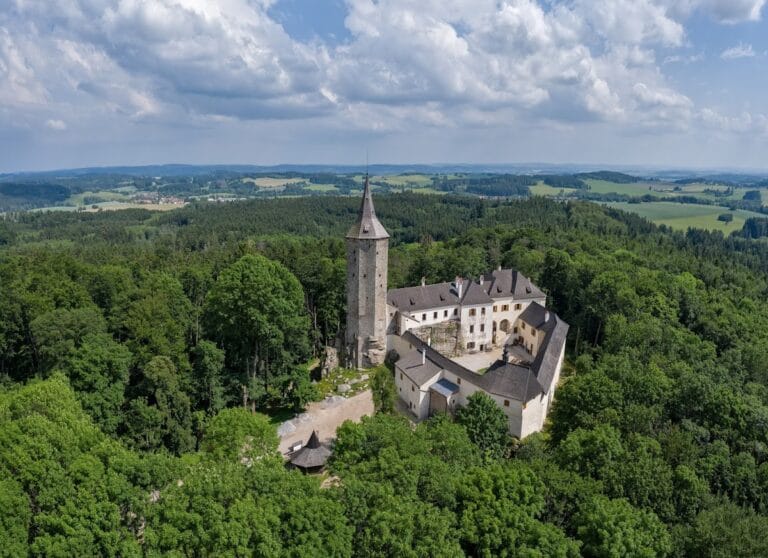
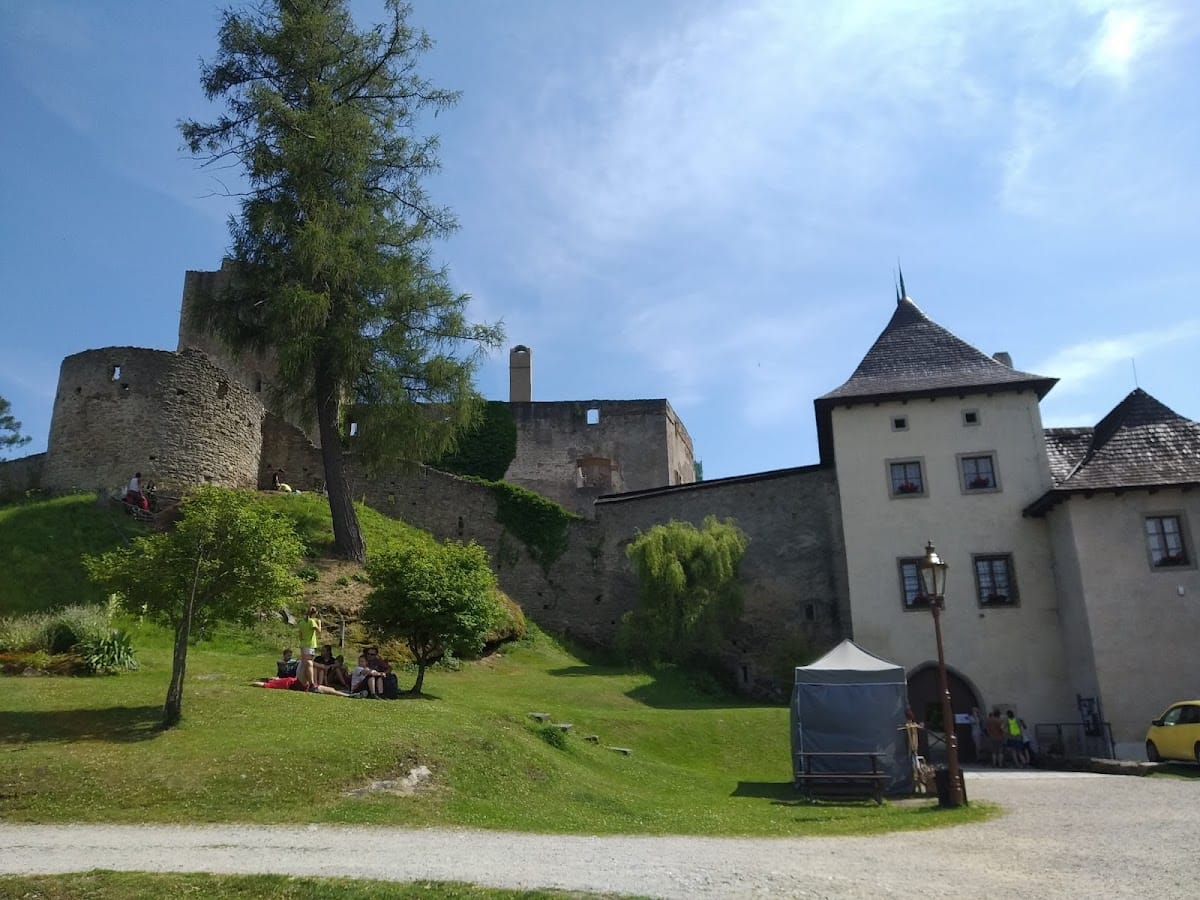
Landštejn Castle’s original design features a pentagonal layout, enclosed by a defensive stone wall with sturdy square towers at the northern and eastern corners. The eastern tower served as a bergfried, a tall, typically uninhabited tower used for defense and oversight, guarding the main entrance situated on the southeast side of the fortress. The northern tower had a residential purpose and included a small chapel built into its thick walls. This chapel had an apse, a semicircular recess typical in Romanesque structures, accessible from the castle’s main palace located between the two towers. The palace itself preserves an outer wall with corbels—stone projections—that once supported a wooden gallery for internal communication.
Within the southern corner of the castle grounds, a smaller building likely stood, but its precise function is less documented. During the 14th century, the castle’s defenses were expanded with the addition of an outer bailey (known locally as a parkán) and a forecourt, designed to strengthen protection against increasing military threats. As part of these developments, a new residential tower was constructed outside the southeast wall, and the original main gate was replaced with a new entrance in the southwest wall.
The ruling Krajíř family further enhanced the castle’s size and appearance. They completely rebuilt the old palace and added additional wings around the courtyard, refurbishing living spaces in the Renaissance style. Sgraffito decoration—a plaster technique creating layered designs—was applied to some interiors, reflecting artistic trends of the era. Fortifications were significantly reinforced by constructing polygonal bastions (multi-angled defensive walls) in the northern and eastern parts of the outer bailey. The castle’s southwest side gained three open semicircular bastions topped with battlements for mounting defensive weapons, illustrating advanced military architecture of the late medieval period.
Access to the forecourt was through two tower gates, while an encompassing moat and an earthen rampart provided added layers of defense. Around 1520, a new defensive wall with a shooting gallery was built to encircle the castle. This wall featured two semicircular open bastions and was complemented by a polygonal earth bastion on the southeast side, representing more modern military design aimed at resisting artillery.
Beneath the core of the castle lies an extensive network of cellars, though they are currently closed off due to ongoing reconstruction efforts. The original well near the western castle wall was replaced during renovations by a much deeper, 27-meter well located within the courtyard, ensuring a reliable water supply during sieges. In 1495, a new chapel dedicated to Saint George was constructed within the eastern palace wing, adding to the castle’s religious architecture.
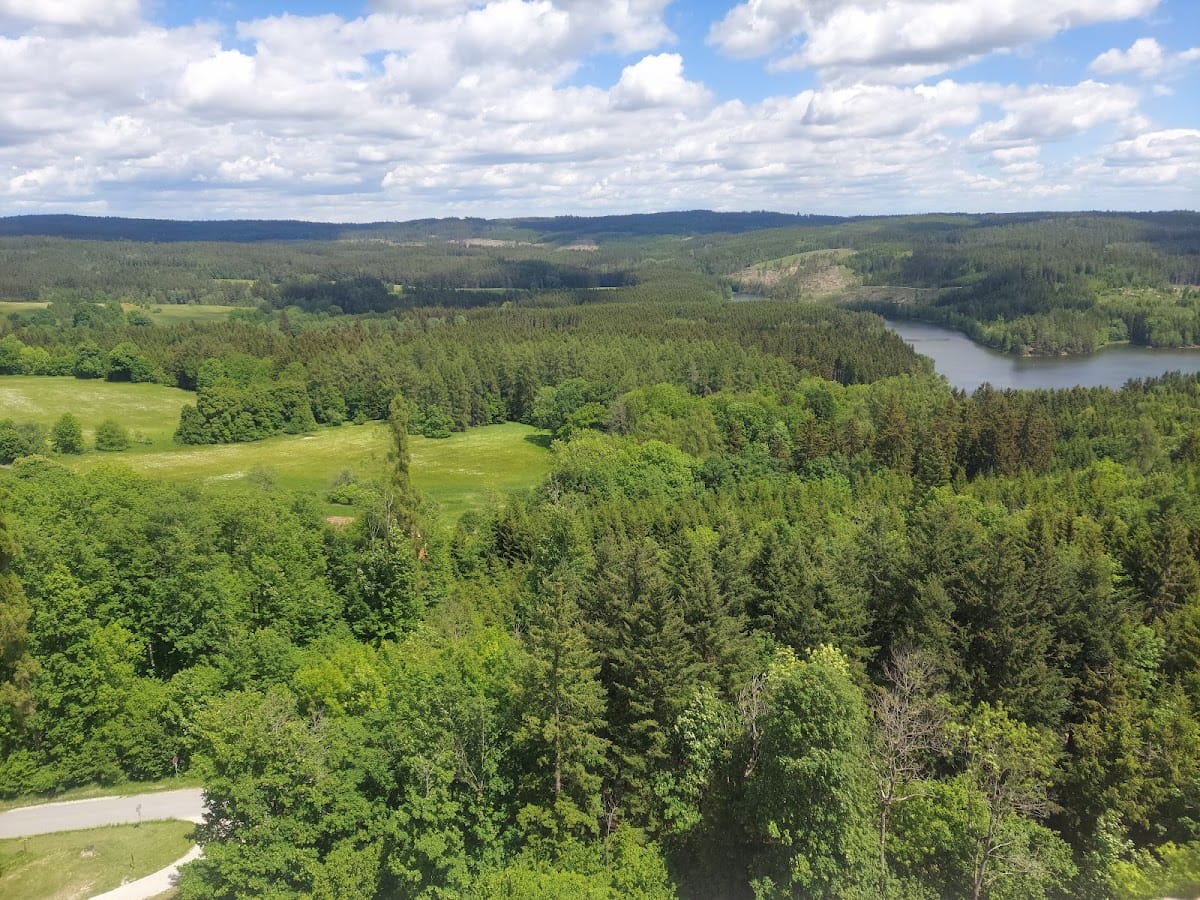
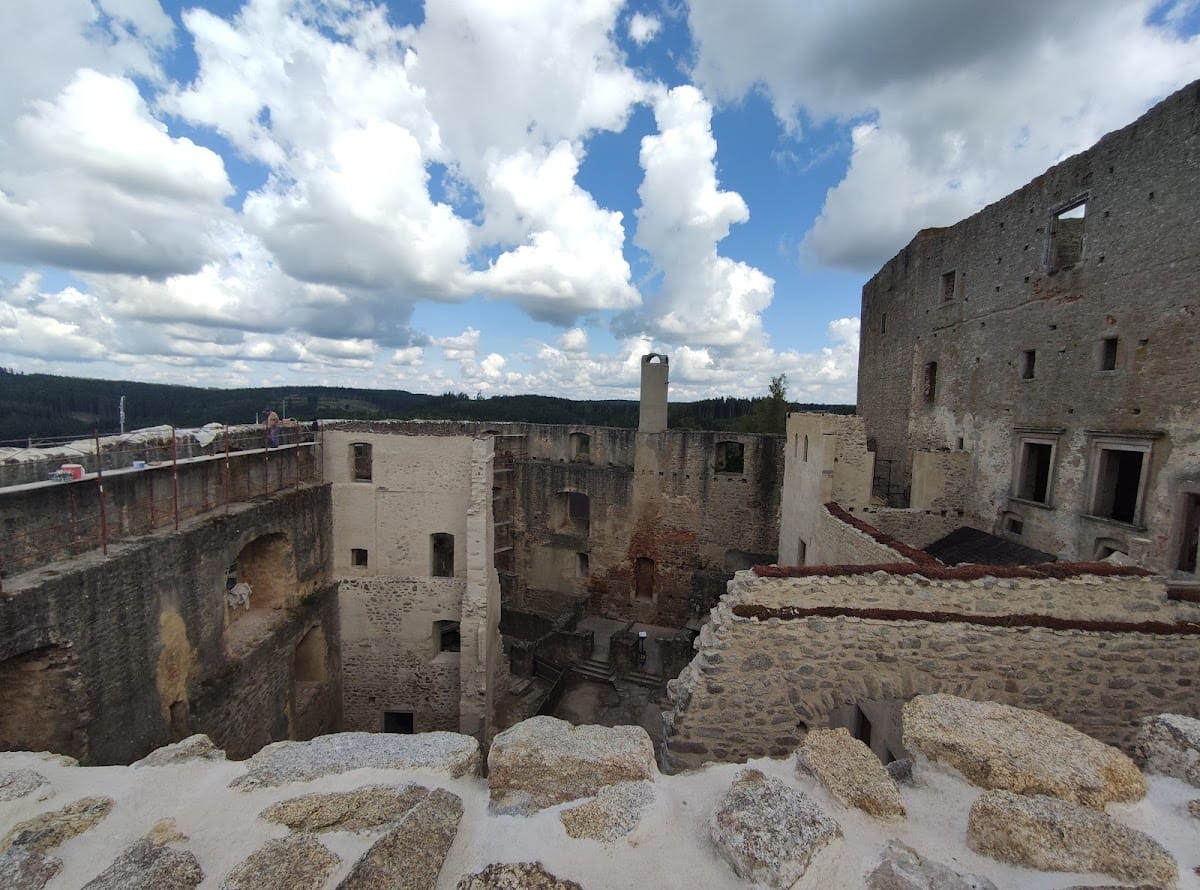
Today, significant portions of the original walls, two main towers, and the Romanesque chapel survive. However, the extensive restoration work carried out in the 20th century has affected the ability to study some earlier construction phases in detail. Visitors to the site can climb the large rectangular tower, known as Velká věž, via a wooden staircase. From its summit, the view extends across the surrounding landscape, reaching as far as the peaks of the Lower Austrian Alps on clear days.
Nearby sites