Burg Heidenreichstein: A Medieval Water Castle in Austria

Site at a Glance
- Rating
- 4.7
- Popularity
- Low
- Country
- Austria
- Primary era
- Medieval
- External website
- Open
- Eras represented
- Medieval, Early Modern
- Civilizations
- Duchy of Austria, Habsburg, Holy Roman Empire
- Site type
- Military
- Remains
- Castle
On this page10 sections
History
Burg Heidenreichstein is a medieval water castle in Heidenreichstein, Austria, probably founded between 1180 and 1190 by Austrian nobles of the Gars-Eggenburg family. Its Romanesque core was established to control two long-distance routes leading to Bohemia, giving the castle a strategic role in the northern Waldviertel.
Foundation and the County of Raabs
The castle and its settlement were probably founded by Heidenreich, son of Wolfker of Eggenburg. The Gars-Eggenburg family were vassals of the Counts of Raabs, a medieval dynasty that controlled much of the northern Waldviertel before its lands were divided through inheritance. The family was also probably connected to the wider Kuenringer network, one of the powerful noble lineages of medieval Austria.
The first written reference to the site dates from 1205, when Heidenreich’s brother Otto used the name Otto of Heidenreichstein. The place was also linked with Minnesang, the aristocratic tradition of courtly lyric poetry and song in medieval German-speaking Europe, because Heidenreich of Gars supported courtly singers.
After the death of Count Konrad of Raabs around 1191, his possessions were divided between his daughters. Sophia inherited the County of Raabs and, through her marriage to Friedrich III of Zollern, became an ancestress of the Hohenzollerns, the dynasty that later produced Prussian kings and German emperors. Agnes brought the western part of the county, including Litschau and Heidenreichstein, into her marriage with Gebhart of Hirschberg-Tollenstein.
Hirschberg, Kuenring, and Austrian Rule
The Counts of Hirschberg held the territories of Heidenreichstein and Litschau for about a century. They promoted the colonization of the border region, strengthening settlement and administration around the castle. In 1282, Gebhard of Hirschberg enfeoffed Leutold I and Heinrich IV of Kuenring with the two lordships. In 1297, authority over the Hirschberg possessions passed to Duke Albrecht I of Austria, bringing the lordship, castle, and town into the Austrian sphere.
Duke Friedrich I of Austria pledged Heidenreichstein and Litschau to Johann of Klingenberg in 1314. Johann’s successor, Heinrich of Klingenberg, was hereditary advocate of the Eisgarn Collegiate Foundation and died at the Battle of Crécy on 26 August 1346. In 1348, Duke Albrecht II granted both lordships as a fief to Albero V of Puchheim in exchange for the transfer of the Puchheim family’s ancestral castle in Upper Austria.
The Puchheim Lordship
The Puchheims became one of the most prominent noble families in Lower Austria. The branch living at Heidenreichstein soon adopted the castle’s name. From about 1400, the family substantially expanded the complex, although the work was interrupted by the Hussite Wars of 1425 to 1431. Hussite supporters and rebellious peasants besieged the castle during the conflict but did not capture it. A district court was attached to the lordship from the fifteenth century.
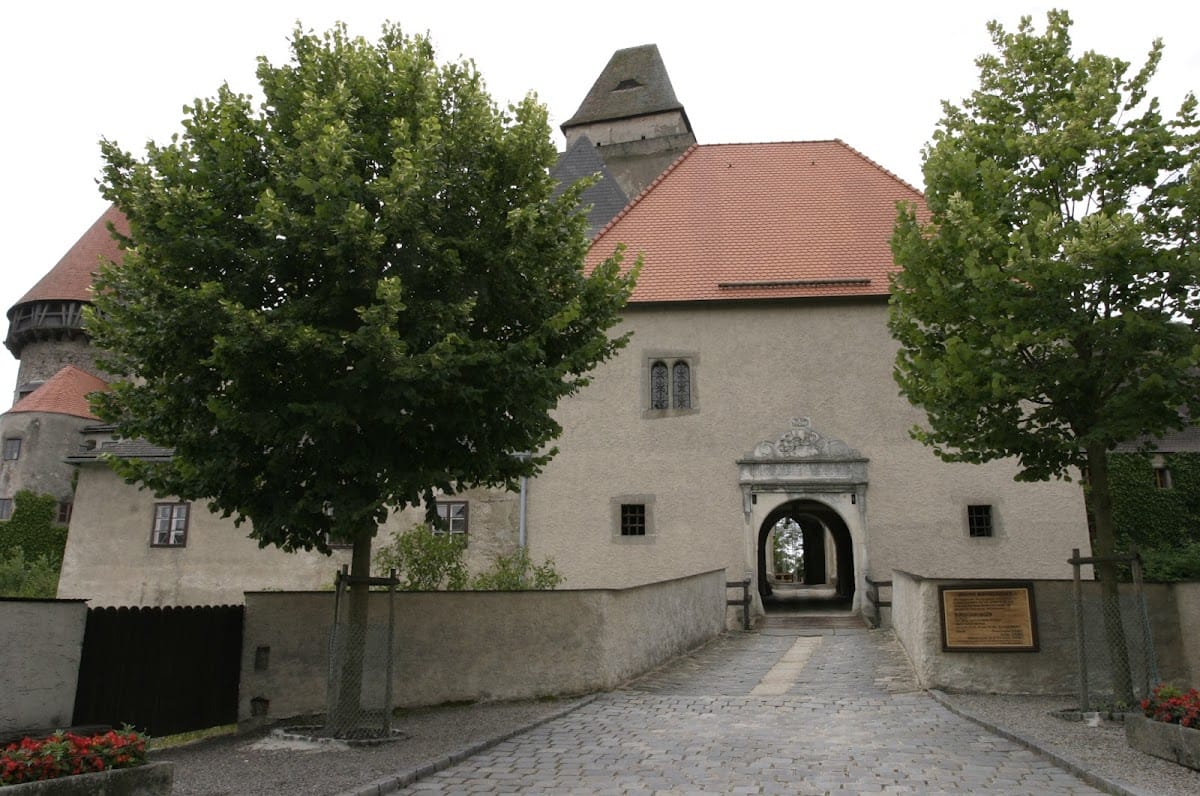
The family’s influence reached its height in the sixteenth century. Wilhelm of Puchheim served as Land Marshal of Austria from 1533 to 1541. This office combined senior political and judicial responsibilities within the estates. He also distinguished himself in fighting against the Turks in 1532. His son Friedrich Christoph and his brothers built the Renaissance outer fortification and gate during the 1540s, with an inscription above the entrance commemorating the work. Other Renaissance alterations made the residence more comfortable.
Around 1584, the Puchheims controlled 4,055 farmsteads, the largest number of subjects held by any Lower Austrian noble family. Their financial position later declined, and in 1636 the heavily indebted lordship passed through enforcement proceedings to Siegmund Adam of Traun.
Changing Ownership and the Pálffy Era
Ownership changed quickly after the transfer to Traun. The Zinzendorf family acquired Heidenreichstein in 1640, followed by the Khuen von Belasy family in 1643 and later the Volkra family. Otto Ferdinand Volkra was raised to Imperial Count of Heidenreichstein in 1670. An Imperial Count held a countship with status within the Holy Roman Empire, although the title did not necessarily mean direct ownership of every part of the territory named in it. Volkra later lost the lordship because of his debts.
Margaretha Marchesa degli Obizzi, born a Countess Pálffy, subsequently acquired Heidenreichstein and incorporated it into a fideicommiss for the Pálffy family. This was an inheritance arrangement intended to keep an estate together within a family and prevent its ordinary division or sale. Nikolaus V Pálffy, a field marshal and Palatine of Hungary, received Heidenreichstein as a fief in 1714. The Palatine was the highest-ranking official in the Kingdom of Hungary after the monarch and represented the monarch in important administrative and judicial matters. The Pálffy family held the estate for roughly three centuries, from the late seventeenth century into the twentieth.
Heidenreichstein was not attacked during the Bohemian conflict of 1621, although the town and surrounding area were burned. The castle had already withstood the Hussite siege, and a later account states that it also defended itself against Swedish troops during the Thirty Years’ War.
Twentieth-Century Continuity
Renovation work around 1900 introduced minor historicist alterations and wooden ceilings. The Pálffy line ended with Ladislaus, 5th Prince Pálffy, who died in Vienna on 19 January 1947 without issue. He left Heidenreichstein to his friend Rudolf Count van der Straten-Ponthoz.
Van der Straten-Ponthoz had served as an adjutant to Archduke Franz Ferdinand of Austria-Este and directed Vienna’s Spanish Riding School from 1919 to 1938. In 1961, the castle passed by inheritance to Christian Count Kinsky von Wchinitz and Tettau through his marriage to Rudolf’s daughter Josephine. It remains in the possession of the Kinsky family. The high castle is used as a museum during the warmer season, while the family occupies more easily heated buildings in the outer bailey. Heidenreichstein is among the few noble residences in the Waldviertel to have remained continuously inhabited. The outer courtyard is also used for summer theatre performances.
Austria’s postal service depicted Burg Heidenreichstein on a 10-schilling definitive stamp issued on 25 October 1957 as part of the Austrian Architectural Monuments series.
Remains
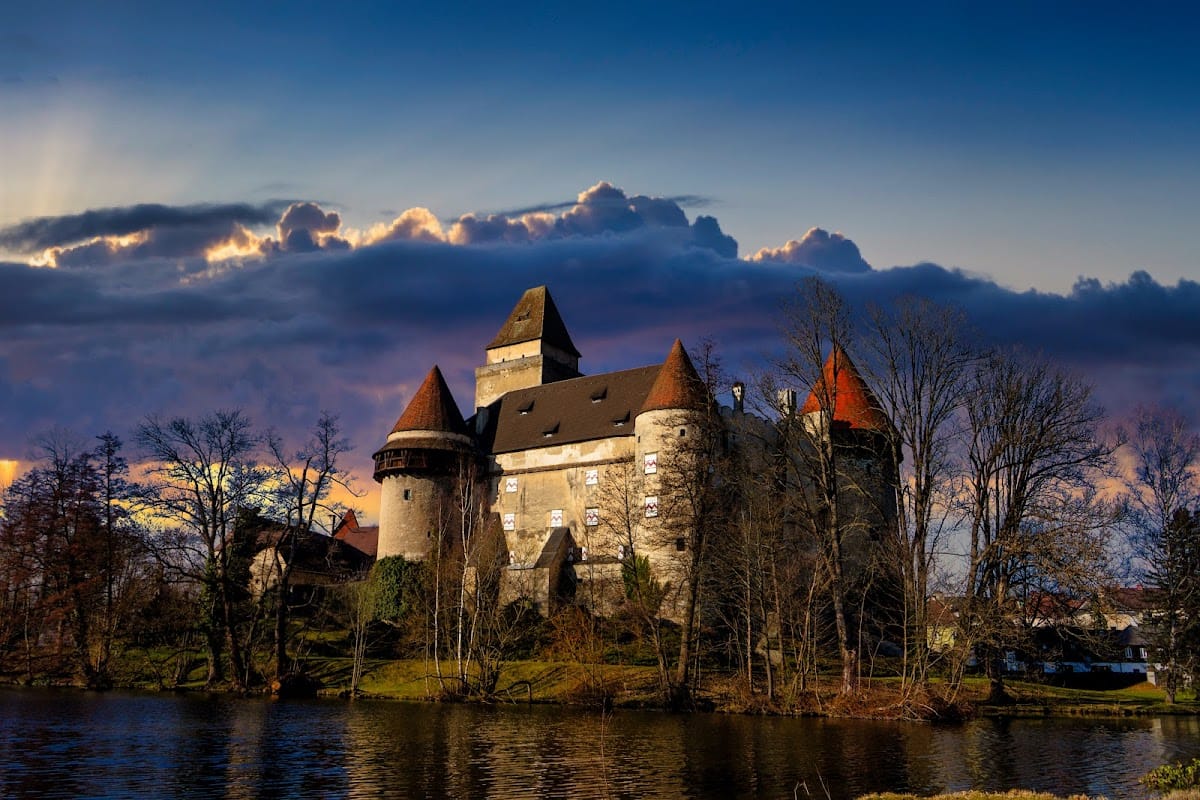
Burg Heidenreichstein is a Niederungsburg, or lowland castle, built on a rocky outcrop that rises only slightly above its surroundings. Its defenses depend on massive walls, towers, ditches, and water barriers. The Hauswehr pond lies south of the castle, the Romaubach runs to the east, and ditches border the site to the west and north. Parts of the western and northern water defenses have been filled.
Medieval Castle Core
The medieval complex developed around a high keep enclosed by walls and courtyard towers. The rectangular bergfried, the principal fortified tower of a medieval Central European castle, is the oldest part of the complex and may predate the main castle. It was probably built around 1160, before the castle’s likely foundation between 1180 and 1190. The tower rises about 42 metres, and its walls are stated to reach a thickness of up to 45 metres. A concealed passage runs within the tower wall.
The austere exterior has very few windows above the water, reinforcing the defensive character of the medieval core. The castle is approached across two drawbridges and through Renaissance gateways. Round corner towers carry steep, conical roofs, while the largest tower has a projecting roof that shelters its battlement walkway.
Outer Defenses and Courtyard
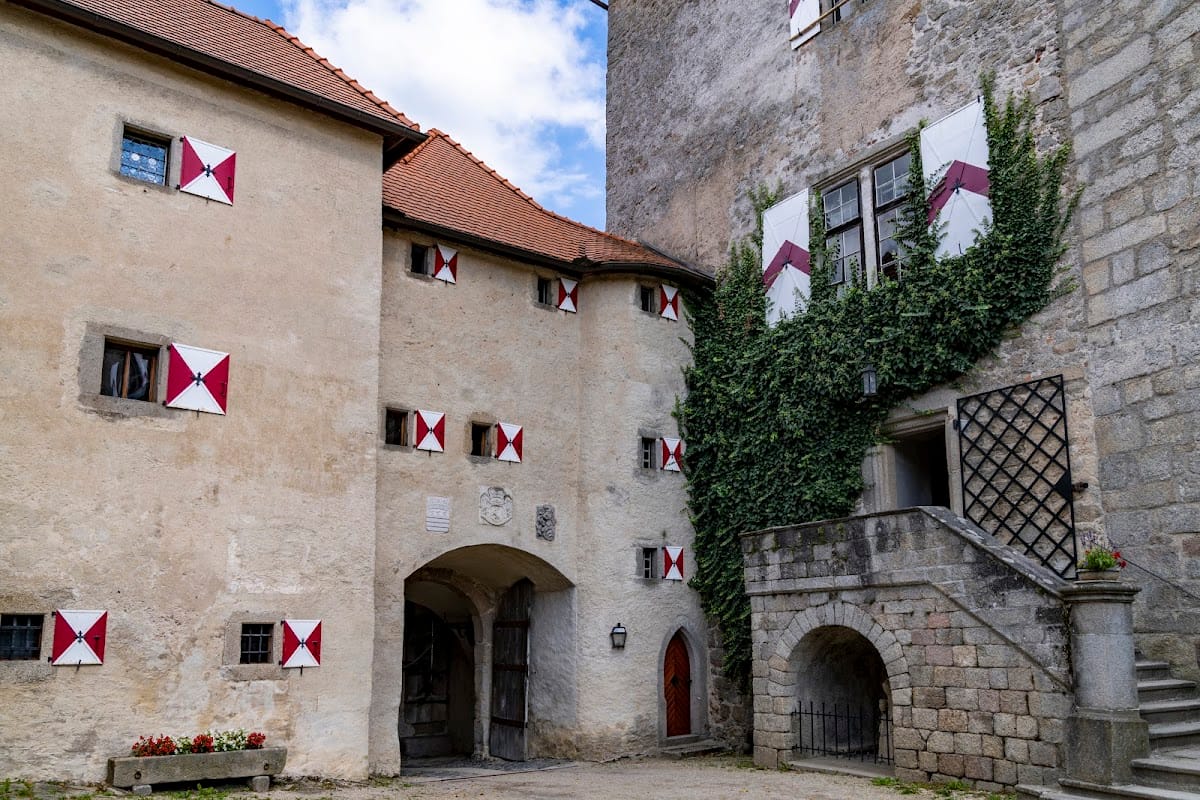
An outer courtyard was added west of the Romanesque high castle, and additional towers strengthened the perimeter. Most of the economic and service buildings belong to rebuilding campaigns of the fifteenth and sixteenth centuries. The outer forework and its gate were constructed in the 1540s as part of the Renaissance defensive expansion.
The Renaissance work also produced a short arcaded passage in the inner courtyard. Its ceiling has cross-rib vaulting, and it stands in front of the medieval smoke kitchen. The surviving arrangement brings together the fortified medieval core, the later defensive additions, and the service buildings that supported the lordship.
Roof, Hall, and Interior Collections
The predominantly Gothic roof framework consists of hewn beams joined with carved wooden pegs, and the roof remains covered with wooden shingles. On the first floor, a large hall formerly used as a knights’ hall measures about 27 metres in length and was once about 12 metres high. Its form has been compared with the hull of a ship.
The interior furnishings span several periods. Gothic tables and chests survive, including a table made from a single slab of thousand-year-old maple. The castle also contains what is described as Austria’s oldest surviving wooden cupboard, Baroque polychrome tiled heating stoves from the mid-seventeenth century, and collections of old armor and weapons. A remnant of the castle chapel survives, and the large attic forms part of the guided visit. Exhibits and personal belongings associated with the Kinsky family are displayed within the castle.
Nearby sites