Kerkouane: An Ancient Punic City in Tunisia



Visitor Information
Google Rating: 4.4
Popularity: Low
Google Maps: View on Google Maps
Country: Tunisia
Civilization: Phoenician
Remains: City

History
Kerkouane is an ancient city built by the Punic civilization, located in the municipality of Kerkouane in modern-day Tunisia. It occupies a cliffside position at the tip of Cape Bon in the northeast of the country.
The earliest known activity at Kerkouane dates back to the 6th century BC, marking its origins in the early period of Phoenician expansion along the North African coast. However, the most visible remains of the city come from a later phase, primarily from the late 4th century to the first half of the 3rd century BC. During this time, Kerkouane developed into a well-planned urban settlement.
Kerkouane’s prosperity is noted in historical accounts such as those by Diodorus Siculus, who described the region before the invasion of Agathocles of Syracuse in 309 BC. The area was known for its luxurious country houses, extensive gardens, and private estates owned by wealthy Carthaginians, indicating a thriving community with strong ties to Carthage.
Following Agathocles’ expedition, a tower was constructed overlooking the sea, likely intended as a lookout or defensive structure. Despite this, the city faced significant challenges during the First Punic War (264–241 BC). Archaeological evidence, including coinage that lacks silver types minted only after 241 BC, suggests that Kerkouane was pillaged by Roman forces after their conquest of the nearby city of Aspis in 255 BC. Unlike other major Punic cities such as Carthage, Hadrumetum, and Utica, Kerkouane was abandoned around 250 BC and was never rebuilt or reoccupied by the Romans.
Religious practices in Kerkouane show clear Carthaginian influence, with artifacts and terracotta heads suggesting the worship of deities such as Melqart, Sid, and Tanit. The symbol of Tanit, often depicted with a crescent moon and solar disc, appears on tombstones and mosaics.
The nearby Necropolis of Arg el Ghazouani, located less than a kilometer from the town, contains well-preserved Punic funerary architecture and tombs scattered across the coastal hills of Cape Bon. This necropolis provides further insight into the burial customs and material culture of the inhabitants.
Kerkouane was rediscovered in 1952, although it had been noted earlier in the 1893 Archaeological Atlas of Tunisia as a large ancient village. Its ruins remain a unique example of a Phoenicio-Punic city, leading to its designation as a UNESCO World Heritage Site in 1985. Today, the site faces environmental threats from rising sea levels and coastal erosion linked to climate change.
Remains
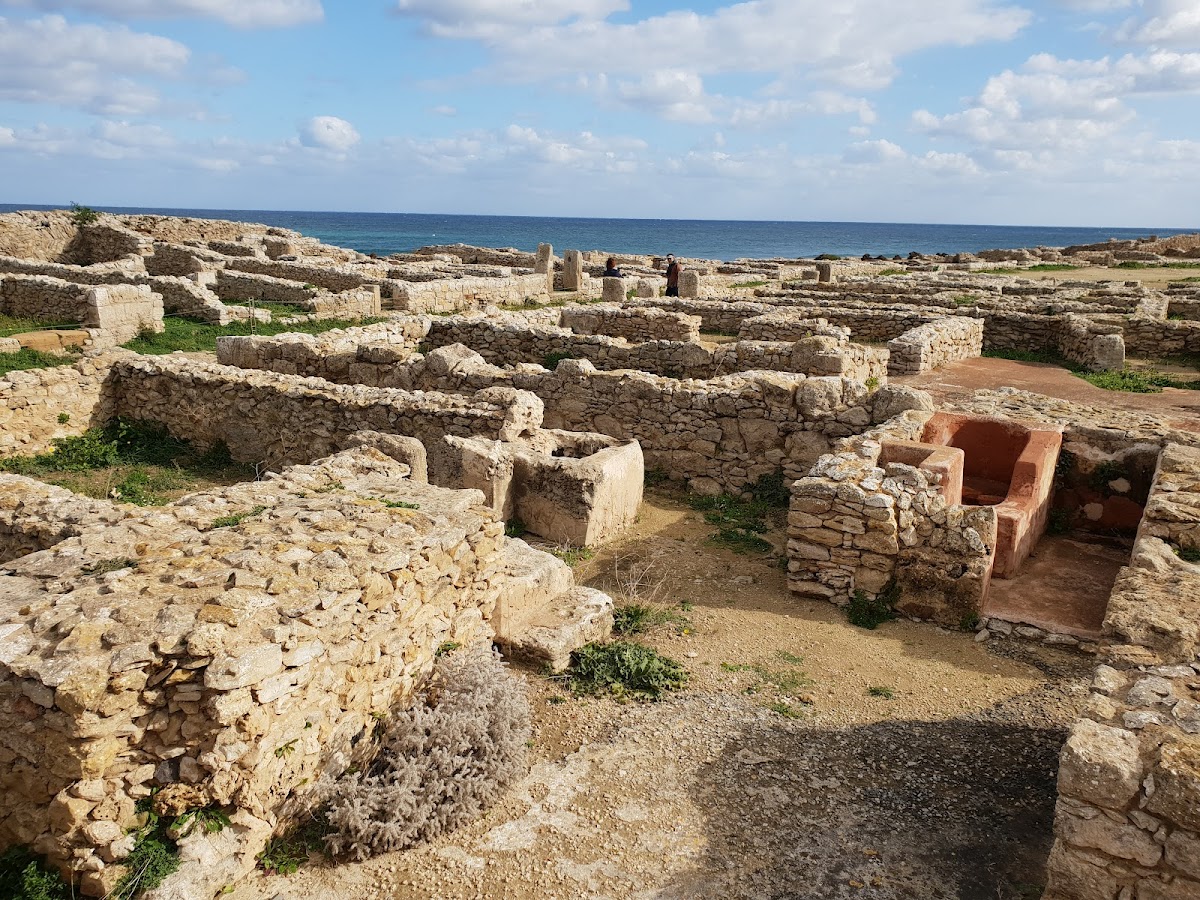
The urban layout of Kerkouane is distinctive among ancient Mediterranean cities. Rather than following the strict grid pattern common in Greek and Roman towns, its houses are mainly arranged along a crescent-shaped street. The main buildings cluster near the center but are not positioned at street intersections, reflecting a unique approach to city planning within the Punic world.
Residential structures typically have a long rectangular form. Upon entering, one encounters a public hall, followed by stairs leading to upper bedrooms. A small courtyard provides natural light to the interior spaces. This design closely resembles houses found beneath the Forum of Roman Carthage, indicating continuity in architectural traditions. One notable example, the House of the Central Courtyard, features advanced amenities such as a well, a waterproof basin that may have served as a bathtub, and a drainage channel directing household waste into street sewers. Floors in some houses were made using broken terracotta jars mixed with small white calcareous stones, a technique known as pavimenta punica. This flooring includes mosaics bearing the symbol of the goddess Tanit, a decorative element that was once criticized by the Roman statesman Cato the Elder for its luxury.
Decorative features throughout the city include stucco plaster, peristyle courtyards (open courtyards surrounded by columns), and mosaics with religious motifs. Some mosaics prominently display symbols associated with Tanit, underscoring the spiritual significance of these designs.
Near the town center, archaeological evidence points to the existence of a public bath complex. This facility was simpler than typical Roman baths, lacking a hypocaust heating system (an underfloor heating method) and a swimming pool, known as a natatio. Its design suggests a more modest approach to communal bathing.
At the heart of Kerkouane lies a temple complex composed of three adjoining halls and a raised platform or podium supporting the cella, the inner chamber where statues of likely three deities were placed. Finds such as animal bones, ashes, and fragments of wine jars indicate that ritual sacrifices took place here.
Defensive structures include visible remains of the western gate and city walls. A ramp at the southern end of the town was used to drag ships ashore, representing the only surviving element of the harbor facilities. Additionally, a northern tower built after Agathocles’ invasion offers a commanding view over the sea, although it was probably ineffective during later military conflicts such as the First Punic War siege.
Artifacts recovered from Kerkouane and its nearby necropolis reveal cultural connections beyond the Punic world. Items such as a fish dish, griffin motifs, and cinerary urns show influences from the Hellenistic world, the Etruscans, and the city of Capua. Tombstone reliefs bearing the symbol of Tanit, often depicted with a crescent moon and solar disc, demonstrate the persistence of Punic religious iconography into the Roman era in North Africa.
Together, these remains provide a rich picture of Kerkouane as a small but sophisticated Punic settlement, with distinctive urban planning, religious practices, and cultural ties that reflect its place within the wider Mediterranean world.


