Castle of Pornic: A Medieval Fortress Controlling the Port


Site at a Glance
- Rating
- 4.4
- Popularity
- Low
- Country
- France
- Primary era
- Medieval
- External website
- Open
- Eras represented
- Medieval, Modern
- Civilizations
- Duchy of Brittany
- Site type
- Military
- Remains
- Castle
On this page8 sections
History
The Castle of Pornic is a fortified castle in France with origins in a tenth-century wooden stronghold built to defend the port and control access to the Bay of Bourgneuf, a coastal inlet on France’s Atlantic shore. Its present appearance largely reflects a nineteenth-century restoration in the Italianate spirit of the Château de Clisson.
Medieval foundation and rebuilding
In the tenth century, Alain Barbetorte, Duke of Brittany, established and fortified a wooden castle on the defensive site above Pornic’s port. A garrison occupied the fortress and guarded the entrance to Pornic, giving the site a military role connected to control of the port and the bay.
During the twelfth century, the Lords of Rais owned the castle and rebuilt it in stone. The stronghold served both defensive and residential purposes, combining protection of the harbour with the needs of its noble occupants.
Gilles de Rais and the Barony of Retz
In the fifteenth century, the castle belonged to Gilles de Rais, a French nobleman whose ownership later gave rise to its traditional name, the Castle of Bluebeard. John V, a later Duke of Brittany, confiscated the property during Gilles de Rais’s trial.
The castle formed part of the Barony of Retz, a historic feudal territory around Pornic. In 1778, Marquis Alexandre de Brie-Serrant acquired the barony. His property was confiscated during the French Revolution, and unsuccessful financial investments later ruined him. By the time of his death in 1814, the castles of his duchy stood in ruins.
Nineteenth-century restoration
During the nineteenth century, the castle passed to the bankers Casimir Perier, Jacques Laffitte, and Philippe-François-Didier Usquin, who were creditors of the marquis’s estate. Joseph Le Breton, a Nantes municipal deputy and founder of a seawater-bathing establishment, purchased the property in 1824 and began its initial restoration.
In 1886, Le Breton’s descendants commissioned the Nantes architect François Bougoüin to restore the castle and create the appearance it largely retains today. The property is privately owned by the Vogüé family. The towers, surviving sections of the curtain walls, and the access ramps have been listed as historic monuments, a French heritage designation for buildings or remains recognized for historical or architectural value, since 1986.
Remains
Fortified complex
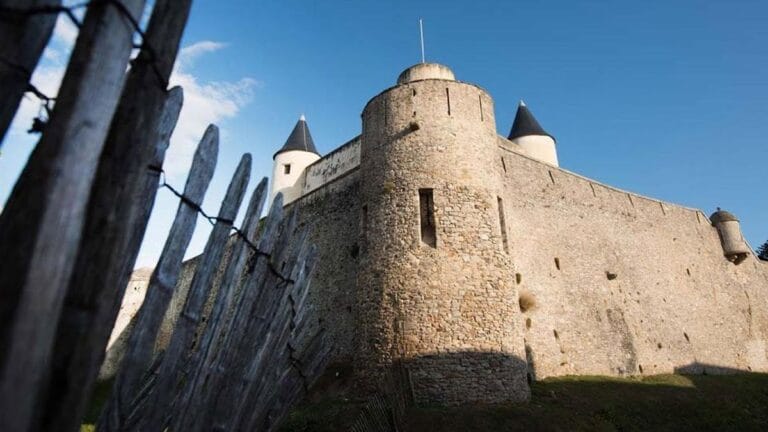
The castle occupies the northern bank of Pornic’s port, with the ocean bordering one side. Its surviving form is a restored fortified complex composed of towers, sections of curtain wall, and access ramps. A curtain wall is the fortified wall linking towers around an enclosed stronghold. Together, these elements reflect the site’s medieval defensive arrangement and its position overlooking the port.
Towers and curtain walls
The towers remain among the principal visible parts of the castle. Sections of the medieval curtain walls also survive, while other portions were restored during the nineteenth-century works. The complex is now used as a privately owned residence.
Access ramps and restored elevations
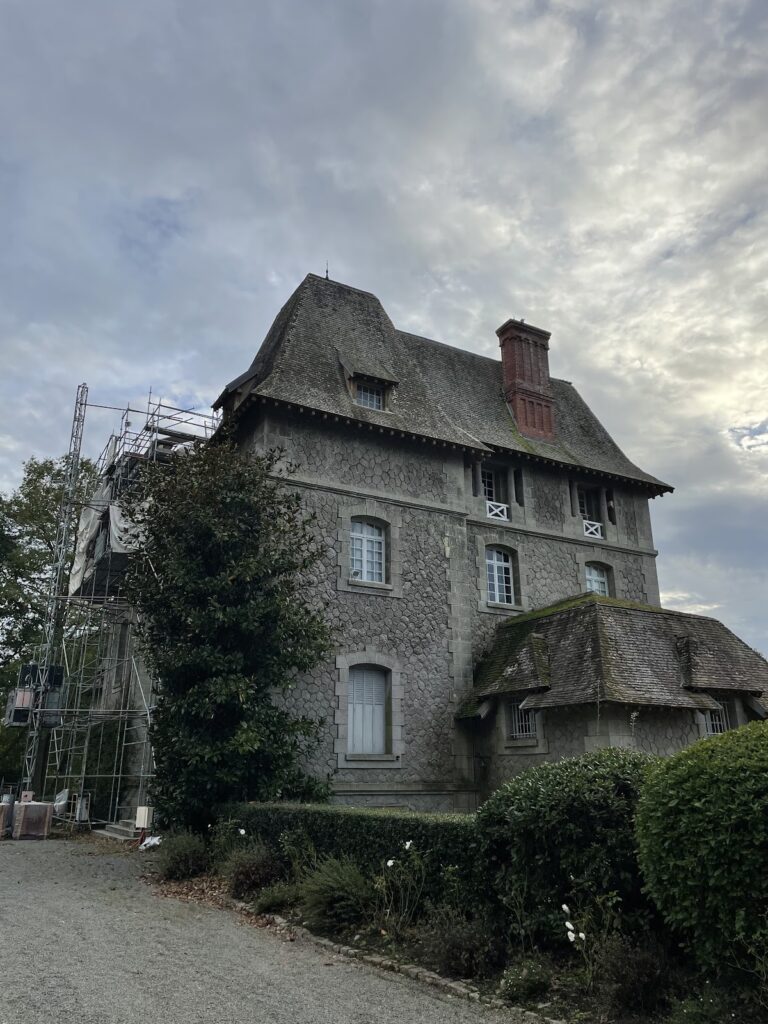
Access ramps form part of the surviving approach to the fortified complex. The nineteenth-century restoration gave the elevations fully arched windows fitted with brickwork, following the Italianate architectural spirit associated with the Château de Clisson. These restored details shape the castle’s present appearance while standing alongside its older defensive remains.