El Haouaria Punic Caves: Ancient Quarry Site in Tunisia


Site at a Glance
- Rating
- 4.3
- Popularity
- Low
- Country
- Tunisia
- Eras represented
- Classical
- Civilizations
- Phoenician
- Site type
- Economic
- Remains
- Quarry
History
El Haouaria Punic Caves, in El Haouaria, Tunisia, were first developed by the Punic civilization. The earliest phase began in the 7th century BC when the cavities were opened as sandstone quarries under Punic control. Stone cut from these workings was sent by sea to Carthage and used in that city’s buildings, including some of its earliest burial places, establishing a close economic link between the promontory and the Carthaginian metropolis.
Classical-era sources record the place under the Greek name Hermaea. The periplus of Pseudo Scylax, a coastal sailing guide called a periplus, refers to Hermaea as a polis (a Greek city-state) and as a maritime port, showing its recognition in Mediterranean navigation and settlement networks. In 310 BC the site is noted in connection with a landing by Agathocles, the Syracusan ruler.
Under Roman influence the locality continued to be worked, carrying the Roman name Merkourion and occupying the headland that Romans called Promunturium Mercurii, the Roman place-name for the projecting coastal point. Literary authors such as Diodorus of Sicily and Strabo identify the stone quarried here, calcareous tufa, as a material used in regional architecture. Byzantine historian Procopius, writing in the sixth century AD, records that a temple dedicated to Hermes stood at the location, attesting to enduring religious associations tied to its ancient names.
Remains
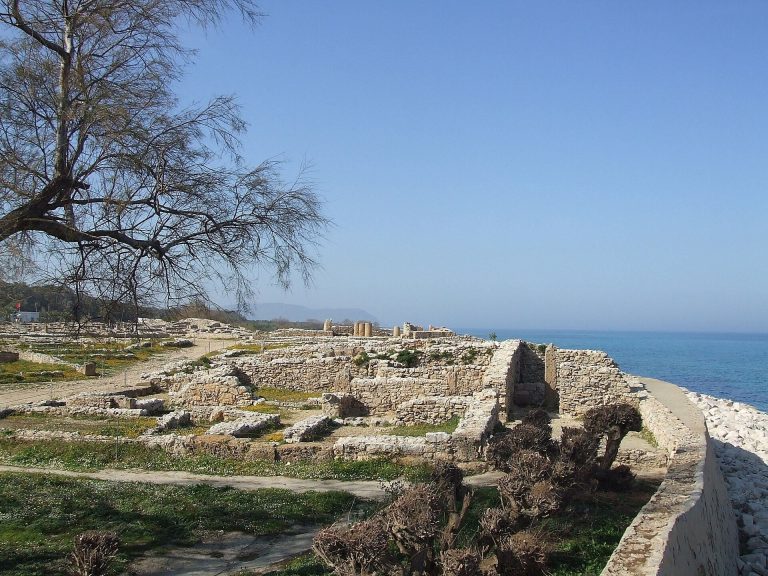
At ground level the site presents a line of narrow, roughly rectangular openings that mark the tops of vertical shafts. Each opening descends into a large man-made cavity; the overall plan reads as a series of hollowed chambers arranged in sequence along the shoreward promontory. The method of working is consistent across the complex, so the pattern of surface openings and below-ground hollows can be read as the product of a single, long-lived quarrying technique.
The underground voids are notable for their bulbous, carafe-like form produced by successive removal of blocks, and some of the larger spaces take on a pyramidal or conical profile where stone was extracted downward. These hollows date to the Punic beginnings of quarrying in the seventh century BC and show continued use into Roman times. The rock taken from the quarry is calcareous tufa, a soft, carbonate-rich stone that carves readily but is fragile; when used in construction it required protective plaster coatings for consolidation and finishing. Historical writers name this material in connection with building programs in the region.
Immediately surrounding the shaft mouths are clear signs of aerial, or open-air, quarrying above the subsurface workings, indicating that extraction took place both at surface level and beneath it. Where narrow vertical openings connected the surface to the chambers, it is likely that hoisting devices were set over the shafts to raise blocks, which were then loaded onto ships for coastal transport; the stone’s recorded destination was Carthage, across the Gulf of Tunis. The quarries occupy the headland near Ghar El-Kebir and match the ancient references to the promontory called Promunturium Mercurii in Roman sources.
The state of preservation allows identification of the shaft apertures and the inner cavities, so visitors and researchers can observe the consistent carving method and the sequence of worked rooms. These features, taken together, make the site an informative example of ancient stone extraction on a coastal promontory and illustrate how a local resource was shaped and moved to support building programs over many centuries.