Kamerlengo Castle, Trogir: A Venetian Fortress in Croatia


Visitor Information
Google Rating: 4.5
Popularity: Medium
Google Maps: View on Google Maps
Official Website: www.pou-trogir.hr
Country: Croatia
Civilization: Medieval European
Remains: Military

History
Kamerlengo Castle is situated in the historic town of Trogir, Croatia. Its origins tie closely to the area’s long and varied past, reflecting the influence of different civilizations that controlled the region over centuries.
Trogir was originally established by Greek settlers in the 3rd century BCE and later became a Roman municipality in the 1st century CE. Throughout the medieval period, the town experienced shifts in governance, moving under Byzantine authority, then Croatian-Hungarian rule. This complex history set the stage for the arrival of Venetian power in the early 15th century.
The earliest military structure on the site was a polygonal tower called the Tower of Chains, constructed around 1380. This fortification served as a key defensive point overseeing the sea channel leading to Trogir’s port. After Venice captured the city in 1420, extensive construction was undertaken to expand and strengthen the defense, resulting in the castle as it is recognized today. Between 1420 and 1437, Venetian authorities commissioned the building of Kamerlengo Castle, guided by master builder Marino Radoje and military engineer Lorenzo Pincino from Bergamo.
The castle’s name derives from the title “camerlengo,” a Venetian official responsible for overseeing the city’s financial and military matters, who lived within its walls together with the castellan and the stationed garrison. Under Venetian rule, lasting until 1797, the fortress was a focal point for military operations and storage, including oil production facilities. However, when the threat from the Ottoman Empire diminished and Habsburg rule began, Kamerlengo’s military purpose waned. By the 19th century, the fortress was largely abandoned, and some internal structures such as the castellan’s residence and the chapel dedicated to St. Mark were demolished.
Today, the castle remains emblematic of Trogir’s Venetian period and its role in maritime defense and administration spanning several centuries.
Remains
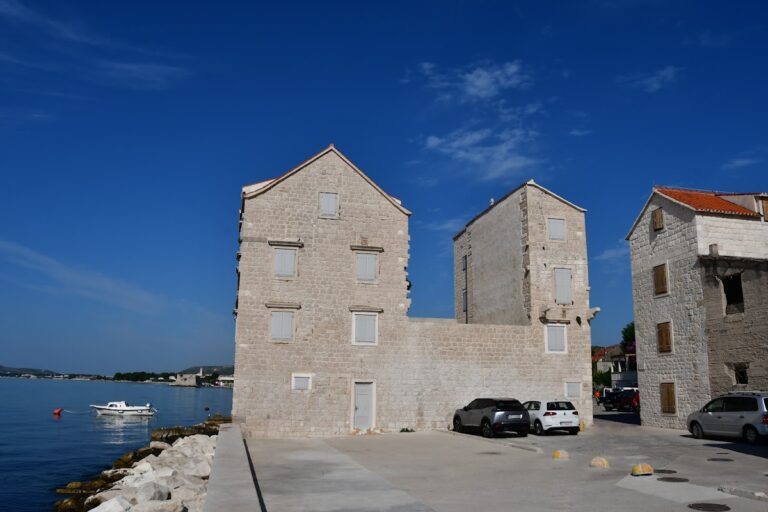
Kamerlengo Castle is laid out on a trapezoidal plan, surrounded by tall defensive walls built primarily from stone. The fortress’s most prominent feature is a large, nine-sided tower roughly 20.5 meters high, which faces the sea. This tower occupies the site of the earlier Tower of Chains from the late 14th century and served as the main point of defense overlooking the harbor entrance.
The walls of the castle are fortified with machicolations, which are openings between the supporting corbels of the battlements allowing defenders to drop objects on attackers below. Along these walls are carved heraldic emblems including the famous Lion of St. Mark, symbolizing Venetian authority, as well as coats of arms belonging to Doge Francesco Foscari, Admiral Pietro Loredan, and Maddalena Contarini, a local ruler of Trogir.
Additional defensive measures include a substantial retaining wall supporting the outer fortifications and a broad defensive ditch located on the northern and eastern sides of the castle. Beyond the main walls, an outer protective wall was constructed several meters away to provide resistance against heavy artillery fire. The castle’s northern entrance features a lunette, a half-moon shaped defensive element above the gate, combined with a drawbridge that originally spanned a moat separating the fortress from the rest of Trogir. Access to the mainland is provided by an old stone bridge and a movable bridge connects the fortress to the nearby island of Čiovo across the Trogir channel.
Inside the castle courtyard, there once stood residential buildings meant for the castellan and the military garrison, along with a chapel dedicated to St. Mark, both removed during the 19th century. A well remains within the courtyard, which was intentionally filled with sand to ensure the fortress could sustain itself during sieges or internal unrest. The castle’s corner towers are equipped with embankments formed by piled stones designed to prevent enemy warships from docking directly alongside the walls.
Today, the main gate of Kamerlengo Castle remains intact and accessible, preserving much of the original form and defensive character established during the Venetian era. Adjacent to the northern wall, a modern football field accommodates local sports activities, highlighting the castle’s integration with contemporary community life while the tower provides an elevated platform offering views of the surrounding area. The open courtyard continues to serve as a space for cultural gatherings during the warmer months.
Nearby sites