Gaujiena Castle: A Medieval Fortress in Latvia



Visitor Information
Google Rating: 4.6
Popularity: Low
Google Maps: View on Google Maps
Country: Latvia
Civilization: Medieval European
Remains: Military

History
Gaujiena Castle is located in the municipality of Gaujiena in modern-day Latvia. It was built by the Livonian Order, a military and religious order active in the Baltic region during the Middle Ages.
The earliest historical mention of the area around Gaujiena Castle appears in the Novgorod Chronicle in 1111, when the region known as Atzeli was recognized as part of a larger territory spanning northeastern Latvia, southern Estonia, and the Russian borderlands. In 1224, after the Treaty of Tālava was agreed upon, this territory was divided: the northern third, including the future site of the castle, came under the control of the Livonian Order, while the southern two-thirds belonged to the Archbishopric of Riga.
Construction of the stone castle likely took place in the late 13th century, although some accounts suggest it may have begun around 1236 to 1238. By the early 14th century, there is written evidence of a commander of Gaujiena Castle, confirming its established role. Initially, the castle served as the main residence for the commander (komturs) of the Livonian Order in the Adzele region. Its placement on the right bank of the Gauja River was strategic, controlling a trade route leading east toward the city of Pskov.
In 1342, after the Livonian Order erected Alūksne Castle (also called Marienburg), Gaujiena Castle’s status shifted to that of a secondary fortress. The castle endured several episodes of conflict: it was unsuccessfully attacked in 1223, but later conquered and destroyed in 1224. More than three centuries afterward, in 1556–1557, the castle held the Archbishop of Riga, Wilhelm von Brandenburg, captive. Throughout the 16th and 17th centuries, Gaujiena was frequently contested during the Livonian War (1558–1583), the Polish-Swedish wars, and the Second Northern War. In 1625, Swedish King Gustav II Adolf granted the surrounding castle district to Marshal Axel Banér, signaling changes in control amid shifting political powers.
During the Great Northern War, Russian forces under Peter the Great captured and destroyed the fortress in 1702. This event marked the end of the castle’s military importance, leading to its abandonment. Over time, ownership of the site passed among Polish, Swedish, and Russian authorities without restoration as a defensive stronghold.
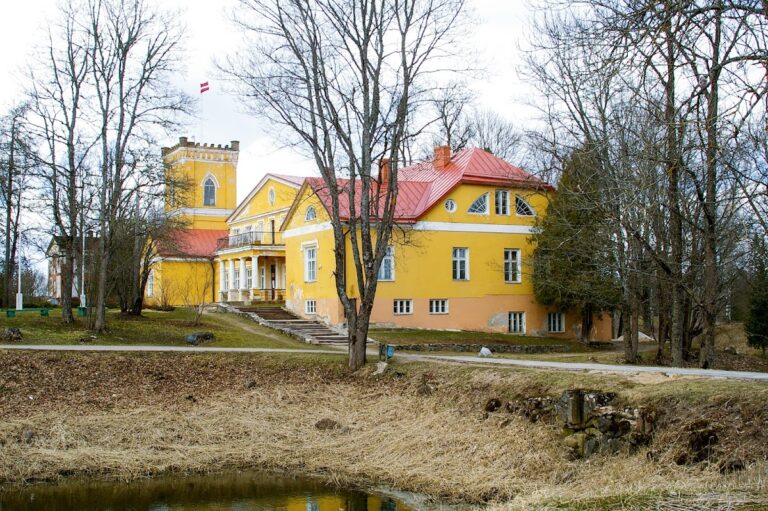
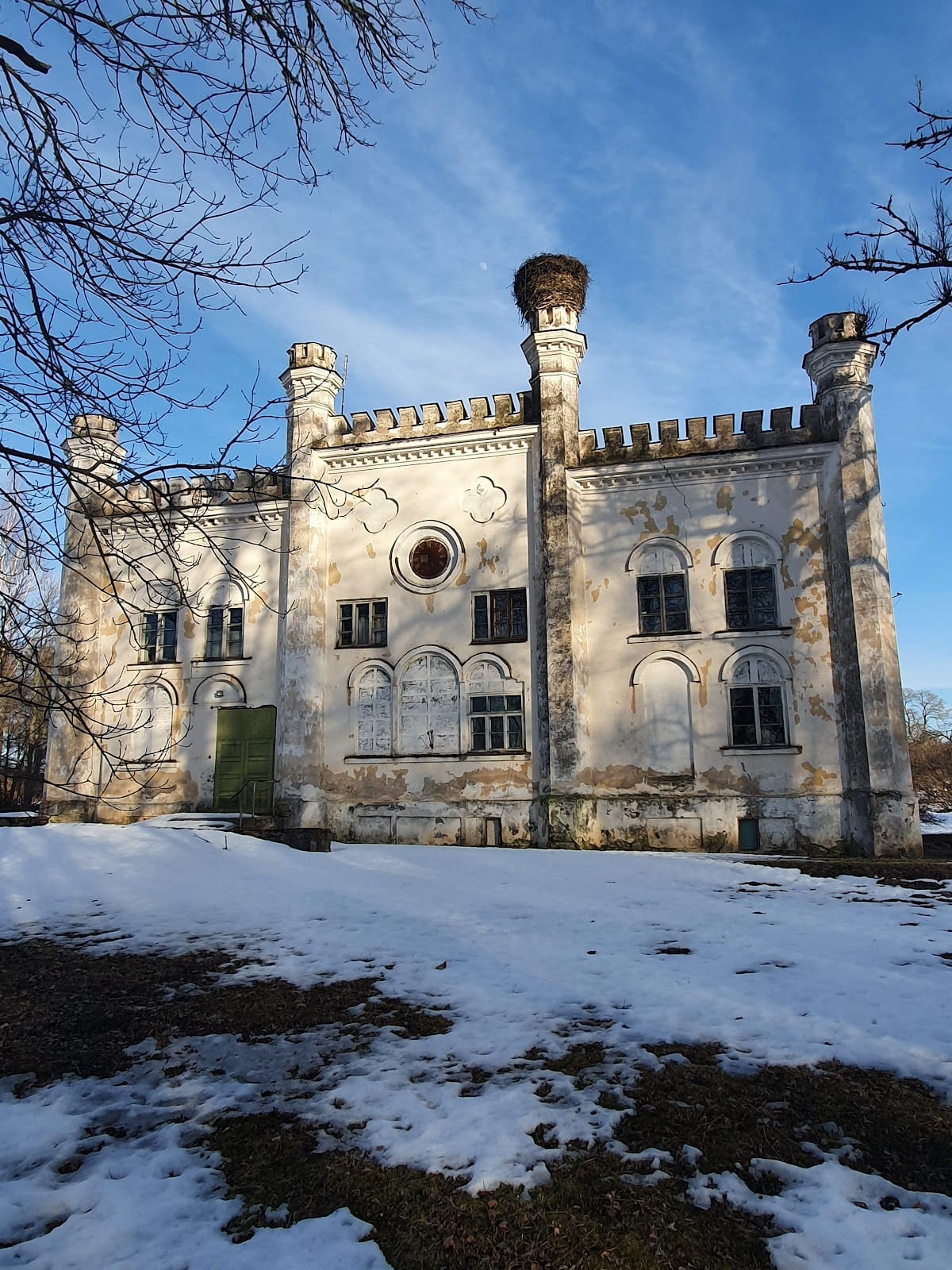
In the early 20th century, in 1911, archaeological excavations led by Karl von Löwis of Menar uncovered underground passageways and foundations, contributing to the understanding of the castle’s layout. The 19th century brought a new chapter as a manor house was constructed on the area corresponding with the castle’s former outer courtyard, incorporating some of the original castle’s building materials into its structure.
Remains
Gaujiena Castle was built as a compact, quadrangular fortress situated on a triangular promontory along the right bank of the Gauja River. Its natural defenses included steep dolomite cliffs on the west and a ravine to the north and northwest. To strengthen protection, an artificial moat was dug on the southeast side, creating a formidable barrier against potential attackers.
The core of the castle consisted of the convent house, a main stone building roughly 29 by 27 meters in size with an inner courtyard measuring about 11 by 9 meters. Its exterior walls were approximately 1.8 meters thick, designed to withstand siege. The entrance was located in the northeast wing through a gate passage almost 3 meters wide. The convent house contained two principal wings connected by additional structures. East of the gateway stood a chapel, distinguished by a triple-arched east window reminiscent of the style used in Riga Cathedral’s ambulatory, pointing to 13th-century origins. Inside, the ground floor housed kitchens, sleeping quarters, and communal rooms, while the upper floor contained the chapel, dining hall (refectory), and assembly room. Below these, a vaulted cellar served various functions such as storage and food preparation, including milling and baking, and later it was adapted for brewing.
Beyond the main castle lay two successive outer courtyards called forecourts. The first forecourt closely followed the hillside’s natural slope and featured numerous supporting buildings. A prominent defensive element here was a semicircular artillery tower about 12.4 meters in diameter and more than 16 meters tall. This tower had thick walls and a star-vaulted ceiling, characteristics indicating construction or enhancement during the 15th century, combining local dolomite stone and later brickwork. The second forecourt stretched beyond the first, enclosed by a high curtain wall up to 12 meters tall, built from dolomite and brick. This wall was reinforced by two watchtowers and surrounded by a moat, further securing the castle’s perimeter. Within this outer ward were stables and farm buildings supporting the castle’s daily operations.
Defensive features of the castle included two drawbridges spanning moats, a zwinger-like (a narrow killing zone between walls) defensive area between the main gate and the first forecourt, and multiple gunports in the outer walls designed to accommodate firearms, which were increasingly incorporated as military technology evolved. Inventories from the years 1465, 1517, and 1627 show the presence of a heated room with a chimney, a gatehouse, and other structures within the forecourt area, outlining additions made over time to improve comfort and defense.
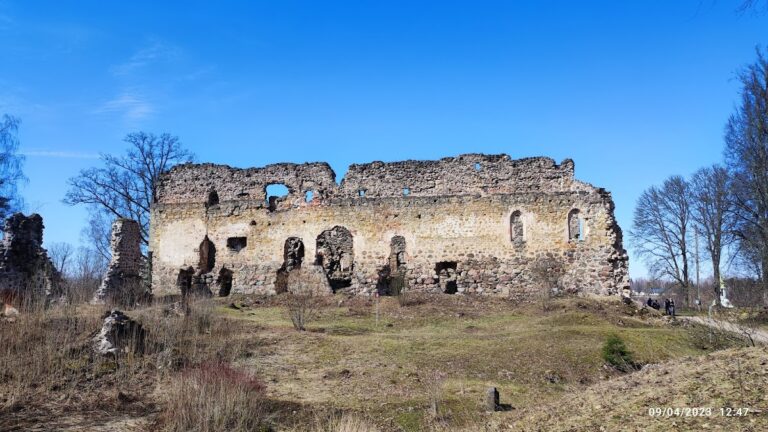
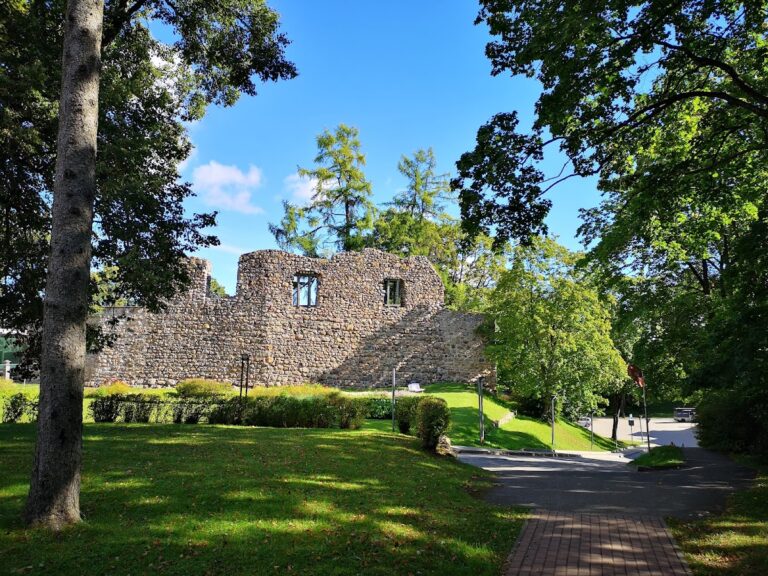
Today, the remaining ruins consist of fragments of the convent house walls and the northwest tower within the first forecourt. A surviving wall section along this tower rises to about 12 meters in height and extends roughly 20 meters in length. Remnants of the outer forecourt walls and the surrounding moat are also visible. These ruins are protected as a national monument, and historical records including archaeological plans and drawings from the 17th century help preserve knowledge of the castle’s former form and significance.
Nearby sites