El Mèdol: The Roman Quarry Near Tarragona



Visitor Information
Google Rating: 4.4
Popularity: Low
Google Maps: View on Google Maps
Official Website: www.tarragona.cat
Country: Spain
Civilization: Roman
Remains: Economic

History
The Roman quarry of El Mèdol is located near Tarragona, Spain. This site was developed by the Romans during the period when Tarraco, now modern Tarragona, was a Roman colony in the province of Hispania Citerior. The quarry began operation around 200 to 220 BCE, during the late Roman Republic and continued through the Roman Empire era.
During the Roman Republic and Empire, El Mèdol supplied limestone primarily for the construction of important buildings in Tarraco, the provincial capital. The stone extracted here contributed to the city’s urban development, supporting public and private architecture. The quarry’s proximity to the ancient Via Augusta, a major Roman road, facilitated the transport of stone to Tarraco.
After the Roman period, the quarry’s stone was reused in medieval times, notably in the construction of the Cathedral of Santa Tecla in Tarragona. This indicates the quarry remained a valuable resource well beyond antiquity. Over centuries, the site fell out of use and was eventually forgotten until rediscovered in the 19th century.
In the 20th century, El Mèdol was formally recognized as a Roman archaeological site. It gained legal protection as a Cultural Interest Asset in 1985 and was elevated to National Cultural Interest Asset status in 1993. In 2000, it became part of the archaeological ensemble of Tarraco, which was declared a UNESCO World Heritage Site. Management of the site changed hands from the private company Abertis to the Generalitat of Catalonia in 2025, with oversight assigned to the National Archaeological Museum of Tarragona.
A forest fire in 2010 uncovered new archaeological areas within the quarry, leading to restoration efforts and the site’s reopening in 2014.
Remains
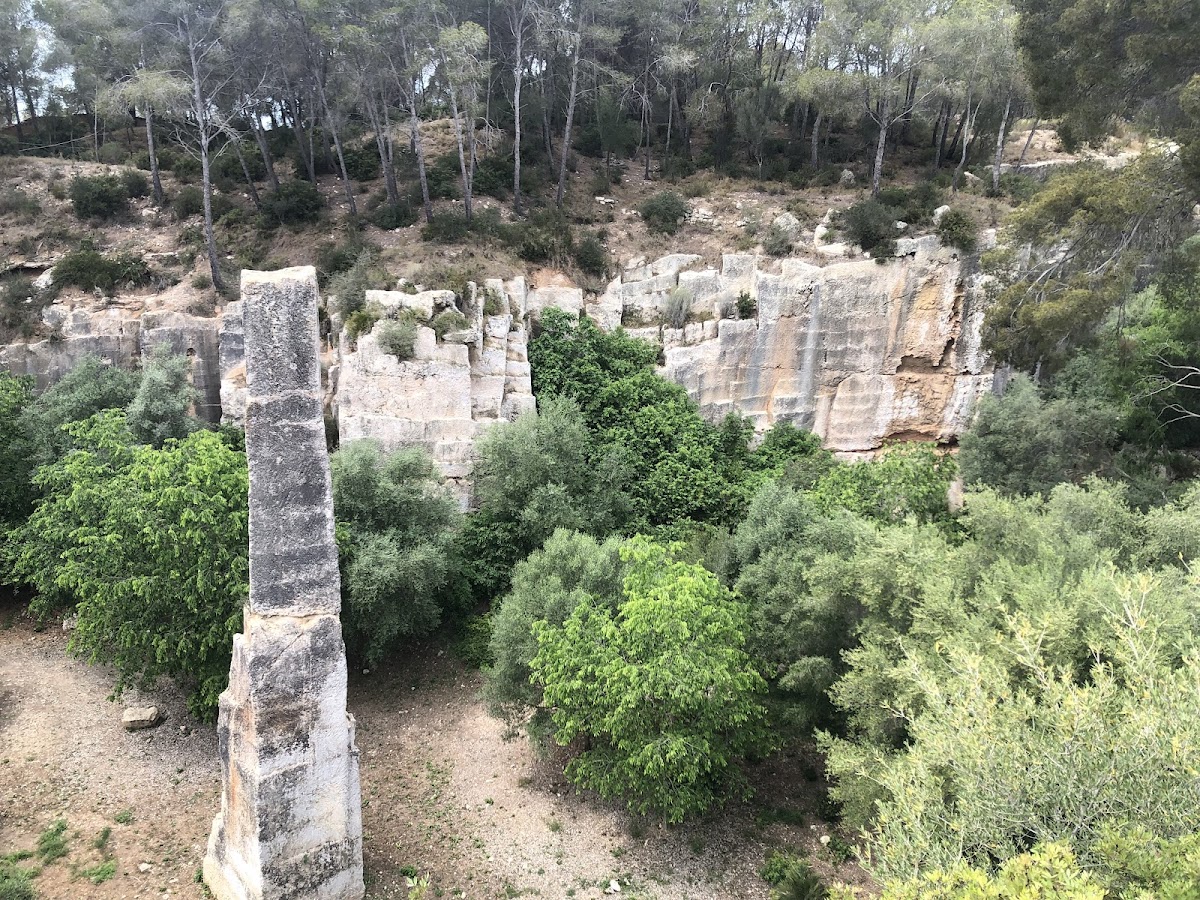
The Roman quarry of El Mèdol is a large open pit known as the Clot del Mèdol. It stretches over 200 meters in length and varies between 10 and 40 meters in width. The quarry walls are steep, rising vertically to heights between 12 and 20 meters. These nearly vertical faces reveal the method of stone extraction used by the Romans.
At the center of the quarry stands a tall, uncut stone pillar about 16 meters high. This “witness column” remained untouched during quarrying and served as a reference to measure the volume of stone removed. Some scholars suggest it may have also functioned as a sundial, though this remains a hypothesis.
The stone quarried here is a type of Miocene limestone locally called Soldó. Its colors range from white to reddish, with a generally light golden hue. This limestone was suitable for general construction but was less favored for prominent Roman architectural details.
El Mèdol is the largest among approximately ten Roman quarries around Tarraco. Its size and state of preservation make it a significant archaeological site. The quarry’s location adjacent to the ancient Via Augusta, which corresponds to modern roads. The vertical quarry walls and the central pillar provide clear evidence of Roman quarrying techniques and the scale of stone extraction carried out over several centuries.
Nearby sites