Ehreshoven Castle: A Historic Medieval and Noble Residence in Germany


Visitor Information
Google Rating: 4.4
Popularity: Low
Official Website: www.stift-ehreshoven.de
Country: Germany
Civilization: Medieval European
Site type: Military
Remains: Castle

History
Ehreshoven Castle is located in Engelskirchen, Germany, and its origins trace back to the medieval period under the influence of the Siegburg Abbey, a religious institution founded in 1164 by Archbishop Anno II of Cologne. The castle’s earliest record appears in 1355, describing it as a house or small castle fortified for defense. At that time, it served as part of the abbey’s possessions, reflecting its ecclesiastical connections during the Middle Ages.
In 1396, ownership of Ehreshoven Castle passed to the family of the Count of Nesselrode, who maintained control of the estate for over five centuries, until 1920. During the late 16th century, Wilhelm of Nesselrode and his wife Elisabeth von Schwarzenberg undertook significant renovations that included the construction of a chapel, which still holds notable artistic value today. This period marked the beginning of the castle’s transformation from a medieval stronghold into a noble residence reflecting Renaissance tastes.
By the end of the 17th century, Philipp Wilhelm Christoph von Nesselrode and his wife Maria Adriana Franziska von Leerodt commissioned the building of a new manor house arranged in three wings alongside an expansive four-winged front building. This development incorporated parts of the medieval structure, such as the chapel and northern sections, blending historical architecture with newer noble domestic styles.
In the early 18th century, the castle grounds were enhanced with a French garden to the north, which included a tea house originally dating from the 16th century. Much of this garden layout has been preserved, showcasing the continuing refinement of the estate’s landscape over time.
Countess Marie von Nesselrode-Ehreshoven, the last family owner from 1853 until her death in 1920, left the property to the Rheinische Ritterschaft, an association of noble families. In 1924, they created a charitable foundation on the estate aimed at supporting unmarried noblewomen, known as a Damenstift. Throughout the twentieth century, despite significant damage from air raids during World War II in 1945, the castle underwent restoration. Since that time, it has served as both a residence for members of the noble class and as a source of income through commercial rentals, while also housing archives related to German nobility.
Remains
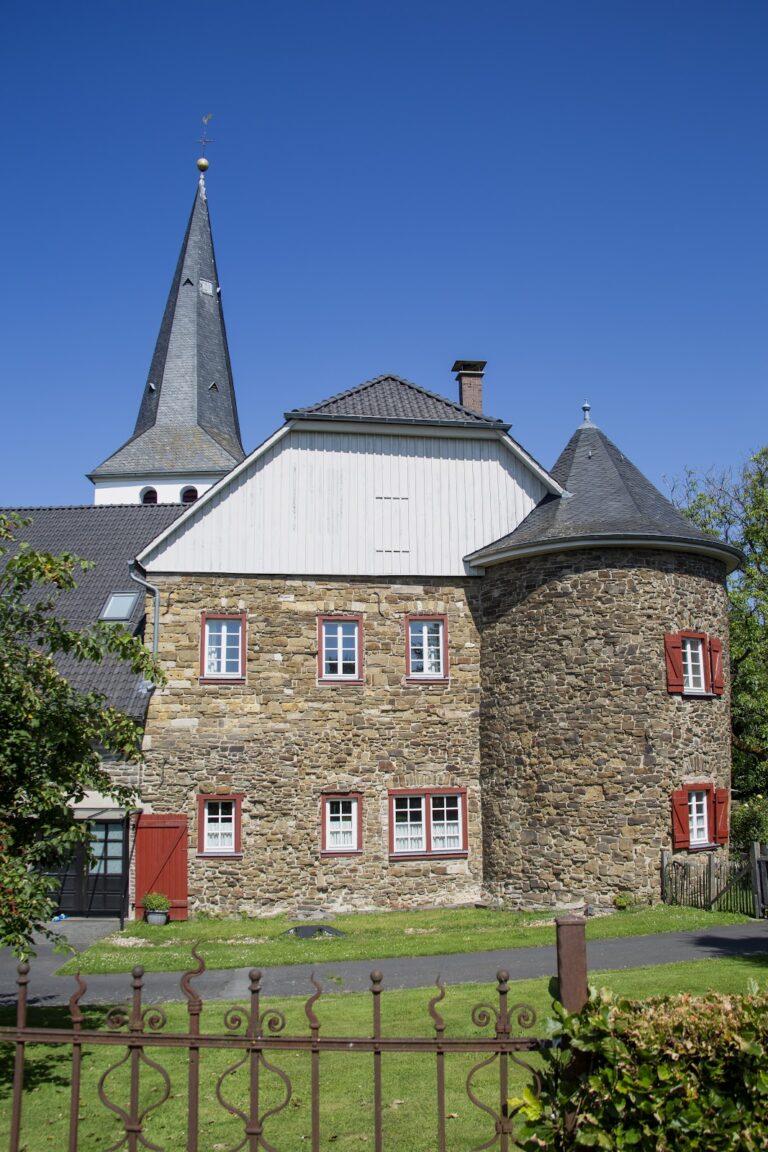
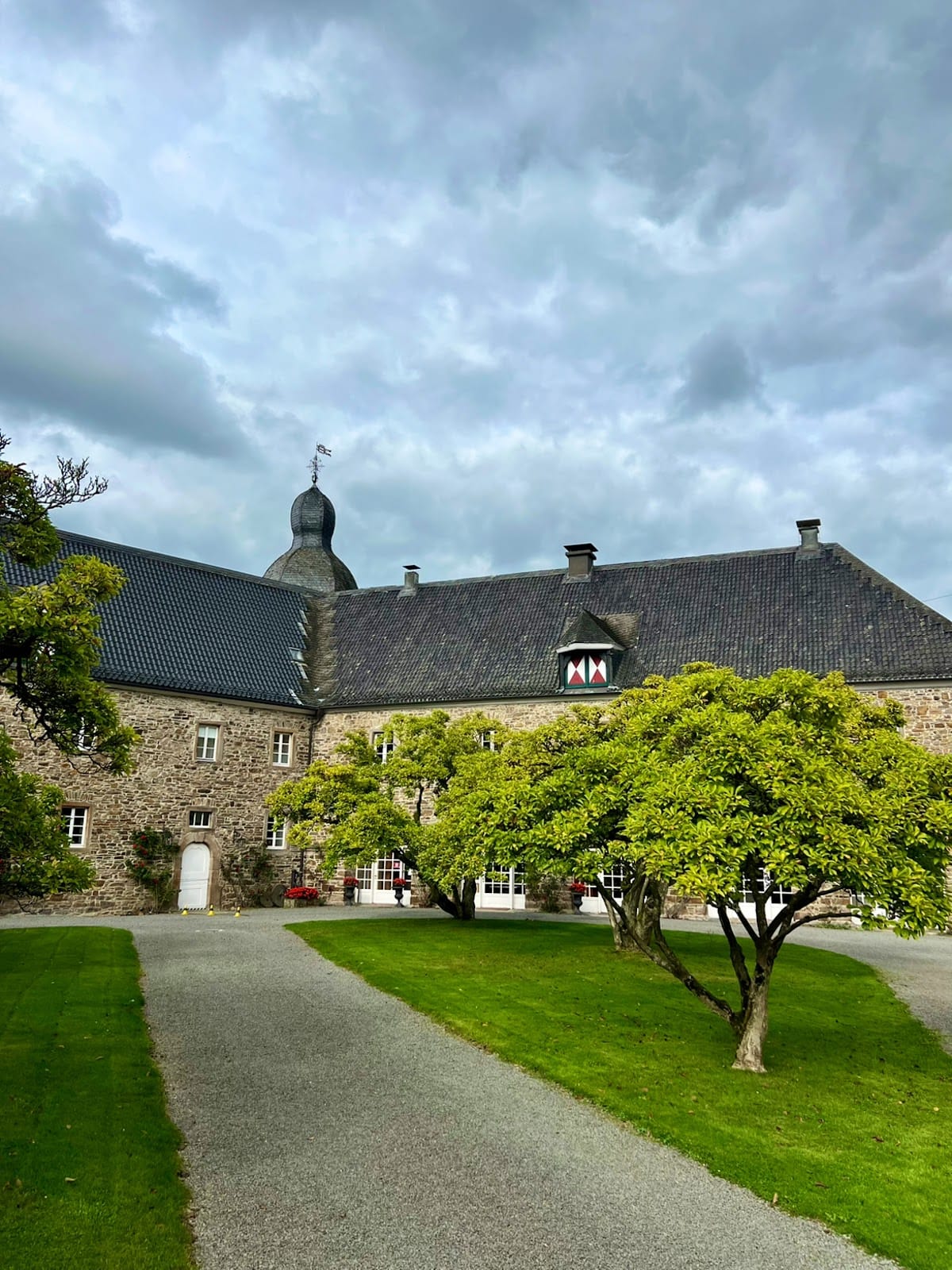
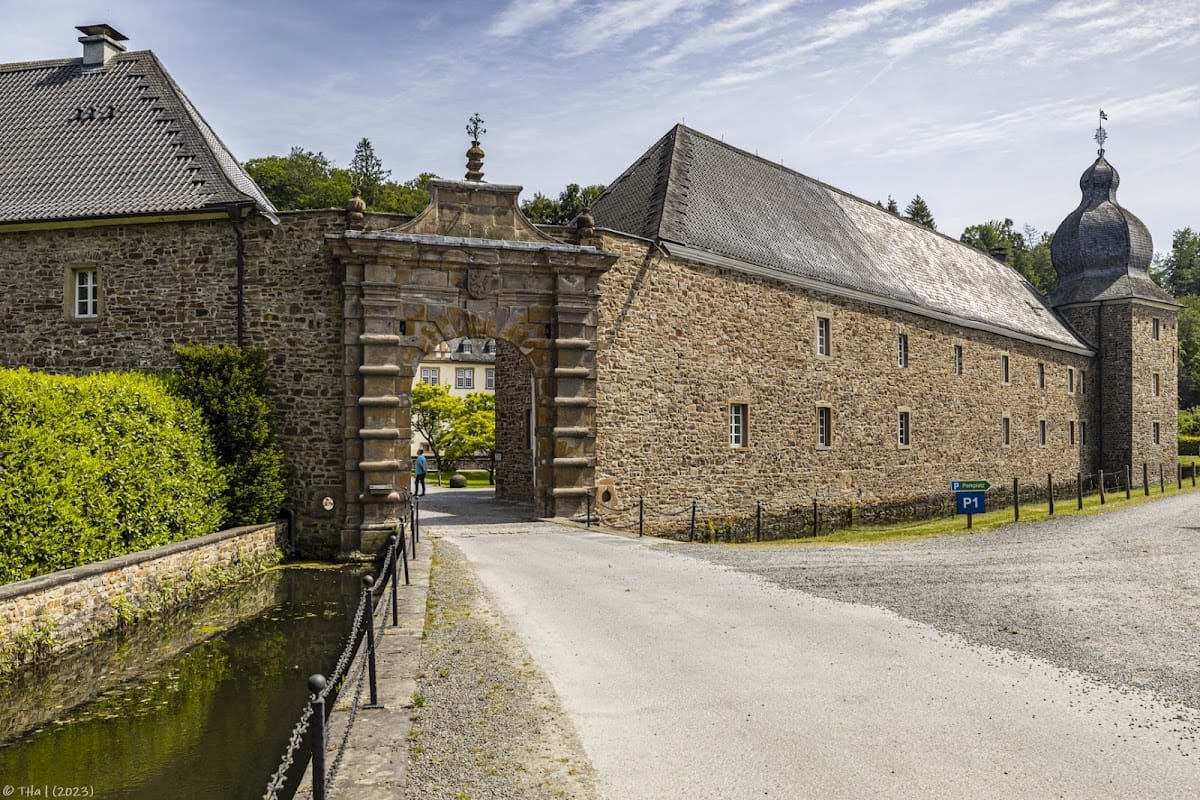
Ehreshoven Castle is a stone-built fortress surrounded by a moat, situated about 114 meters above sea level. Its layout features a front castle, or Vorburg, that consists of four two-story wings arranged at obtuse angles to form a courtyard. These wings have hipped roofs covered with distinctive blue-glazed hollow tiles. The exterior walls display exposed stone and are punctuated by small, irregularly spaced windows, lending a sense of fortification while maintaining an elegant appearance.
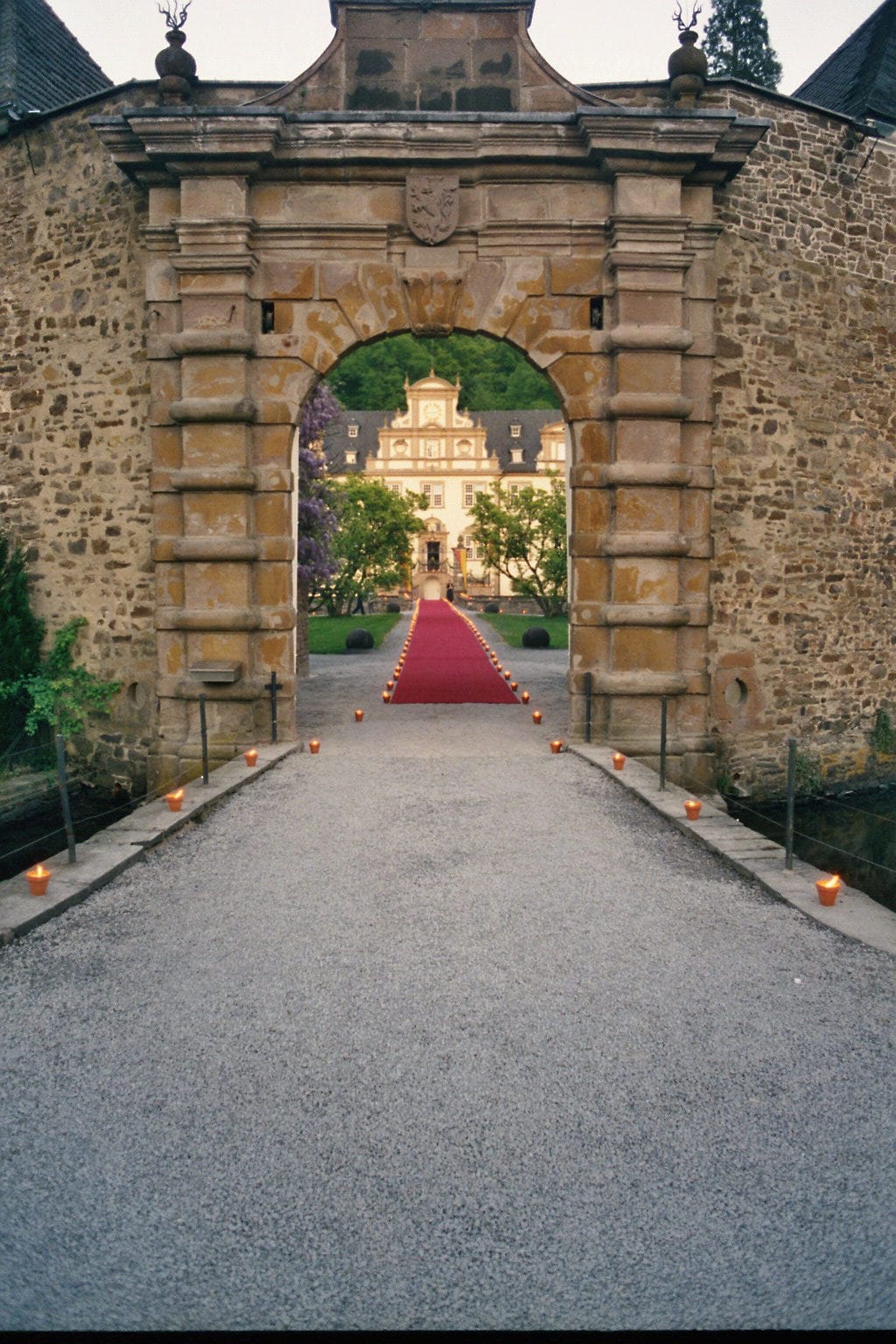
At two of the courtyard’s external corners stand sturdy three-story towers with roughly square bases topped by five-sided double-recessed cupolas, offering both defensive capabilities and architectural emphasis. The main gate of this front castle is visually striking; it is framed by strong Tuscan pilasters decorated with heavy rusticated bosses. Above, a broad frieze supports a small gable adorned by three vases finished with wrought-iron floral motifs. Historic openings and pulleys within the gate hint at the former presence of a drawbridge, since replaced by a stone bridge probably constructed during the 18th or 19th century.
Beyond the entrance lies a narrow passage that opens into a pentagonal courtyard divided by lawns. The approach to the main manor is marked by pairs of large stone spheres along the pathway. Defensive walls and pillars line this route, directing the visitor’s focus towards the centerpiece of the estate—the manor house itself.
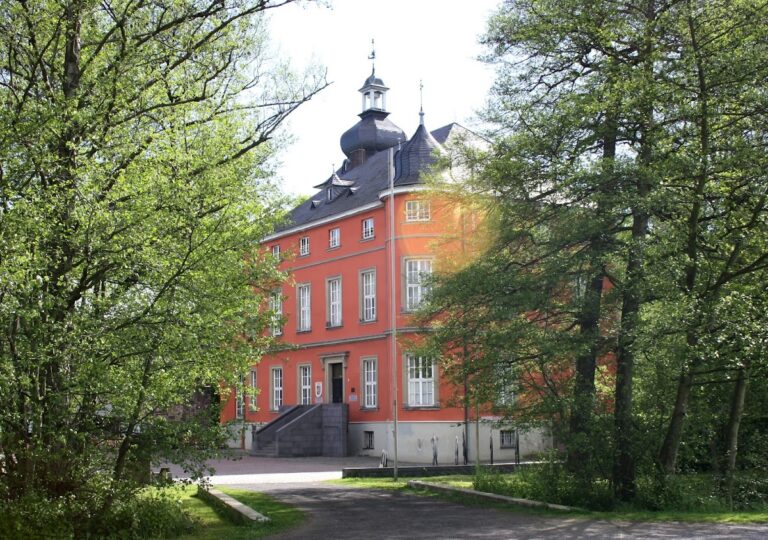
The main manor house stands with a plastered facade composed of eleven vertical section divisions, arranged symmetrically as four sections on each side of a central three-axis risalit. It rises two full stories above a raised basement. Most windows here are rectangular and include central mullions, offering a rhythm to the facade. The risalit’s architectural details draw on Italian Mannerist influences: its sandstone gable is richly articulated with volutes, a segmental pediment, and acroteria shaped as stone spheres and vases. An upper field contains a clock, and dormers plus false gables in the Tuscan order, each topped with stone ball finials, flank the central gable. The main portal is accessed via a double-flight staircase with elaborately decorated wrought-iron railings.
The side wings of the manor contrast by being only one story tall and each features six windows facing the courtyard as well as two facing the front castle. Their roofing is notable for a complex design incorporating hipped roofs with keel-shaped dormers, an upper wall clad in slate with small rectangular windows, and a second, similarly shaped hipped roof above.
At the rear facade, elements of the original medieval castle remain visible, including irregularly placed windows and a small wooden oriel dating to the Baroque period. The medieval castle’s old house section is distinctive for its bell-shaped hipped roof, highlighting the layered history of the structure.
The chapel, integrated into the rear part of the castle, retains its medieval origins and extends outward with a polygonal altar bay supported by profiled consoles. Its pointed-arch windows are sizable, and a pyramidal roof tops the chapel alongside a polygonal shed roof on the altar bay. This space is particularly important for its artistic heritage.
A stairwell resembling a small tower protrudes from the rear facade, featuring windows consistent with those on the courtyard side, contributing to both functional circulation and aesthetic balance.
Inside the manor, visitors encounter a vestibule extending through the length of the building, laid with a checkerboard stone floor and accented by black marble door frames and tiled baseboards. The stairwell here is modest, equipped with a balustrade crafted from colored stucco marble. Among the interior highlights is a dining room that preserves its original leather wallpaper, possibly of Flemish origin. This wallpaper is richly decorated with floral and fruit motifs, playful putti figures, birds, and a silvered background that accentuates the red and green hues, offering a rare glimpse into the castle’s historical interior decoration.