Craigievar Castle: A Historic Scottish Baronial Residence



Visitor Information
Google Rating: 4.6
Popularity: Medium
Official Website: www.nts.org.uk
Country: United Kingdom
Civilization: Unclassified
Site type: Military
Remains: Castle

History
Craigievar Castle is situated near Alford in Scotland and was constructed by members of Scottish society during the early 17th century. The structure was completed by 1626 under the direction of William Forbes, a merchant from Aberdeen who purchased the unfinished building from the Mortimer family in 1610. Forbes, known for his prosperous Baltic trade and nicknamed “Danzig Willy,” completed the castle over the following fifteen years.
Following its completion, Craigievar Castle became the ancestral seat of the Forbes family, specifically the Forbes baronets of Craigievar, marking their presence in the region for roughly 350 years. William Forbes’s son was bestowed the baronetcy of Nova Scotia by King Charles I in 1630, which continues as an extant title. The family maintained a notable role in political affairs, with the fourth baronet serving as the representative for Aberdeenshire in the British House of Commons. Eventually, the Forbes family titles intertwined with those of the Lords Sempill, forming a combined lineage.
Throughout the 19th century, the castle encountered deterioration and was at risk of demolition. However, in the 1820s, Sir John Forbes enlisted Aberdeen architect John Smith to oversee restoration efforts rather than dismantle the structure. These renovations included repairing the roof, elevating the towers, and restoring the original entrance, which preserved the castle’s historic appearance. The estate remained a private residence until the Second World War, after which the family primarily lived at Fintray House, which served as a hospital for wounded Belgian soldiers during the conflict.
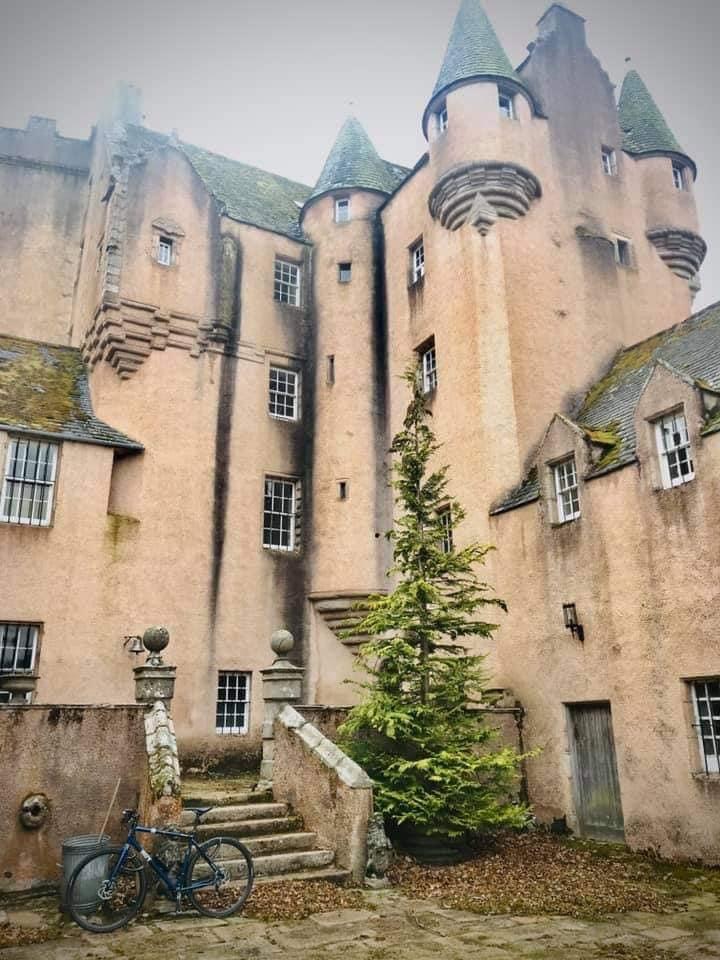
In 1963, ownership of Craigievar Castle transferred to the National Trust for Scotland when the 19th Lord Sempill sold the property. The castle was officially recognized as a listed building in 1990. Restoration projects on the external surfaces took place between 2007 and 2009, and again in 2024, when the limewash coating was renewed to maintain the building’s distinctive pink color. Traditions associate Craigievar Castle with the inspiration behind Walt Disney’s depiction of Cinderella’s pink castle, a connection confirmed by the current custodians. The surrounding landscape, shaped over centuries, primarily reflects changes from the late 18th century onward, including the addition of gardens in the 1930s and later ornamental plantings.
Remains
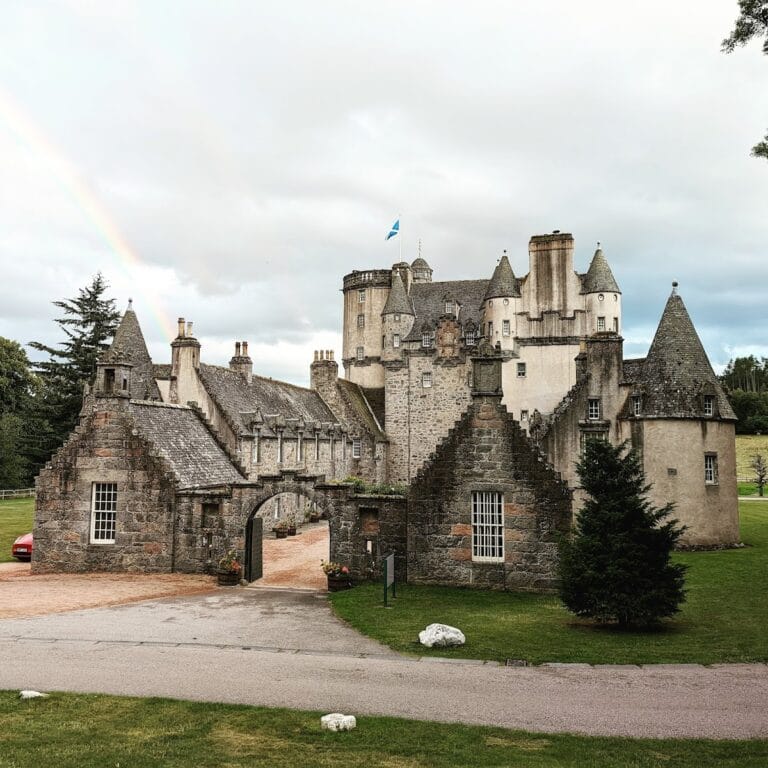
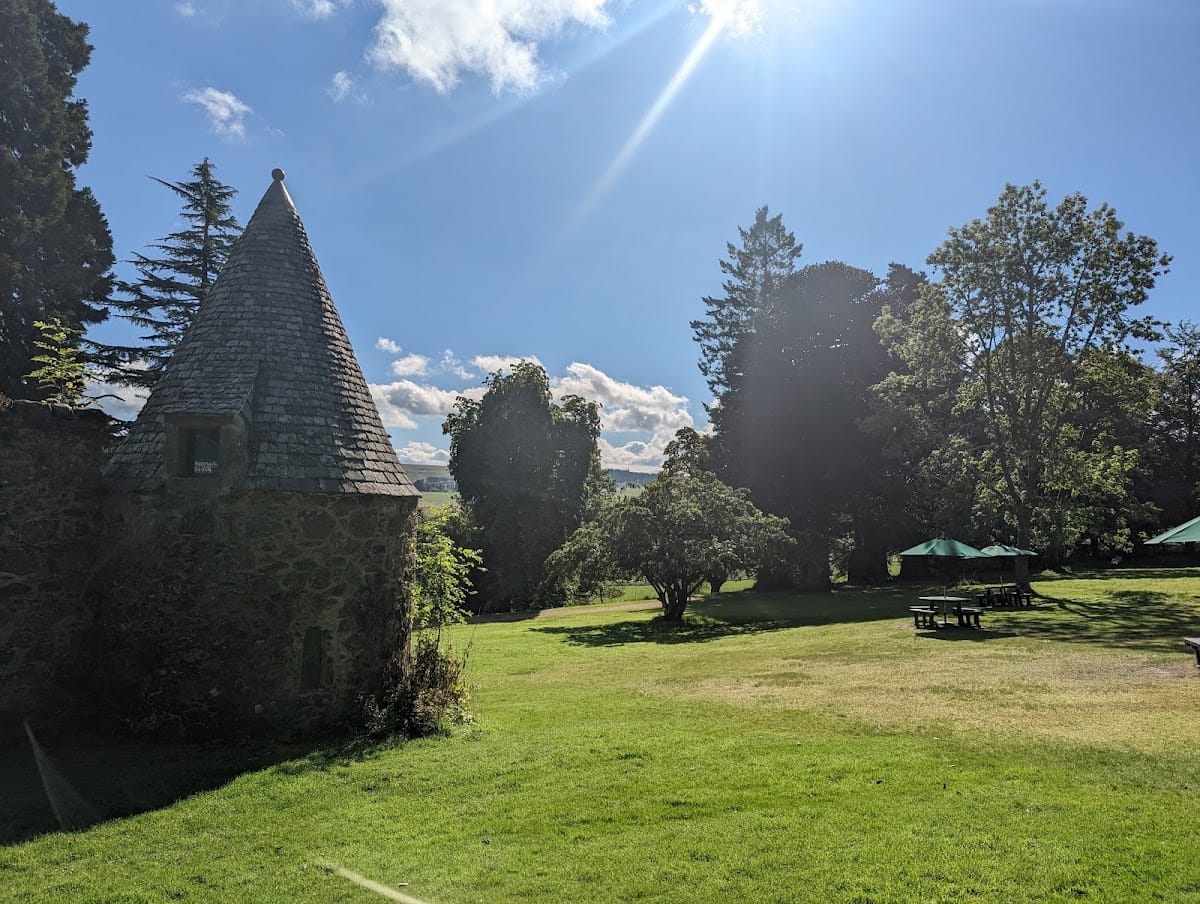
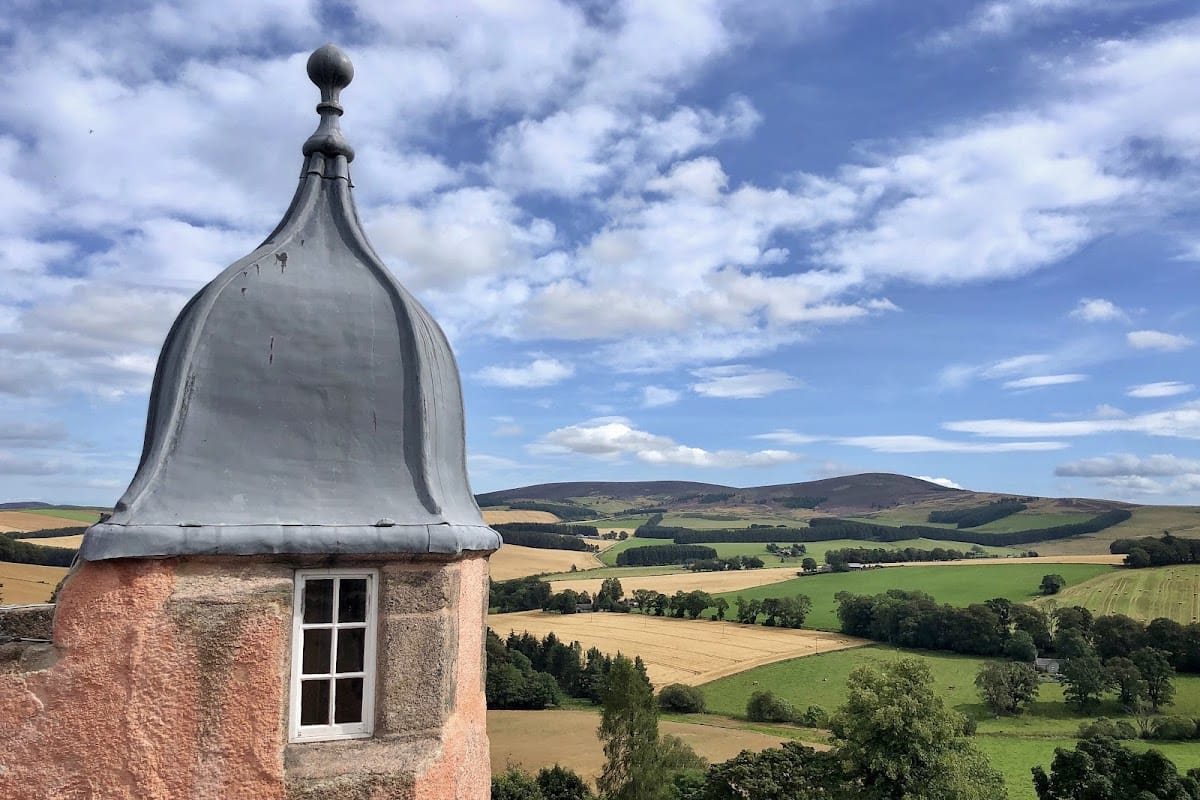
Craigievar Castle stands as a seven-storey residence arranged in an L-shaped plan, characteristic of the Scottish Baronial style common in the region. The castle’s exterior is coated with a traditional lime-based harling, restored to a pink tone that accentuates the granite mouldings, a feature renewed during 19th-century renovations and again in the 21st century. Historically, the castle was enclosed by a walled courtyard featuring four round towers; today, only one of these rounded towers remains intact. This surviving tower bears carved initials above its arched entrance, attributed to Sir Thomas Forbes, the son of the castle’s original builder.
A prominent defensive element is the massive iron portcullis, locally called a yett, which protected the main entrance. This heavy iron grill could be raised or lowered as a barrier against intruders, reflecting the fortified nature of such noble residences in the early modern period.
Inside, visitors find richly detailed plaster ceilings, considered among Scotland’s finest, decorated with symbolic figures known as the Nine Worthies alongside family heraldic emblems. The Great Hall showcases the Stuart family arms positioned prominently above the fireplace, and features a musicians’ gallery that would have allowed entertainers to perform during gatherings. A hidden staircase connects the castle’s high tower directly to this main hall, serving practical and defensive purposes.
Other notable rooms include the Queen’s Bedroom and quarters used by servants, displaying collections of Forbes family portraits and furnishings from the 17th and 18th centuries. Among these artworks are two original paintings by the acclaimed artist Henry Raeburn, preserved along with their payment receipts. The upper floors of the castle have no artificial lighting, relying wholly on daylight streaming through windows, a choice made to maintain the authenticity of the historic interior experience.
The extensive estate encompasses more than 200 acres of farmland and woodland. Landscape features primarily date from the late 18th and early 19th centuries, with decorative conifers, flower borders, and a rock garden created in the 1930s near the coach house. Situated approximately 218 meters above sea level, the castle overlooks a varied terrain of hills to the south and flat plains to the north, all within a sparsely inhabited coastal climate zone.
Nearby sites