Corse Castle: A Sixteenth-Century Forbes Fortress in Scotland


Site at a Glance
- Rating
- 4.4
- Popularity
- Very Low
- Country
- United Kingdom
- Primary era
- Early Modern
- External website
- Open
- Eras represented
- Early Modern
- Civilizations
- Kingdom of Scotland
- Site type
- Military
- Remains
- Castle
On this page7 sections
History
Corse Castle is a ruined sixteenth-century fortress in the United Kingdom, near Banchory in north-eastern Scotland. Sir William Forbes built the present Scottish tower house in 1581 after an earlier family residence was destroyed by bandits, creating a secure centre for the Forbes landed estate.
Construction and the Forbes Estate
The earlier house was destroyed during a raid in the sixteenth century. Sir William Forbes is reputed to have said that he would build a house so secure that thieves would have to knock before entering. The castle that followed became the principal residence and administrative centre of the Forbes estate at Corse.
Sir William’s eldest son, Patrick Forbes, was born at the earlier house before its destruction. He became Bishop of Aberdeen in 1618 and held that office until his death in 1635. William Forbes’s second son, a merchant, acquired nearby Craigievar Castle in 1610 and completed its building in 1626. His third son, John Forbes, entered the church, while his sixth son, Arthur, settled in Ireland and was created a baronet, a hereditary British title ranking below a baron but above most knighthoods.
Seventeenth-Century Succession
Patrick Forbes’s second son, the theologian John Forbes, inherited Corse in 1635 and died there in 1648. He had opposed the National Covenant, a Scottish religious and political movement against efforts to impose episcopal church government and worship, and had spent three years in exile.
After John Forbes’s death, the estate passed to his son George and then to his grandson. When that branch produced no further heirs, Corse reverted to the Forbes family of Craigievar, descended from John Forbes’s brother William.
Replacement and Later Ownership
The castle became redundant in the mid-nineteenth century after a new house replaced it. By the late nineteenth century, a modern mansion stood near the older building. In 1869 the estate was occupied by James Ochoncar Forbes, the second son of Sir John Forbes, 7th Baronet of Craigievar, and the husband of Charlotte Elizabeth, daughter of James Ochoncar Forbes, 17th Lord Forbes.
Following James Ochoncar Forbes’s death in 1900, the estate passed to his son John Walter Forbes, who died unmarried in 1912. It then passed to his younger son, Lieutenant Colonel James Ochoncar Forbes, a Deputy Lieutenant of Aberdeenshire. A Deputy Lieutenant is a representative of the Crown in a Scottish lieutenancy who assists the Lord-Lieutenant in civic and ceremonial duties. His son, Lieutenant Colonel Patrick Walter Forbes, also lived on the estate and held the same office.
Corse Castle is a scheduled monument, a site of national archaeological or historical importance protected under Scottish heritage law, and received that designation in 1964. Its former Category B listed-building status, a designation for buildings of regional or greater-than-local importance, was removed in 2015, while its scheduled-monument classification remained in force.
Remains
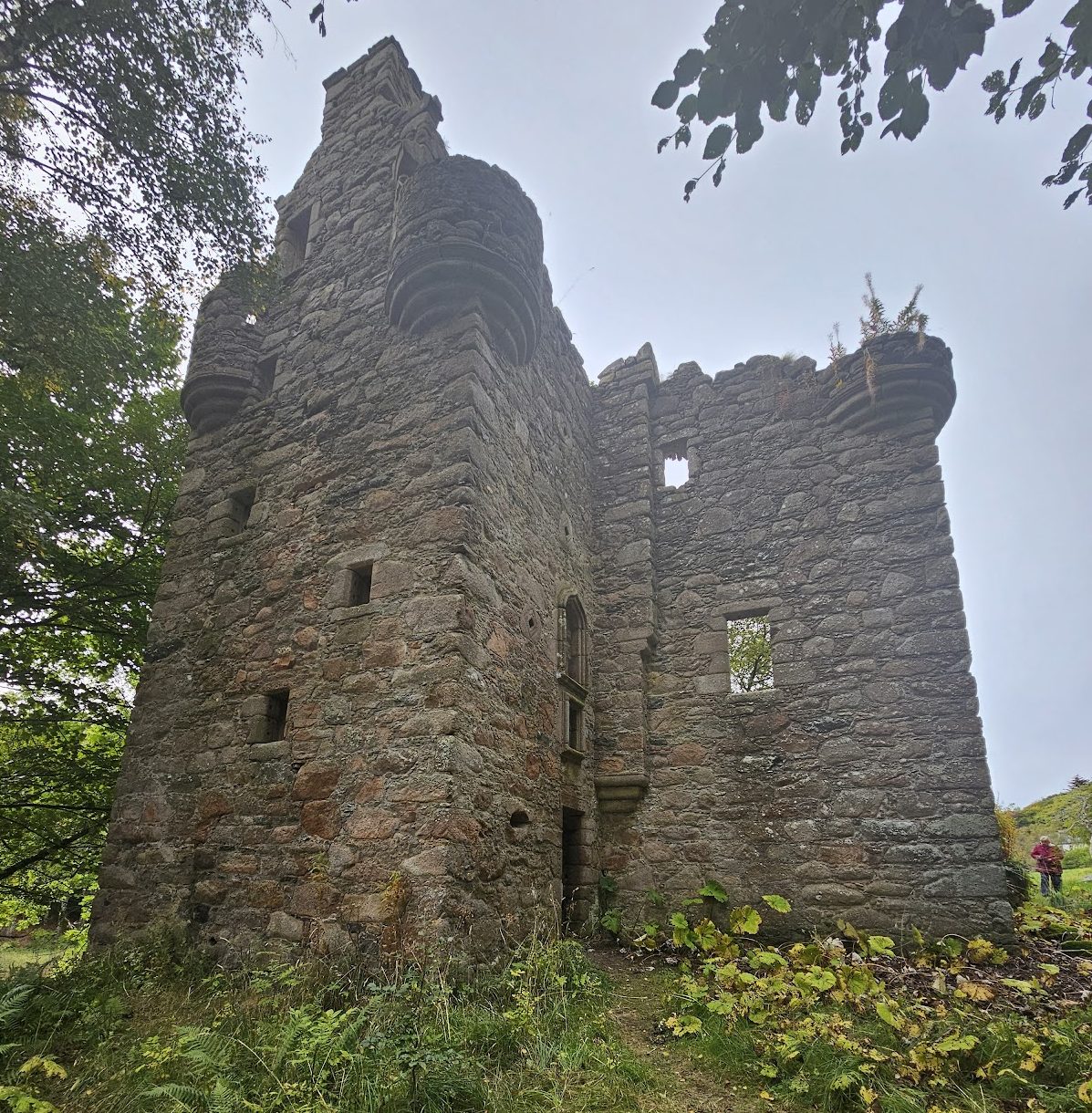
Corse Castle survives as a ruin beside the Corse Burn, approximately 5 kilometres north-west of Lumphanan in Aberdeenshire. It is a compact fortified residence whose surviving form has been described as a Scottish Z-plan castle. In this arrangement, the main block has projecting towers or wings at diagonally opposite corners. W. D. Simpson instead characterized the building as an unusual combination of L- and Z-plan forms, with projecting elements arranged at two adjoining corners as well as diagonally.
Fortress Structure
The building is a sixteenth-century stone tower house, a fortified domestic residence designed for both defence and habitation. Its entrance doorway retains a lintel carved with Sir William Forbes’s initials and the date 1581. The ruinous structure preserves the compact plan that led Historic Scotland to identify it as a notable example of Scottish Z-plan castle architecture.
Burn and Water Feature
The Corse Burn runs through the hollow adjoining the castle. A dam created a sheet of water south of the building, a feature recorded in 1887. The nearby modern mansion formed part of the later estate setting by the end of the nineteenth century, while the older fortress remained ruinous.