Chester Roman Amphitheatre


Visitor Information
Google Rating: 4.3
Popularity: Medium
Google Maps: View on Google Maps
Official Website: www.english-heritage.org.uk
Country: United Kingdom
Civilization: Roman
Remains: Entertainment

History
The Chester Roman Amphitheatre, located just outside the south-east corner of the Roman fortress Deva Victrix in present-day Chester, England, was built by the Romans in the late 1st century AD. It was constructed soon after the founding of the legionary fortress, serving as a venue for public spectacles and military training. The amphitheatre was initially erected by the Second Legion Adiutrix in the late 70s AD and was rebuilt shortly after 86 AD by the Twentieth Legion Valeria Victrix.
By the early 2nd century, the amphitheatre fell out of use when the Twentieth Legion was redeployed to Hadrian’s Wall around the 120s AD. Following this, the site was abandoned and repurposed as a rubbish dump. However, in the late 3rd century, around AD 275, the amphitheatre underwent significant refurbishment. New paving was laid, a shrine dedicated to the goddess Nemesis, believed to oversee the fate of performers, was restored, and a colonnade was added to the east entrance. The amphitheatre remained active until approximately AD 350.
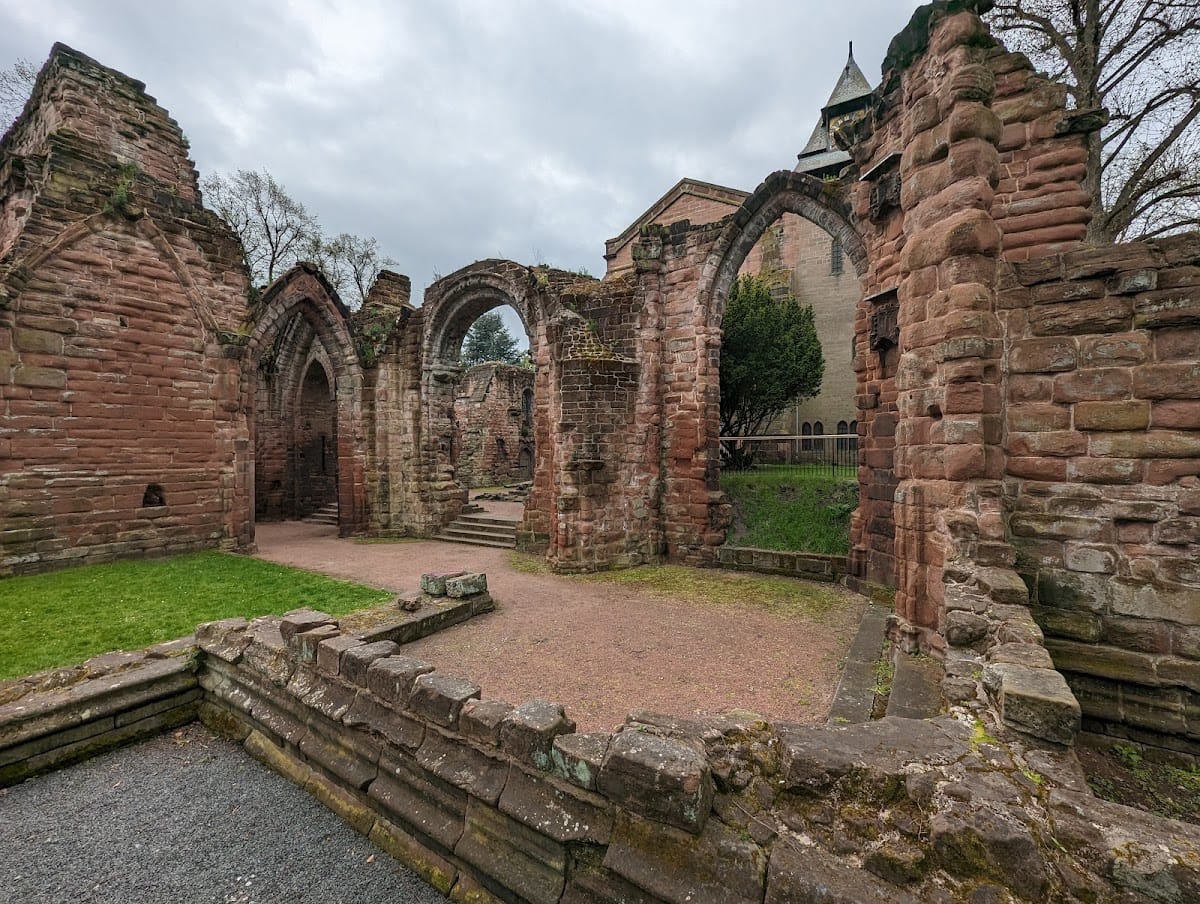
In the 5th or 6th century, a timber hall was built within the arena, possibly reconstructed later. Large stone blocks inserted at the east entrance may be linked to the crypt of the original St John’s Church, dating from the 7th century. During the medieval period, the site was quarried for building materials and again used as a rubbish dump. By around 1200, houses were constructed over the southern half of the amphitheatre, covering much of the structure.
The amphitheatre was rediscovered in 1929 during construction work. Excavations began in 1957 and have continued into the 21st century under the care of English Heritage and Chester City Council. Archaeological work since 1999 disproved earlier beliefs that the original amphitheatre was made entirely of wood. Instead, it was found that wooden grillage supported stone seating. Finds such as coins from Emperor Vespasian’s reign, a gladius sword hilt, and decorated pottery with hunting and battle scenes have been uncovered. Some historians speculate that Chester might have become the capital of Roman Britain had the Romans expanded into Ireland.
Remains
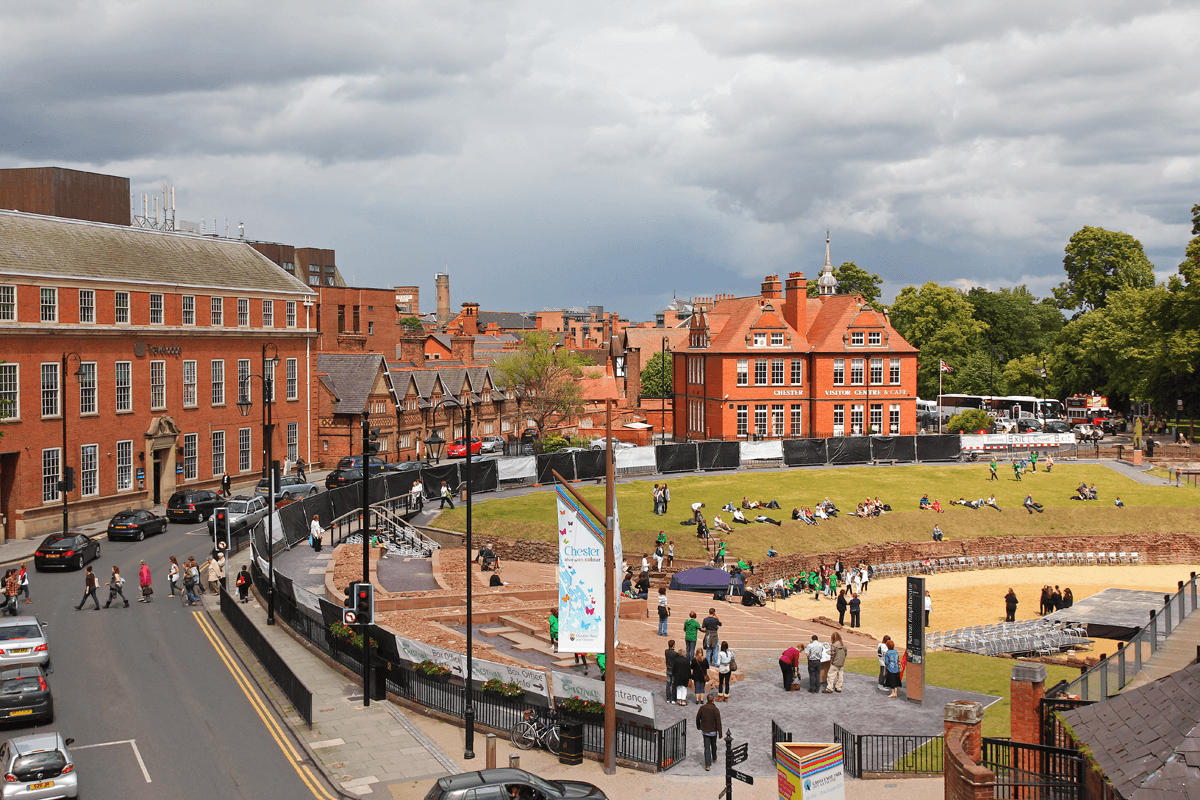
The Chester Roman Amphitheatre is an elliptical stone structure measuring about 320 feet (98 meters) along its longest north-south axis and 286 feet (87 meters) across its shorter east-west axis. Its outer wall is roughly 9 feet (2.7 meters) thick, with foundations extending 1.3 meters deep. Today, only about two-fifths of the amphitheatre is visible, as the northern half is exposed while the southern half remains covered by later buildings, including Dee House and the County Court.
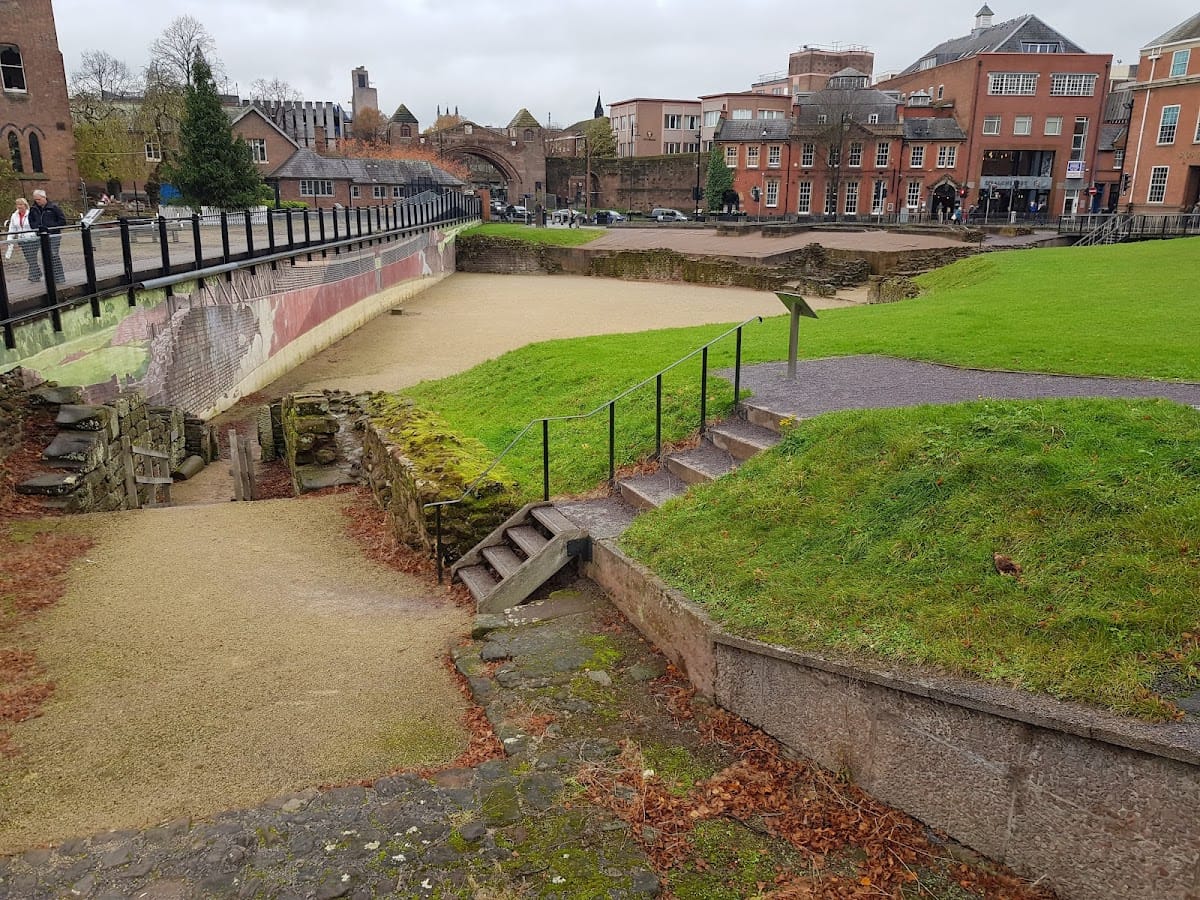
The arena floor lies more than 3 feet (1 meter) below the original Roman ground level. Two main entrances are visible: a larger one on the north side and a smaller one on the east. Originally, exits existed at all four compass points. Inside the north entrance corridor, stairs lead to a small room where officials once controlled events. Nearby, a door opens into a chamber containing an altar dedicated to Nemesis, the goddess associated with the fate of performers.
Seating was accessed via stairways connected to a corridor running inside the outer wall. Excavations revealed that the stone seating rested on a wooden grillage, a framework of timber beams. Surrounding the arena was a complex of support facilities, including dungeons, stables, and food stands to accommodate events. During the 3rd-century refurbishment, a colonnade was added to the east entrance.
The amphitheatre’s preservation is partial. Some original stone walls remain, though sections are missing due to stone removal in later periods. Modern concrete has been used to support surviving walls. The worn steps at the east entrance survive and may relate to medieval or ecclesiastical use, possibly connected to the early St John’s Church crypt. Archaeological finds include cooked animal bones, inexpensive Roman pottery decorated with gladiatorial scenes, a coin from Emperor Vespasian’s time, and a gladius sword hilt.
In 2010, a large trompe-l’œil mural was painted along a 50-meter walkway wall near the site. This artwork visually reconstructs the amphitheatre’s original appearance, showing the red marble-covered arena wall, doorways, vomitoria (passageways for spectators), and seating layout. The amphitheatre is a Grade I listed building and a scheduled monument, recognized as the largest Roman amphitheatre uncovered in Britain.
Nearby sites