Ewloe Castle: A Native Welsh Fortress of Gwynedd


Site at a Glance
- Rating
- 4.6
- Popularity
- Low
- Country
- United Kingdom
- Primary era
- Medieval
- External website
- Open
- Eras represented
- Medieval
- Civilizations
- Kingdom of Gwynedd
- Site type
- Military
- Remains
- Castle
On this page8 sections
History
Ewloe Castle is a native Welsh castle in the United Kingdom, built by the medieval kingdom of Gwynedd near Ewloe in north-east Wales during the early thirteenth century as a fortification combining motte-and-bailey and enclosure-castle characteristics. It stood in Tegeingl, a cantref, or traditional Welsh territorial division, within the Perfeddwlad, the medieval Welsh term for the middle country of north-east Wales. Its position on high ground near the Chester road and the Wales–England border gave it strategic importance. Ewloe was among the last fortifications constructed by the native Princes of Wales.
Early construction under Gwynedd
An earlier fortification may have stood in Ewloe Woods after Owain Gwynedd defeated the forces of Henry II, king of England, at the Battle of Ewloe in 1157, although this possibility remains uncertain. The castle was once dated mainly to around 1257 and associated with Owain’s grandson, Llywelyn ap Gruffudd. It is now thought to have been begun earlier under Llywelyn ab Iorwerth, known as Llywelyn the Great. Suggested building phases fall in either 1213–18 or 1221–37, and construction appears to have proceeded piecemeal over many years, perhaps without reaching completion.
If work began during the 1210s, the castle may have formed part of improving relations between Llywelyn the Great and Ranulf de Blondeville, Earl of Chester. The two rulers remained allies after 1218 until the earl’s death in 1237. Ewloe later served as a base for unsuccessful negotiations during prolonged disputes over the marcher lordship of Mold, a border territory governed under special authority by a marcher lord. In the early 1240s, Dafydd ap Llywelyn, son of Llywelyn the Great, negotiated there with officials of Henry III of England. The disputes developed into war between 1244 and 1246, after which the Welsh appear to have abandoned Ewloe when English authority returned to north-east Wales.
Reconquest and the wars of Edward I
Llywelyn ap Gruffudd recaptured Ewloe and refurbished it during the Welsh reconquest of the Perfeddwlad in 1256–57. The castle was again linked with negotiations between the Welsh and English in 1259 and 1260. The Chester Plea Rolls of 1311 stated that Llywelyn ap Gruffudd had regained Ewloe from the English by 1257 and had strengthened a castle in the wood. They also indicated that much of the castle was still standing in 1311.
Edward I began his first Welsh War in 1276 by advancing from Chester along the Dee estuary. After the English established a base at Flint, work began on Flint Castle. Ewloe is not mentioned in the war chronicles of 1276–77, but an apparent siegework outside the castle may indicate that it was besieged. Its military value to Edward I was limited because Flint and Rhuddlan could be supplied by sea. The English Crown therefore placed little value on Ewloe, and the castle was allowed to fall into ruin.
Later ruin and protection
By the late medieval period, Ewloe had become ruinous. Much of the dressed stone from its curtain walls and keep was removed for construction around Mold and Connah’s Quay. The ruins are now incorporated into Wepre Park, a country park managed by Flintshire County Council, and cared for by Cadw, the Welsh national heritage agency. Ewloe is a Grade I listed building. In 2009, the surrounding 24 acres were sold at auction, while the castle and its site remained protected from development. Since 2024, Cadw has used the Welsh name Castell Ewloe in English as part of an effort to standardize the site’s names in both languages.
Remains
Layout and defenses
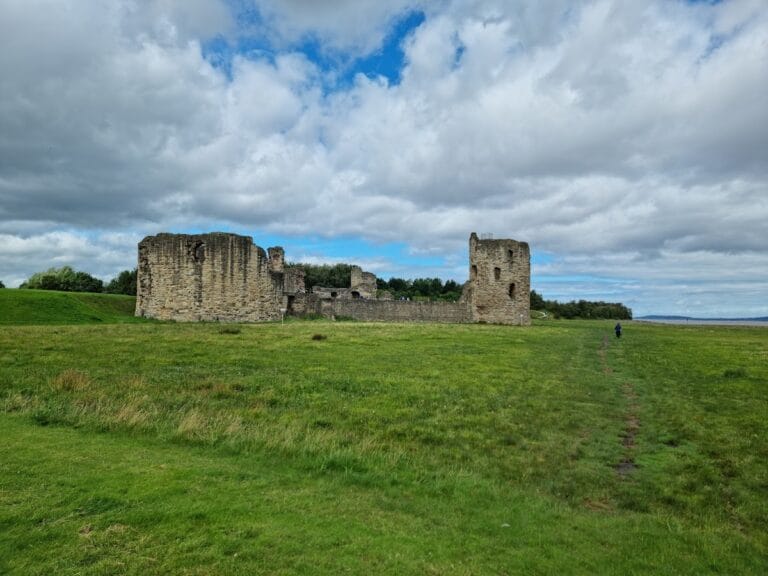
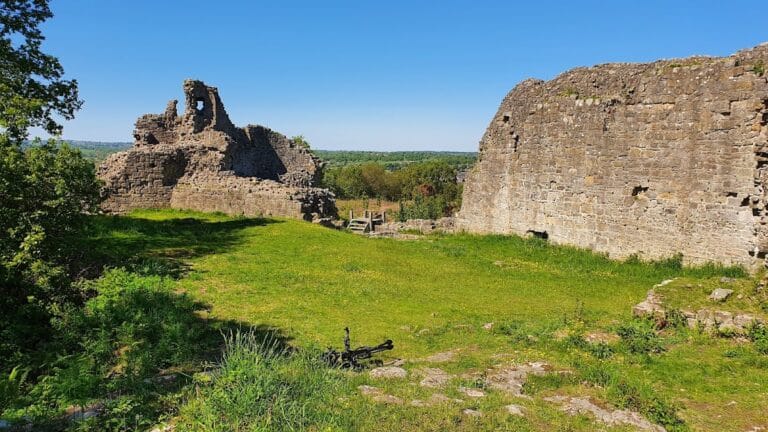
Ewloe occupies a steep, wooded promontory in a valley overlooking the meeting point of two streams, with higher ground to the south and the Wepre Valley beyond. Its asymmetrical curtain wall, a defensive perimeter wall, encloses two courtyards and combines features of a raised-mound castle with those of an enclosure castle. A rock-cut neck ditch, cut across the southern approach, defended the promontory, while an external defensive rampart occupied the higher ground beyond it. The castle was built from locally quarried sandstone, and its surviving fabric is now in ruin.
The upper inner ward
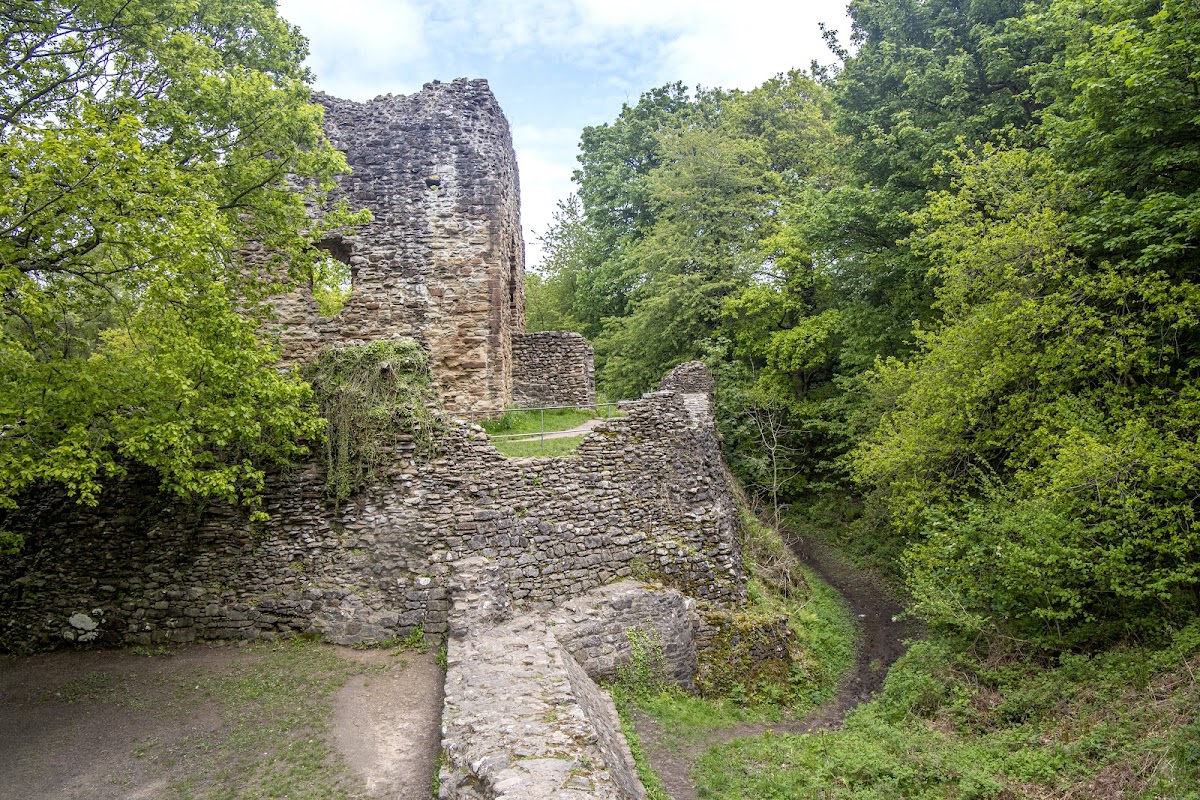
The upper inner ward is triangular and contains the D-shaped or horseshoe-shaped tower known as the Welsh Keep. It stands on a stone outcrop that forms the motte, or raised mound, with a stone retaining wall called a chemise around its base. This arrangement is unusual in relation to later Plantagenet keeps. Rather than projecting from a wall or gatehouse, the tower occupies the motte within the upper ward. A stair led to its first-floor gateway. Its form has been compared with a similar D-shaped tower built by Llywelyn the Great at Castell y Bere in the 1220s.
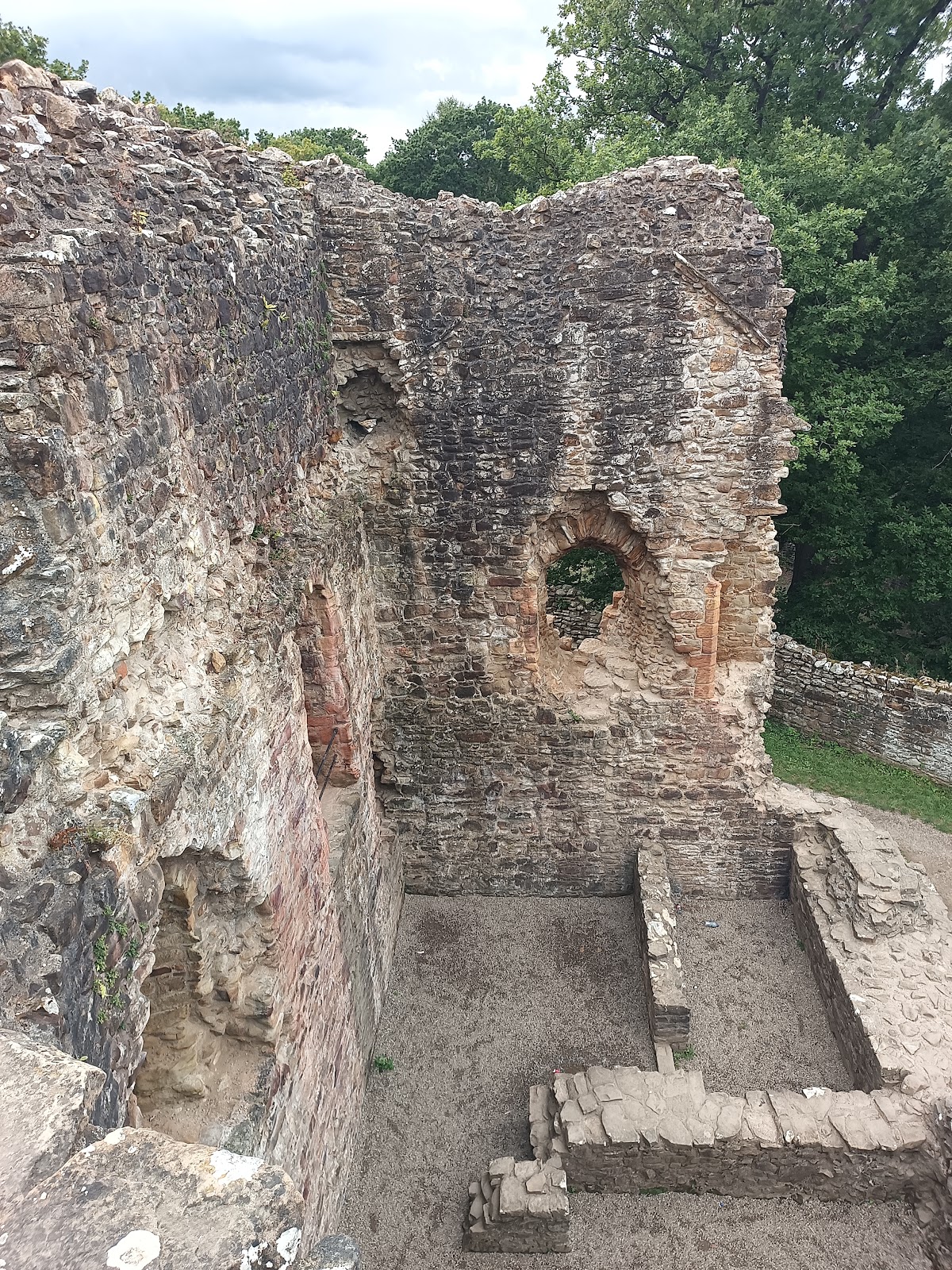
The Welsh Keep had outer walls about 2 metres thick at the base and rose to approximately 11 metres. They extended above the upper storey, helping protect its pitched roof from projectiles. A parapet, the protected upper edge of a wall or tower, ran around the top. Stonework includes spaces interpreted as storage slots in the roof spaces. Inside, a single first-floor hall stood above a lower ground-floor chamber. Narrow arrowslits, openings through which defenders could shoot, pierced the curved sides, while the flat side facing the outer ward contained a Romanesque window, an opening in a medieval style known for rounded arches and heavy masonry.
The lower outer ward
The lower outer ward was enclosed by two separate sections of curtain wall that met at a circular fortified tower on a rocky knoll. Because the wall sections did not join, ladders would have been needed to reach their parapets. No gateway connected the inner ward with the outer courtyard. Movement throughout the castle instead relied on wooden ramps, and several wooden buildings stood within the outer ward.