Château de Montréal: A Historic Medieval Castle in France


Visitor Information
Google Rating: 4.4
Popularity: Medium
Google Maps: View on Google Maps
Country: France
Civilization: Unclassified
Remains: Military

History
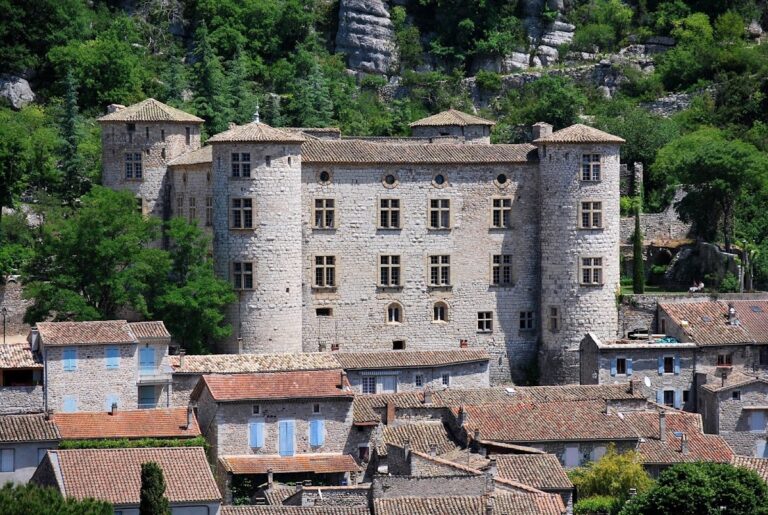
The Château de Montréal stands in the village of Montréal in France, constructed originally by the medieval lords of the region. Its name traces back to the Latin term “Mons Regalis,” meaning “King’s Mountain,” which evolved through “Mont Royal” to the current name, reflecting its prominent rocky hilltop position overlooking the settlement.
The origins of the castle date to the 12th century when the Balazuc family built a Romanesque defensive tower on the site. This tower was one of three in the village, serving as a stronghold in the early medieval defensive network. The castle was first recorded in 1206 and was owned by Pierre de Vernon, a descendant of the Balazuc lineage, by 1210. During the following century, the original tower was expanded with the addition of a residential building known as a logis, and a surrounding ring wall was constructed. This fortress was part of a chain of eight castles safeguarding the region’s valuable silver mines located near Argentaria, today known as Largentière.
In 1343, the castle came back into the hands of the Balazuc family through marriage and remained their possession for roughly three centuries. Throughout this period, the site was enlarged and transformed, reflecting Gothic architectural influences. Around the late 15th to early 16th century, a Renaissance-style logis was added, signaling a shift towards more comfortable and refined living spaces within the fortress.
Ownership changed in 1638 when the castle passed by marriage to the Hautefort de Lestrange family. They modified the Renaissance logis, notably altering its north facade by removing a small corner turret while preserving a decorative supporting stone known as a console. Later, in 1742, control shifted to the Merle de Lagorce family. During this time, a significant dowry included the removal of 58 Aubusson tapestries from the castle; these tapestries survive today in the town hall of nearby Vallon-Pont-d’Arc.
The castle was sold again in 1775 to Nicolas de Beauvoir du Roure but only fifteen years later, amid the upheavals of the French Revolution, Simon de Lapierre acquired the property. Lapierre took measures that reduced the castle’s height, demolishing the upper seven meters of the keep and selling the stones as building material. This marked a period of decline and partial dismantling linked to revolutionary turmoil.
In the 19th century, the castle adapted to new uses, notably housing a silkworm breeding facility. The west facade was remodeled during this time, and a fire in 1875 destroyed the original Renaissance ceilings in the logis. Subsequent owners utilized the castle primarily for agricultural activities and as a wine cellar.
In 1998, Hubert Fénestrier, a skilled mason, purchased the château and embarked on a gradual restoration effort. Initially working independently, his restoration work expanded after 2008 with professional assistance. Since 2000, the site has gained official recognition as a Monument historique, ensuring its protection and preservation.
Remains
The Château de Montréal complex is centered around a sturdy square keep, or bergfried, constructed in the 12th century. This military tower was built from rusticated ashlar stone, meaning roughly dressed blocks that present a rugged surface, and measures ten meters on each side at the base. Its walls are impressively thick, measuring about 2.5 meters, and the tower currently reaches twenty-five meters in height. The original entrance was raised five meters above ground level as a defensive feature, accessed via a gate protected by a robust defensive mechanism and narrow arrow slits that allowed defenders to shoot while remaining shielded.
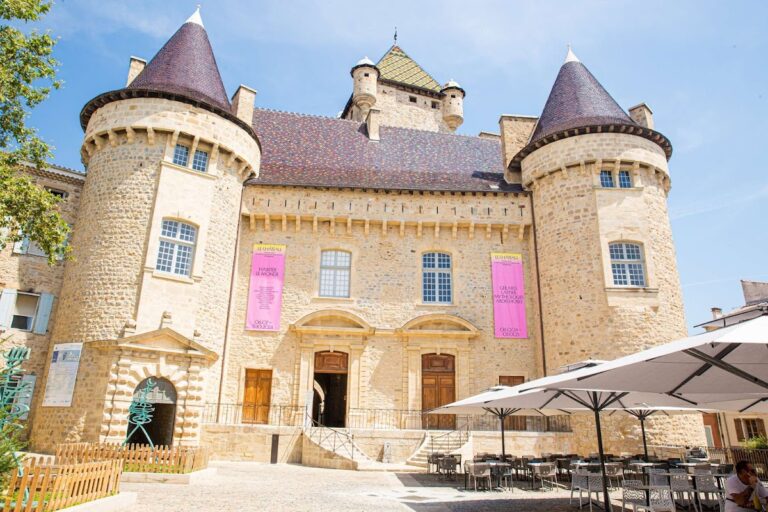
Attached to the keep are two main residential structures from later centuries: a Gothic logis and a Renaissance logis. The Renaissance addition, from the late 15th or early 16th century, includes a gatehouse measuring seven by four meters. This gatehouse opens into a small paved courtyard enclosed by living quarters, reflecting a design from a period focusing more on comfort alongside defense. The vaulted passage through the gatehouse features a low cross vault, its central keystone bearing the coat of arms of the Balazuc family, linking the architecture visibly to its early noble owners.
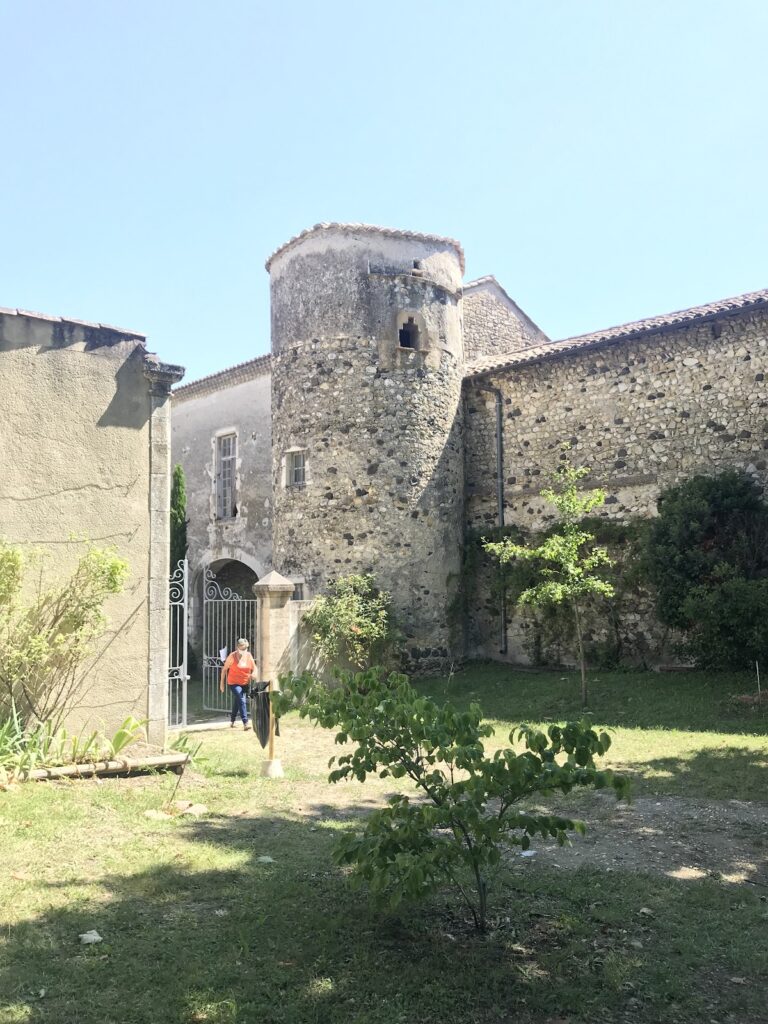
Within the courtyard, three cisterns collect and store water, compensating for the absence of a well on the site. The gatehouse corridor leads to a pointed-arch door flanked by arrow slits, which provides access to a prominent staircase tower. This tower contains a large spiral staircase with exceptionally wide steps of two meters, dated by an inscription to 1559. Along the east facade of the Renaissance logis, remnants of machicolations—openings used for dropping objects on attackers—remain visible in the form of corbels, though the full defensive structures connected to them no longer survive.
Inside the Renaissance logis on the ground floor, a vaulted hall is now divided into three rooms. These include a pantry that was later converted into a curing chamber, a lordly dining room which once hosted a now-removed fireplace, and a kitchen retaining its original fireplace. The earlier Gothic logis once featured Romanesque-style fireplaces and stone gargoyles, architectural elements that have since been dismantled and sold.
The upper floors of both residential buildings, connected by a gallery passage, are private and not accessible to the public today. Near the residential quarters lies the castle’s small chapel. This unique space has a floor incorporating a former altar slab and was historically warmed by the adjacent bread oven, whose rear wall forms one side of the chapel, illustrating a close relationship between daily living spaces and religious functions.
Inside the keep, the focus remains entirely military; it contains no residential fittings. Narrow arrow slits provide minimal light, while the ground floor served as storage and included one of the cisterns. The first floor functioned as a guardroom, which communicated with the battlements above through wall channels enabling guards to coordinate defense across levels. Beneath the keep, a cellar accessed by a metal staircase extends down 5.5 meters, used historically for storing food supplies during sieges.
The castle’s grounds incorporate a former orchard toward the north and an outer courtyard to the south, containing service buildings dating from the late 18th century. The entire property is enclosed by a ring wall, with the original northern entrance dating back to the 13th century preserved, though present-day access is through the southern outer courtyard. The Renaissance courtyard is paved and includes a well and a balcony gallery visible from the upper levels. The terrace atop the keep connects to the guardroom through a concealed conduit within the wall, allowing strategic communication during defense.
Damage sustained over the centuries includes partial demolition in the revolutionary period, specifically the loss of the upper section of the keep, and fire destruction in 1875 that affected the Renaissance ceilings. Modifications made in the 19th century altered the west facade of the castle, reflecting changing functions and tastes of its various owners through time.
Nearby sites