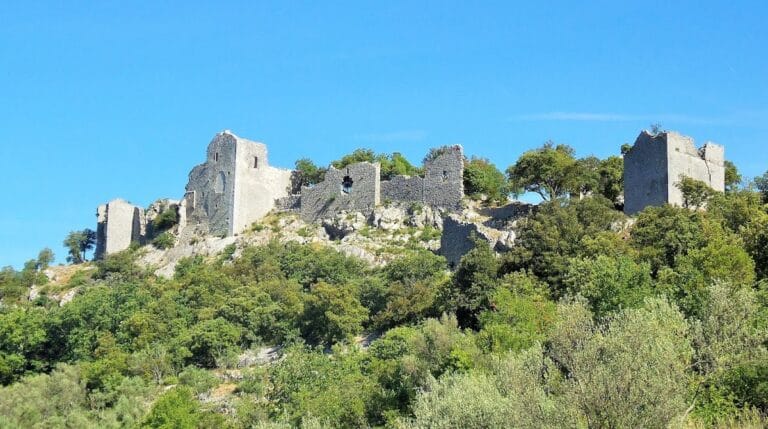
Château des Roure: A Medieval Fortress and Silk Museum in France


Site at a Glance
- Rating
- 4.4
- Popularity
- Medium
- Country
- France
- Primary era
- Medieval
- External website
- Open
- Eras represented
- Medieval, Modern
- Civilizations
- French
- Site type
- Military
- Remains
- Castle
On this page11 sections
History
Château des Roure is a late-medieval fortress in Labastide-de-Virac, France, built and developed through successive feudal and early modern phases on the route over the Pont d’Arc. Its position between Nîmes and Privas gave it a strategic role during periods of religious conflict.
From feudal watchtower to fortified residence
A square tower may have been established in the eleventh century to monitor the major route crossing the Pont d’Arc. At the end of the fourteenth century, a new castle was built over the earlier feudal fortification. The first proprietors were identified as the prior of Pont-Saint-Esprit and later Philippe de Sautel.
During the sixteenth century, Labastide became the possession of Philippe Sautel, lord of Barjac. His son Claude constructed a fortified residence, which took the name Roure after Claude’s daughter married Pierre de Beauvoir du Roure. The castle then belonged to the Beauvoir de Grimoard du Roure family, whose lord held the title Count of Roure.
Religious conflict and royal demolition
Château des Roure became involved in the French Wars of Religion, the sixteenth- and early seventeenth-century conflicts between Catholics and Protestants in France, and later in the Camisard revolt, an uprising by predominantly Protestant insurgents in the Cévennes after the revocation of the Edict of Nantes. In 1628, the Huguenot Count of Roure sheltered the Duke of Rohan, a leading Huguenot military and political commander, at the castle.
In 1629, Louis XIII and Cardinal Richelieu ordered the castle’s defensive parts and the village ramparts to be demolished. The royal action removed the projecting watch turrets, keep, machicolations, and other defensive elements. After the Edict of Nantes was revoked in 1685, the Count of Roure abjured Protestantism and became Catholic. In 1703, Jean Cavalier, a prominent Camisard leader, captured Labastide-de-Virac and burned its church.
From family property to museum
In 1825, the Beauvoir du Roure family sold the castle to its tenant farmer, a member of the Pradier family. The building was then converted into a magnanerie, an establishment for raising silkworms to produce silk. It became one of the largest such establishments in the region, although the activity declined at the end of the First World War.
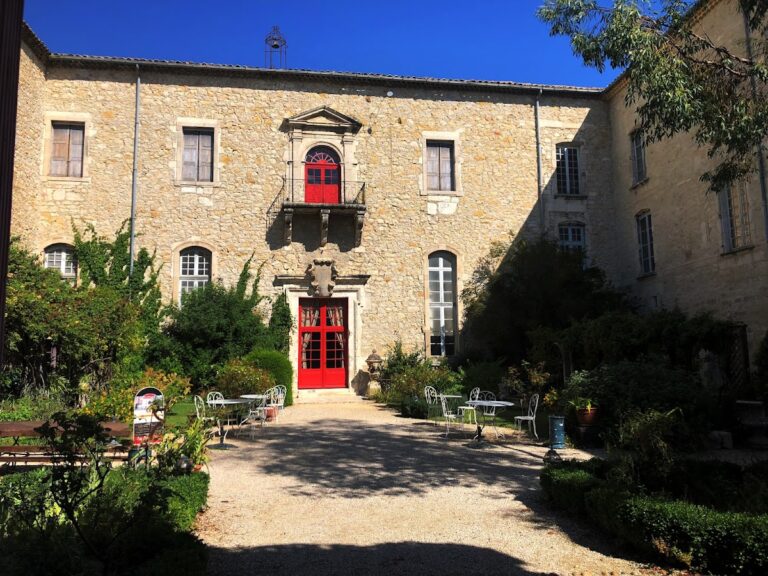
Descendants of the Pradier family opened the castle to the public in 1975. It was classified as a French historic monument in 1978, with protection covering the façades and roofs, the inner courtyard, the staircase, and fireplaces on the ground floor and in the first-floor great hall. Renovation between 2013 and 2016 restored major defensive features and other parts of the building. The castle is now owned by the Lascombe family and functions as a museum. Its interpretation covers the history of the castle and regional silk production, while a silk museum has received the public since 2002.
Remains
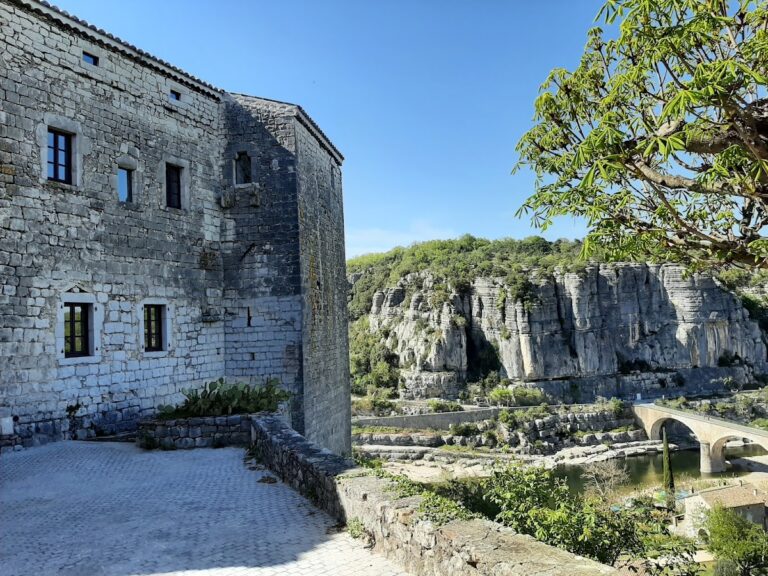
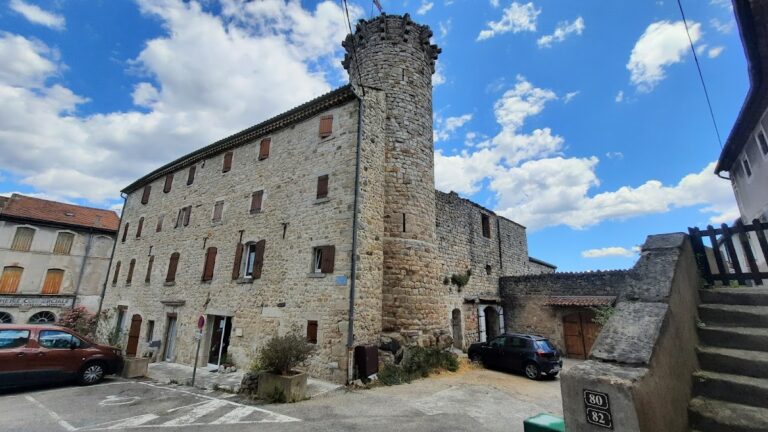
Château des Roure is a powerful quadrangular structure within the village. Houses were built around it, forming a natural rampart around the castle. The surviving complex combines the restored defensive outline with interior spaces connected to its later use as a silkworm farm and to its present museum function.
Defensive structure
Towers and keep
Two round towers are roofed with orange tiles, while two projecting watch turrets extend from the castle. The site also includes a keep, a wall-walk, or circulation path along the top of a fortified wall, and machicolations, which are projecting defensive galleries or openings used to drop objects onto attackers. These elements were demolished in 1629 and restored during the renovation carried out from 2013 to 2016.
Trebuchet and medieval park
A replica trebuchet, a medieval siege engine that launched projectiles using a counterweight or similar throwing mechanism, stands at the foot of the castle. A medieval park established in 2019 is associated with historical demonstrations and activities.
Interior and silk production
Rooms and circulation
The interior contains arranged rooms, a large spiral staircase, French-style ceilings, and a monumental fireplace. The protected fireplaces are located on the ground floor and in the great hall on the first floor.
Magnanerie
A magnanerie within the castle presents the raising of silkworms and the production of silk thread. Mulberry trees are cultivated on the site, and silkworms are raised for cultural and educational purposes, linking the surviving building to the agricultural activity that followed its medieval and military history.