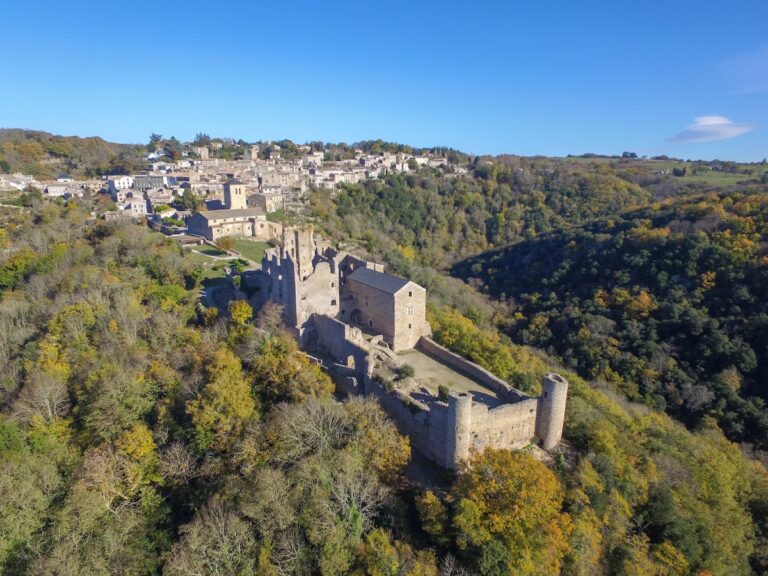
Château de Campan: A Historic Castle in Anglès, France
Visitor Information
Google Rating: 5
Popularity: Very Low
Country: France
Civilization: Unclassified
Site type: Military
Remains: Castle

History
The Château de Campan is situated in the village of Anglès, France. Its origins trace back to the 11th century when it was built by medieval Christian builders to secure control over a strategic passage through the Thoré valley.
The site itself reveals signs of human activity dating from much earlier times, including prehistoric monuments such as dolmens and menhirs. These ancient standing stones suggest that this location has long been valued for its strategic position in controlling movement through the surrounding landscape.
The earliest phase of the castle’s construction consisted of three rectangular towers linked by a robust curtain wall. This defensive complex was surrounded by a moat deliberately carved from solid rock, enhancing its protection. Local tradition associates the castle with the Knights Templar, a medieval Christian military order, who reportedly used it as a resting point on journeys between the Ariège region and the Cévennes mountains. In support of this link, interior staircases still bear horseshoe marks that are interpreted as traces left by Templar riders.
By the 15th century, additional fortifications were introduced, including a round tower at the northwest corner, equipped with narrow vertical openings for archers and machicolations—stone projections with openings used to defend the castle’s base. During the 16th century, the internal courtyard was transformed with the construction of a substantial new residence, featuring an unusually elongated staircase tower known as barlong-shaped.
The first known lord of the castle was Guillaume de Citou in the mid-1500s, followed by his son Jean-Philippe. Through marriage, ownership passed to the Saïx family, who maintained control for around one hundred years. The Saïx undertook considerable renovations, with two major campaigns evidenced by repurposed architectural elements dated 1666 and 1671. Following this period, the property came under the Bedos family from nearby Puylaurens. Among them was Jean-Gaston de Bedos, who held the titles lord of Campan and Paulignan, and Henri-Dominique de Bedos-Campan, an infantry captain who took part in the American War of Independence. The Bedos-Campan family line ended in the late 19th century with Lucie Dominique de Bedos-Campan.
Recognizing its historical and architectural importance, the castle’s roofs and façades were officially listed as protected historic monuments on May 17, 1961.
Remains
The Château de Campan presents a complex layout shaped by centuries of architectural additions. It is oriented to face the Montagne Noire and is composed of a large main building accompanied by several towers of different shapes and functions, reflecting the various construction phases it has undergone.
The northwest corner features a prominent round tower that houses a spiral staircase. This staircase remains notable not only for its age but also for the horseshoe imprints left on its steps, supporting stories of the Knights Templar’s presence. About the same corner, the defensive character of the tower is enhanced by narrow openings for archers and stone machicolations designed to allow defenders to strike at attackers directly below the walls.
Towards the south, a rectangular tower rises with distinctive barlong vaults—vaulting shaped with an elongated rectangle—that supports the main staircase and a solid buttress, projecting strength to the structure. Adjacent to this southern tower lies a corbelled turret, a small overhanging projection supported by stone brackets, providing additional vantage points or defensive positions.
Further details of the castle’s fortifications include a watch turret, known as an échauguette, positioned at the southeast corner and a small round defensive tower to the southwest. These turrets contribute to the irregular, intricate floor plan characteristic of the castle’s successive building stages.
Surrounding the entire assembly, a moat filled with water was hollowed out directly from the rocky ground, preserving the castle’s initial footprint without alteration. This feature provided a formidable natural barrier against attackers over the centuries.
Within the estate, associated structures add to its historical fabric. Extensive gardens indicate a cultivated and maintained landscape, while a sizable farmstead is notable for a circular tower centered on its western façade. A system of water channels feeds numerous basins on the property, demonstrating careful management of resources. Of particular interest is a specialized warren equipped with a predator trap—an enclosure designed for the controlled raising of rabbits or game and protection from natural threats.
Among architectural elements reused from now-lost buildings, a lintel dated 1671 marks the end of the 17th-century renovation period. This piece not only links the current remains with earlier parts of the estate but also attests to ongoing adaptations that have shaped the castle’s present form.