Castle of Salir: A Medieval Fortress in Loulé, Portugal


Visitor Information
Google Rating: 3.9
Popularity: Low
Google Maps: View on Google Maps
Official Website: www.monumentos.gov.pt
Country: Portugal
Civilization: Medieval European
Remains: Military

History
The Castle of Salir is located in the municipality of Loulé, Portugal. It was originally built by the Almohad Muslim rulers during their control of the Algarve region in the 12th century. The fortress was part of a defensive network to protect local communities from Christian military campaigns.
The site saw human occupation dating back to at least the late 11th century, with evidence of a Muslim settlement nearby, including a funerary stele dated to 1016. During the Almohad period in the 12th and early 13th centuries, the castle functioned as a rural stronghold. Positioned strategically atop a hill, it guarded important inland routes and provided refuge for the population during Christian incursions, particularly as the Reconquista advanced.
Between 1248 and 1250, Christian forces, notably the Order of Santiago, captured Salir shortly after taking the nearby town of Tavira. Following its conquest, the castle was set ablaze but subsequently rebuilt twice under Christian rule. It served as a military outpost during the Algarve campaign, hosting notable commanders such as D. Paio Peres Correia and King D. Afonso III. However, by the 14th century, military focus shifted toward the coast, reducing the castle’s strategic importance, which led to its gradual abandonment.
Over time, the Castle of Salir fell into ruin, a decline accelerated by the 1755 earthquake that damaged many buildings in the region. Later construction activities reused stones from the fortress, further contributing to its deterioration. Archaeological investigations beginning in the 1980s uncovered many remains that shed light on the castle’s extensive history. In recent years, efforts to recognize and protect the site have gained momentum, reflecting its cultural and historical relevance.
Remains
The Castle of Salir occupies a limestone hill rising about 250 meters above sea level, overlooking valleys to the north and northeast with steep slopes, and gentler terrain to the southwest. Its defensive enclosure originally formed an irregular polygon covering approximately 4,200 square meters. Walls stand around 1.8 meters high and 2 meters thick, constructed primarily using rammed earth—a technique where earth is compacted in layers—with limestone foundations supporting the towers.
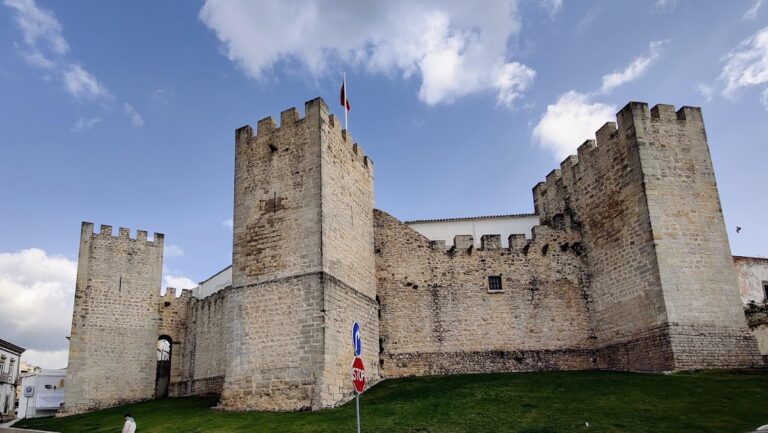
Four quadrangular towers survive today in varying conditions. One is located on the southwestern slope near a street that once bordered the southern wall; the second, known locally as the “Muro Maior” tower, sits on the northwest slope alongside remnants of 12th and 13th-century buildings. A third tower lies in a heavily ruined state on the northern steep rocky slope, while the fourth, called the “Alfarrobeira” tower, occupies the northeastern corner with its steep approach. The main castle entrance is thought to have been on the southern side where the slope is gentler, though no definite gate remains have been identified.
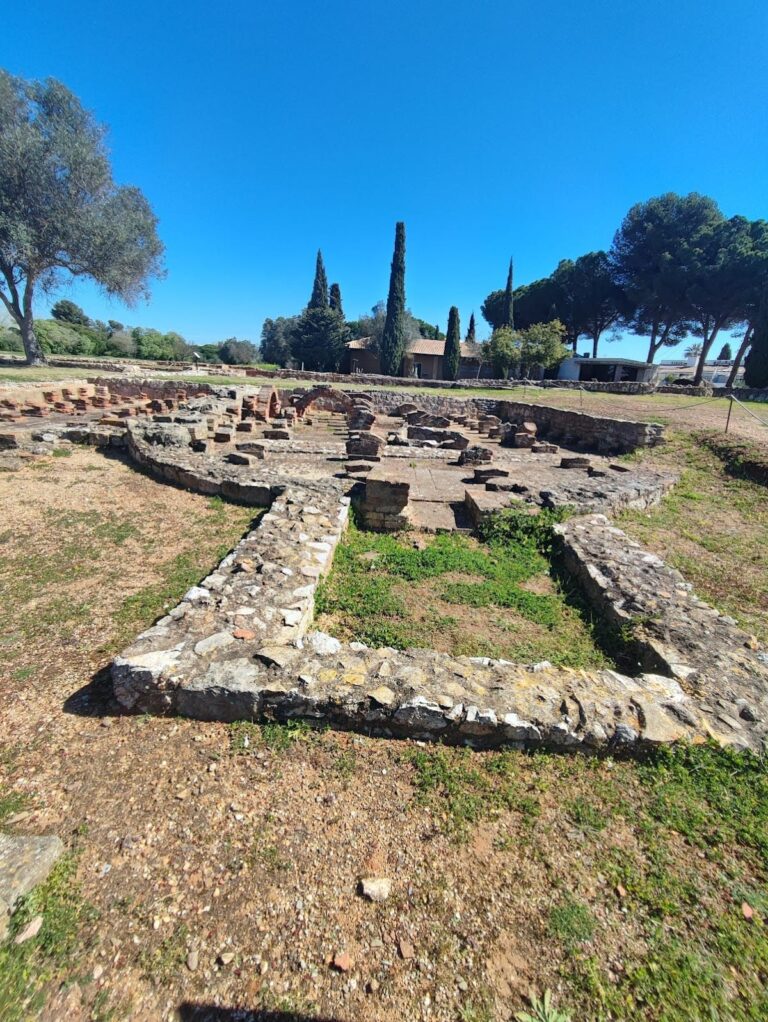
Excavations within the castle reveal an organized urban core laid out in a grid pattern. Six small, simple rectangular houses surround a central courtyard paved with stone slabs. These dwellings, built with rammed earth walls atop stone bases, each contained kitchens equipped with hearths, indicating domestic use. Additional structures include a narrow street roughly 1.8 meters wide that terminated at a wall, suggesting a peripheral neighborhood adjacent to the northwest defenses.
The site also features ten silos used for storage and ancient drainage systems that expelled water through small holes in the walls, reflecting attention to sanitation and resource management. Archaeologists uncovered a variety of objects ranging from glazed and unglazed ceramics spanning the 12th to 15th centuries to metal items such as scissors, knives, a decorated belt plate, and weapons. Bone fragments believed to be weaving tools and botanical remains, including seeds of wheat and acorns, point to the daily lives and agricultural practices of the inhabitants during the Islamic period.
Defense was provided by a complex circuit of five main walls incorporating the four rectangular towers. Wall thickness varies from one to nearly five meters, with some sections reaching up to four meters in height. Several wall segments have been assimilated into later constructions, while others remain partially ruined. East of the “Muro Maior” tower, excavators uncovered remains of Moorish kitchens and living quarters, now surrounded by landscaping that includes traditional Portuguese pavement stones and benches.
Within the excavated area stands a simple rectangular building oriented to the south, housing an interpretative center that serves as a museum and visitor facility. This structure aids in understanding the archaeological findings and complements the physical remains of the castle. Together, the ruins and artifacts present a well-preserved glimpse of a medieval fortress that once played a key role during a turbulent period in the Algarve’s history.
Nearby sites