Castle of Sabiote: A Historic Renaissance Fortress in Spain


Visitor Information
Google Rating: 4.6
Popularity: Medium
Google Maps: View on Google Maps
Official Website: www.sabiote.com
Country: Spain
Civilization: Unclassified
Remains: Military

History
The Castle of Sabiote stands in the municipality of Sabiote, Spain, and was initially established by Muslim builders in the 13th century. Its location atop La Loma hill had long been recognized for its strategic value, with fortifications dating back to ancient times.
During the Christian Reconquista, control of the site passed from Muslim to Christian hands, leading to significant rebuilding efforts. In the 13th century, Juan de Zúñiga oversaw major reconstruction that adapted the former Muslim alcázar to serve newly established Christian rule. The castle became a key element in asserting noble dominance over the surrounding lands, linked closely with the nearby Castle of Canena.
Centuries later, between 1538 and 1549, the castle underwent a dramatic transformation under the direction of the architect Andrés de Vandelvira. Commissioned by Don Francisco de los Cobos, a prominent secretary under emperors Charles V and Philip II, the castle was redesigned in the Renaissance style, influenced by Italian military architecture. This renovation turned the fortress into a palace-fortress featuring modern defensive elements inspired by contemporary Italian fortifications. The castle thus became one of the earliest examples of Renaissance bastioned military design on the Iberian Peninsula.
In the early 19th century, during the Napoleonic Wars, the castle suffered heavy damage at the hands of occupying French forces. Many of its artistic and architectural features were lost, leaving only parts of the original structure intact. Recognizing its historic and cultural importance, Spanish authorities declared the castle a Historic-Artistic Monument in 1931. Subsequent acknowledgments included designating its walled enclosure as a historic-artistic complex in 1972 and receiving special recognition from the Andalusian government in 1993. Today, local municipal authorities manage the site’s conservation and restoration efforts.
Historical records note that the castle once housed the sculpture known as San Juanito de Úbeda, attributed to Michelangelo, before it was relocated to the Sacra Capilla del Salvador in Úbeda. The fortress itself is referenced in medieval geography texts, specifically by the scholar al-Hamawi, situating it within the territory surrounding the city of Úbeda. This emphasizes the castle’s longstanding role in regional territorial organization and defense.
Remains
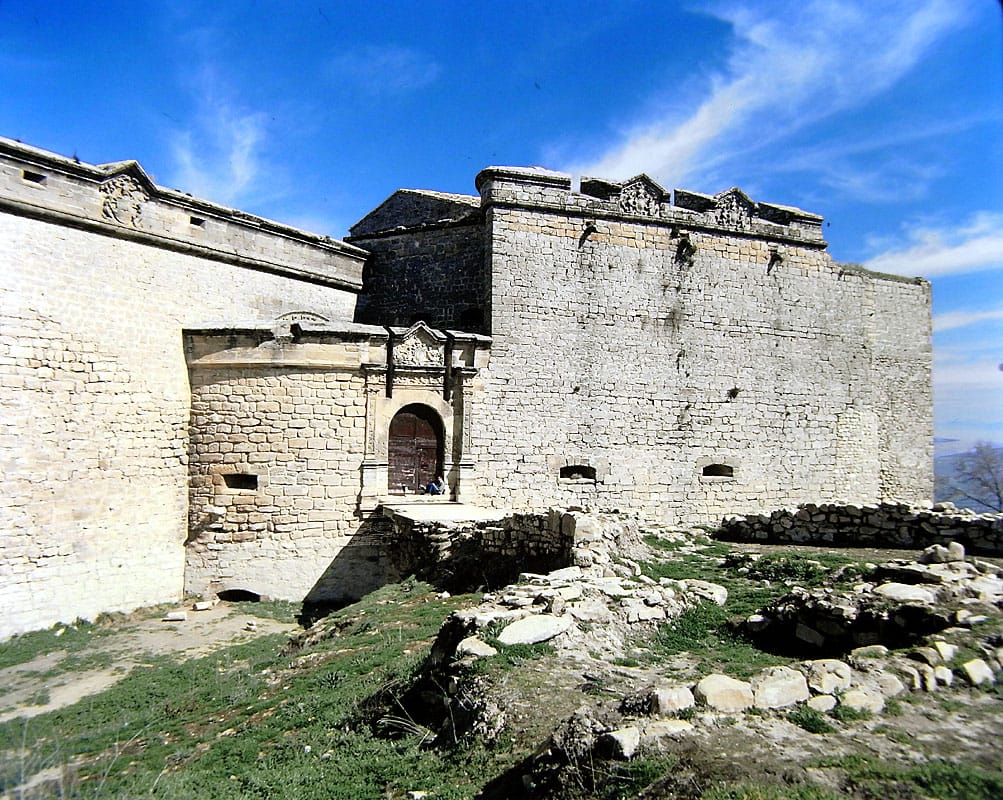
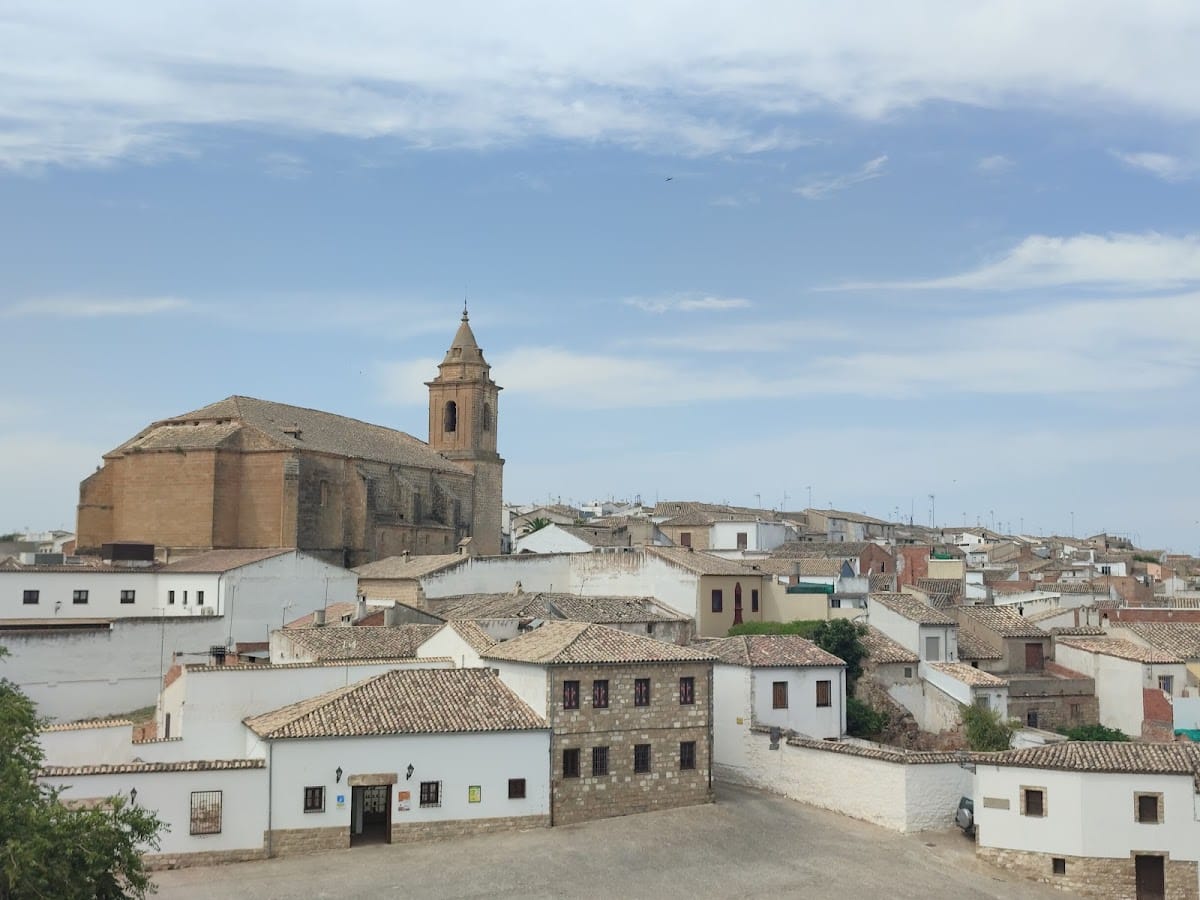
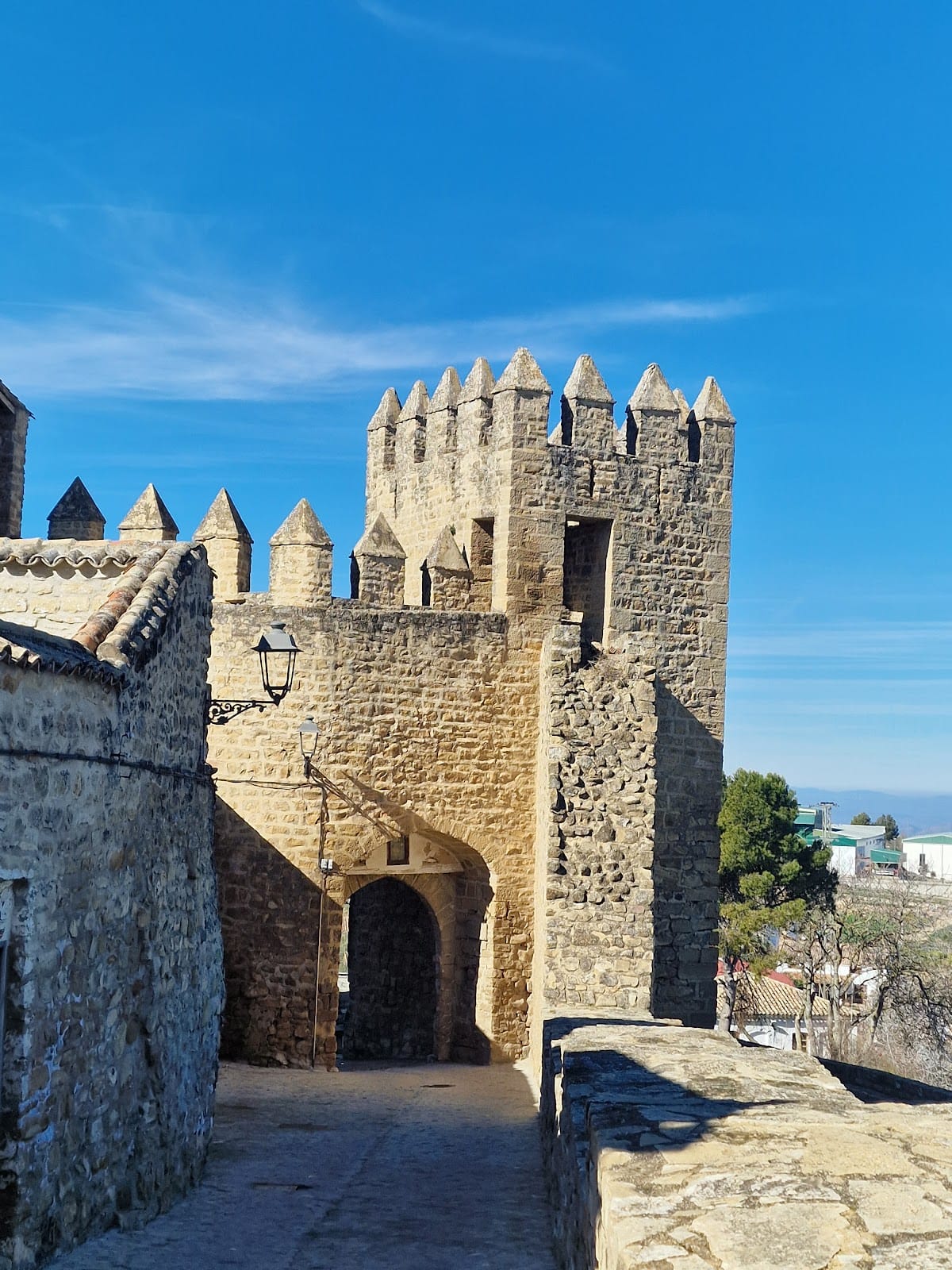
The Castle of Sabiote is positioned atop a small hill, overlooking the town plaza below. Originally enclosed by defensive walls, the fortress is accessed through a main gate protected by a moat. The 16th-century reconstruction introduced the Renaissance palace-fortress layout, which incorporated a bastioned system featuring angular, five-sided towers designed to improve defense against artillery. These towers were equipped with embrasures, small openings (troneras) for firing cannons, alongside narrow arrow slits (saeteras) for archers. Merlons and ear-shaped battlements (orejeras) crowned the walls, serving both functional and aesthetic roles.
The castle’s exterior displays a large Renaissance façade built from finely cut ashlar stone combined with traditional masonry. This façade is adorned with the coats of arms of Don Francisco de los Cobos and his wife Doña María, signifying their patronage. The main gate presents a sober yet robust appearance, characterized by a semicircular arch. Historically, it was equipped with a drawbridge and was topped by a heraldic shield. Decorative elements on the gate include archaic pilasters and Plateresque motifs—a style known for its intricate, silver-like ornamentation—along with relief sculptures emphasizing the founders’ heraldry.
Within the fortress, the interior arrangement centers around several courtyards framed by palatial Renaissance architecture, reflecting the dual military and residential purposes of the castle during the 16th century.
Surrounding the castle, remnants of the original walled enclosure are visible. Notably, near the site of the now-lost southern Puerta de la Villa, semicircular masonry towers and sections of wall still stand. A further fragment of the medieval walls survives near the southeastern Puerta del Tejar or Pilarillo gate, although it has undergone substantial repairs over time.
The castle’s defensive design reveals a clear influence from Italian military engineering of the Renaissance period, particularly the treatises of Francesco di Giorgio. This foresaw fortification principles that would become widespread in the following century. Decorative refinements on the castle include a frieze featuring grotesque figures on the entablature, and a Plateresque classical portal that prominently displays the coats of arms related to the castle’s founders.
From its elevated vantage point, the castle commands extensive views over the Guadalimar valley as well as the distant mountain ranges of Sierra Morena and Sierra Mágina. This commanding position underlines its continued strategic importance since ancient times.
Nearby sites