Castle of Pau: A Historic Fortress and Museum in France

Visitor Information
Google Rating: 4.4
Popularity: Medium
Official Website: www.chateau-pau.fr
Country: France
Civilization: Medieval European
Site type: Military
Remains: Castle

History
The Castle of Pau is located in the town of Pau, France. It was originally constructed by the medieval rulers of the Béarn region as a military fortress.
The earliest known parts of the castle date back to the 12th century when Gaston IV of Béarn built three key towers—Mazères, Billère, and Montauser—on a rocky hill overlooking the Gave river and bordered by the Hédas ravine. This strategic position allowed control over the surrounding territory. In the 14th century, Gaston III, Count of Foix, also known as Gaston Fébus, strengthened the castle’s defenses by adding a tall brick donjon (a fortified tower) standing 33 meters high. This donjon bears the inscription “Febus me fe,” meaning “Fébus made me,” highlighting his role in the castle’s fortification during a period marked by conflicts between France and England.
In the early 16th century, the castle’s function shifted from a purely military stronghold to a Renaissance residence of pleasure and governance. This change occurred when the court of Navarre was established there in 1512. Henry II of Navarre and his wife Marguerite d’Angoulême lived in the castle, leaving their initials carved into walls and ceilings, which were preserved through later restorations. The castle gained further historical importance as the birthplace of the future Henry IV of France and Navarre, born on December 13, 1553. Although Henry IV did not spend his childhood or final days at the castle, it became closely associated with him, symbolized by the preservation of his cradle made from a turtle shell.
Following the loss of Béarn’s independence in 1620, when King Louis XIII entered the castle and took an oath marking royal authority over the region, the castle’s role diminished. It entered a period of decline, serving administrative purposes and functioning as a prison, with little royal presence.
In the 19th century, restoration efforts sought to revive the castle’s status as a royal residence and a memorial to Henry IV. Under Louis-Philippe and later Napoleon III, the castle was restored and adapted. Notably, in 1848, the castle briefly held Emir Abd El-Kader as a prisoner. Since 1927, the castle has operated as a national museum dedicated to Henry IV’s memory and history.
Remains
The Castle of Pau occupies a polygonal layout atop a rocky spur rising 30 meters above the surrounding landscape. It is protected by two main defensive walls, or enceintes. The first is a crenellated stone wall, while the second forms a steep 60-degree slope called a glacis, topped by a walkway known as a chemin de ronde. A third defensive wall, originally separate, was incorporated into the castle during the 15th century. The entire complex covers 6,227 square meters, with the main building occupying 2,300 square meters and the central courtyard measuring 850 square meters.
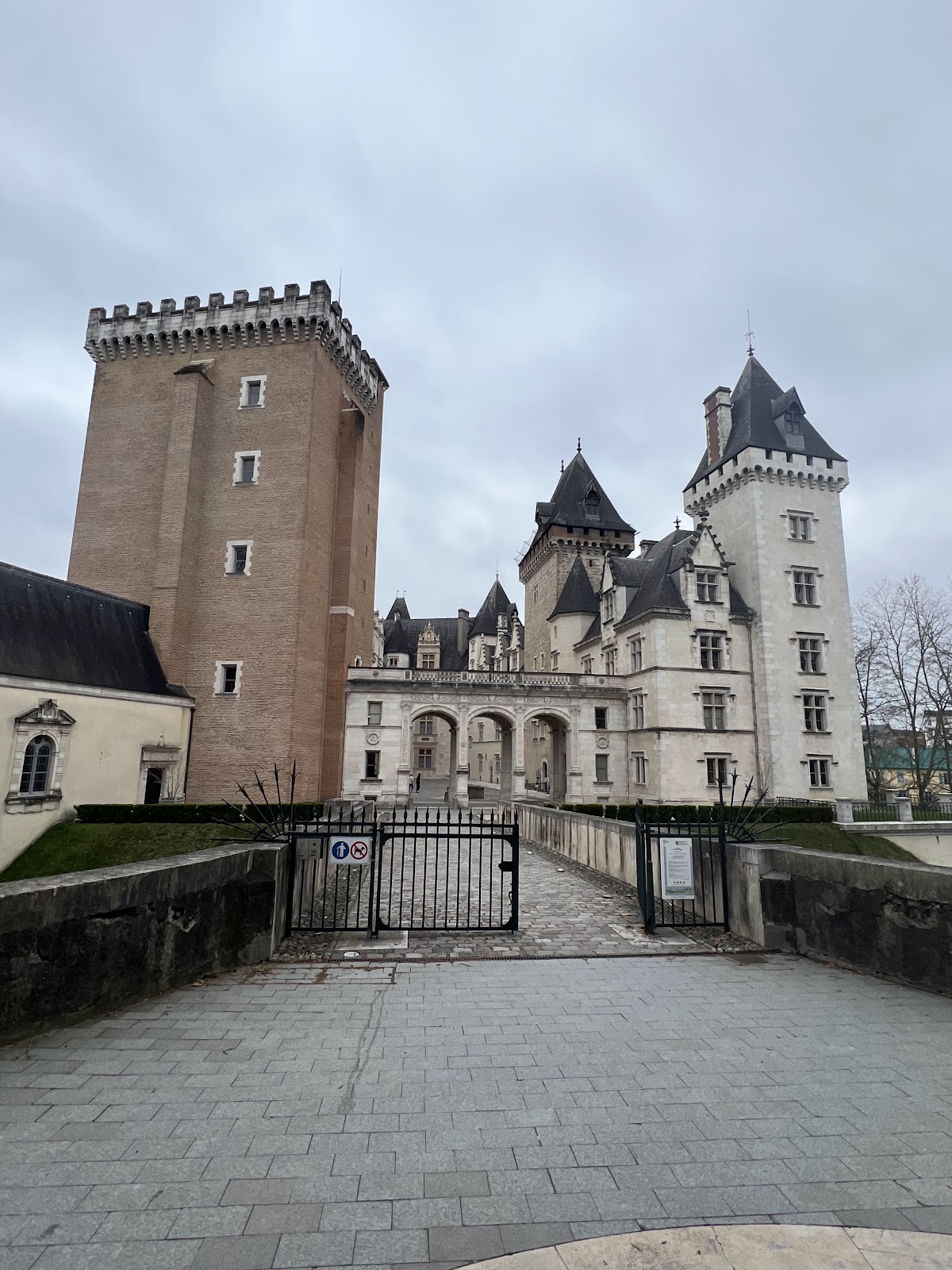
Among the castle’s towers, six rectangular ones date from the 12th to the 19th centuries. The Tour de la Monnaie, originally called the Tour du Moulin, stands 18 meters tall and was built around 1375. This tower housed a mint from the mid-16th century until 1778, reflecting the castle’s administrative functions. The 33-meter-high brick donjon, known as the Tour Gaston-Fébus, features walls 2.8 meters thick and was constructed by Gaston Fébus in the 14th century. The 12th-century towers Mazères and Billère rise 22.3 and 30 meters respectively, with square bases measuring approximately 7 meters on each side; both have undergone modifications over the centuries.
The southern main wing, called the aile méridionale, contains the grand apartments situated between the Mazères tower and the donjon. This section features Renaissance-style windows and a terrace dating from the 16th century. A monumental staircase with 107 steps, built around 1528 under Henri d’Albret and Marguerite d’Angoulême, connects the floors. On the ground floor, the large hall known as the salle des cent couverts contains an 18-meter-long table capable of seating about 100 guests. This hall is decorated with Gobelins tapestries illustrating hunting scenes and other motifs. The first-floor salons include the former medieval tinel, a hall used for Béarn’s main court and royal ceremonies, adorned with 16th-century stone fireplaces and tapestries.
While much of the castle’s original interior decoration was lost over time, 19th-century restorations reintroduced neo-Renaissance and neo-Gothic furnishings. These include a significant collection of tapestries from the 16th to 19th centuries, mainly produced by the Gobelins manufactory, as well as furniture dating from the 15th to 18th centuries. The chapel, consecrated in 1843, occupies a 16th-century defensive outbuilding at the eastern entrance. It features a stained-glass window depicting the Adoration of the Magi, inspired by the painter Zurbarán, and a commemorative plaque honoring Henry IV, restored after the French Revolution.
The courtyard’s paving evolved over the centuries from medieval stone to a 16th-century pebble mosaic decorated with floral and star patterns. This was later replaced by earth and gravel before being restored in 2015 with 28,200 cobblestones. Surrounding the castle is a 22-hectare national domain, remnants of the royal gardens and parks developed from the Middle Ages through the Renaissance. These gardens include the Petit Jardin, Grand Jardin de Bas, and Grand Jardin de Haut, featuring parterres (formal garden beds), canals, orchards, and wooded areas.
Several outbuildings once existed, such as the Castèt Besiàt, a pleasure house built by Jeanne d’Albret, and the Tortaguère, a turtle pond, both now lost. Present-day dependencies include the Maison Baylaucq, dating from at least 1740, which is now part of the museum complex. The 19th-century restorations also altered the castle’s appearance: Louis-Philippe’s architects removed some medieval fortifications, added a faux tower named Tour Louis-Philippe, and installed neo-Renaissance interiors. Napoleon III’s architects restored the facades, demolished a dilapidated wing called the Chancellerie, and built a three-arched portico connecting the donjon to the rest of the castle.
Modern adaptations include an elevator installed in the Tour de la Monnaie and museum facilities housed in the 19th-century north-east wing and the Tour Napoléon III, which contain offices and exhibition spaces.
Nearby sites