Castle of Monopoli: A Historic Fortress in Italy


Visitor Information
Google Rating: 4.4
Popularity: Medium
Google Maps: View on Google Maps
Official Website: www.comune.monopoli.ba.it
Country: Italy
Civilization: Unclassified
Remains: Military

History
The Castle of Monopoli stands within the municipality of Monopoli in Italy. Its origins trace back to multiple civilizations, with the earliest phases attributed to the Messapians, an ancient people active during the 5th century BCE.
The site first gained defensive importance in antiquity through the construction of substantial Messapian walls. Later, during the 1st century BCE, the Romans built a monumental gate atop these earlier fortifications, reflecting the site’s continued strategic role. By the late 10th century CE, a religious presence was established with the founding of the church of San Nicola in Pinna by a local figure named Sassone. This church, accompanied by a monastery, enjoyed documented privileges and land grants across the 11th to 14th centuries, before disappearing from records.
The castle as it appears today was commissioned during the Spanish rule in the mid-16th century. Emperor Charles V ordered its construction in 1552 as part of the coastal defensive system in the Apulia region. The fortress was built on a promontory known as Punta Pinna, incorporating the earlier church and the Roman gate into its structure. The work was completed under the oversight of either Viceroy Don Pedro Álvarez de Toledo or Marquis Don Ferrante Loffredo, according to different accounts.
In 1600, the castle underwent significant expansion and renovation. These changes transformed it from a strict military fortress into a space with residential functions, significantly altering both its exterior and interior organization.
During the first half of the 19th century, the castle’s role shifted dramatically when it was used as a district prison. This function continued until 1969, during which time the fortress gained a reputation tied to harsh events such as the imprisonment, torture, and execution of prisoners of war. These darker episodes contributed to local tales about the castle being haunted.
After decades of abandonment, the castle experienced thorough restoration and consolidation processes beginning in the 1990s and continuing into the early 21st century. Since then, it has become a cultural venue, hosting exhibitions and events including the Museo del Mare, established in 2010 to present the maritime history of Monopoli.
Notably, archaeological excavations led by Dr. Miranda Carrieri and the Soprintendenza Archeologica di Puglia between the 1990s and 2010 revealed the site’s complex layering of historical phases, from prehistoric fortifications to Roman and medieval structures, culminating in the imposing 16th-century fortress. The castle’s history also includes charming anecdotes, such as coral fishing beneath its walls during the 1700s and the remarkable life of Colonel Martino Coquemont, who lived to 101 years old and died in 1773.
Remains
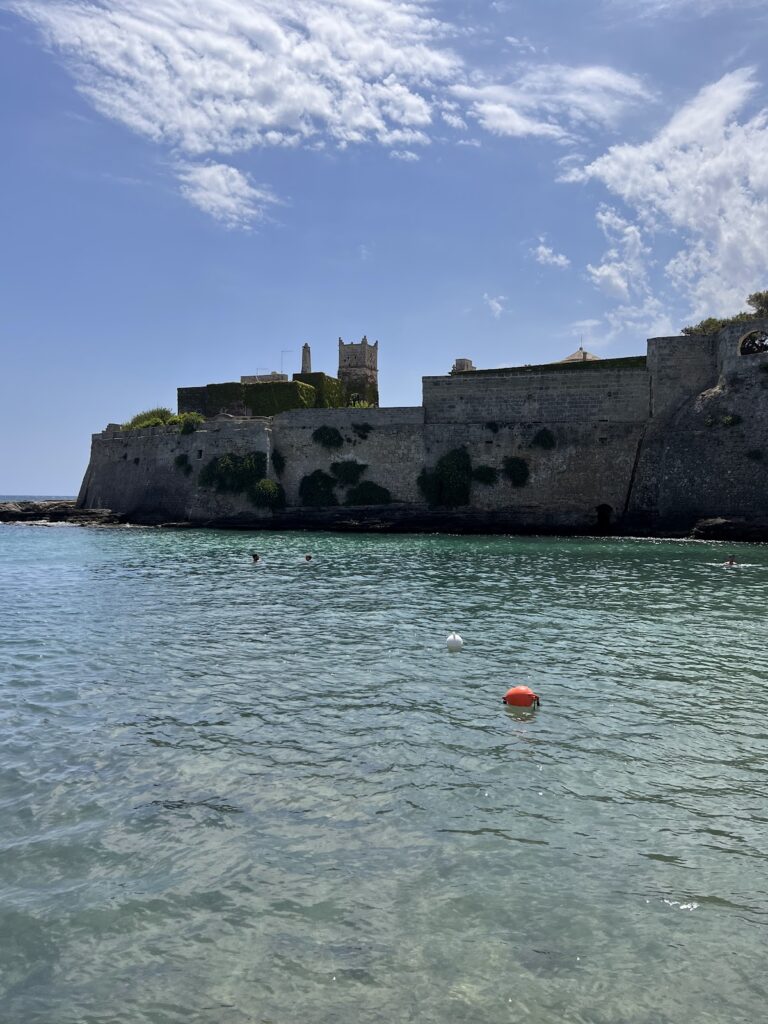
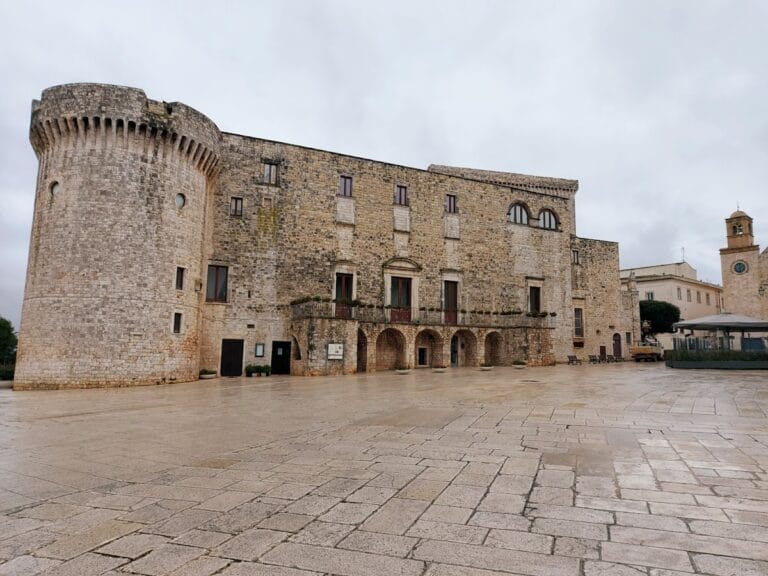
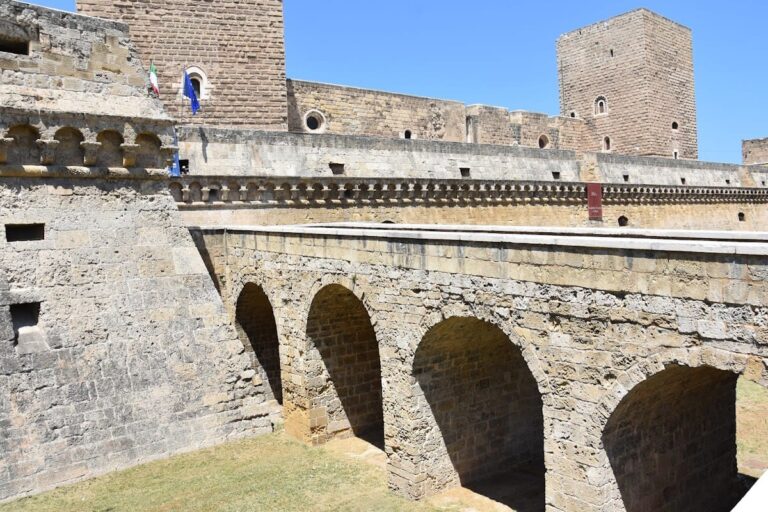
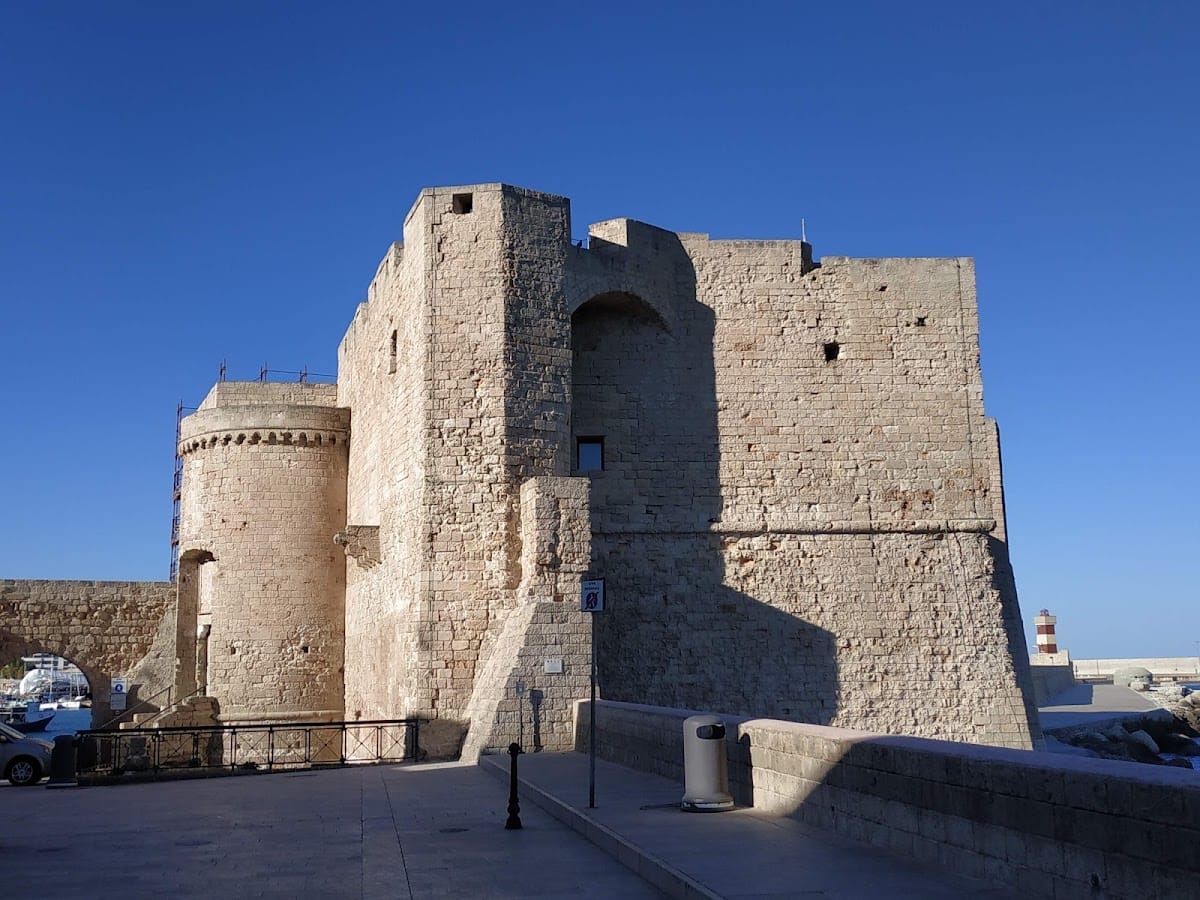
The Castle of Monopoli presents a pentagonal layout marked by five bastions at its corners, a simple design reflective of Renaissance military architecture adapted for coastal defense. The primary entrance once featured a drawbridge on the southwest side, which led from a small ramp to a later-added cylindrical tower. Adjacent to this tower are well-preserved segments of ancient walls, visibly linking the newer structures to earlier periods.
A distinctive feature of the fortress is the extensive presence of cannon openings, known as embrasures, distributed from the rooftops down to the waterline on both the harbor-facing and seaside walls. These were strategic for artillery placement, allowing coverage of both internal harbor waters and the open sea.
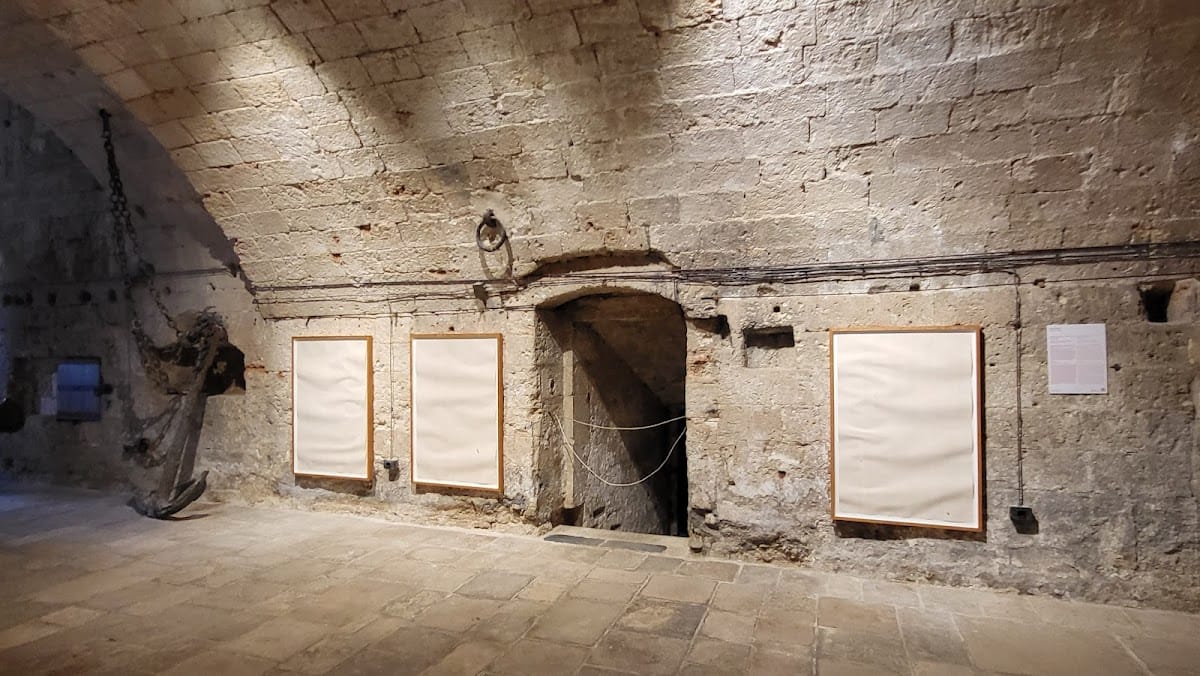
The armory inside the castle is a large hall containing four cannon openings situated at water level: two face outward toward the sea, while two look inward over the harbor. This space housed four smoothbore Neapolitan howitzers from the early 19th century, each weighing approximately 1,400 kilograms, underscoring the castle’s continued military role into the modern era.
Beneath the Renaissance fortress lies an imposing Roman gate dating to the 1st century BCE. This sizeable structure includes two guardhouses arranged over two stories and topped by octagonal towers, elements now largely enveloped by the later castle construction. The Roman fortifications themselves rest on robust Messapian defensive walls from the 5th century BCE. These ancient walls stand atop a prehistoric embankment (agger) located beneath the apse of the church in the underground area.
The church of San Nicola in Pinna, situated beneath the castle, is a single-nave building with one apse and a central dome. Its left external façade retains traces of original Romanesque stone corbels and shares stylistic features typical of rural churches from the 11th to 12th centuries. Originally, the church was connected to the southern guardhouse of the Roman gate, which served as monastic living quarters during the medieval period.
Within the castle’s loggia is a stone coat of arms inscribed with the date 1552 and the name of Viceroy Don Pedro Álvarez de Toledo, linking the fortress to its Spanish construction period.
Restoration work in the late 20th century, led by engineer Francesco Selicato and architect Domenico Capitano, was accompanied by detailed archaeological and architectural studies by Angelo Papio. Their efforts documented the complex layering and construction stages of the site, providing insight into its adaptation across centuries. These combined features illustrate a unique palimpsest of history, where prehistoric, classical, medieval, and Renaissance elements coexist within the Castle of Monopoli.
Nearby sites