Castle of Loarre: A Romanesque Fortress in Aragón, Spain

Visitor Information
Google Rating: 4.6
Popularity: High
Google Maps: View on Google Maps
Official Website: castillo-loarre.es
Country: Spain
Civilization: Medieval European
Remains: Military

History
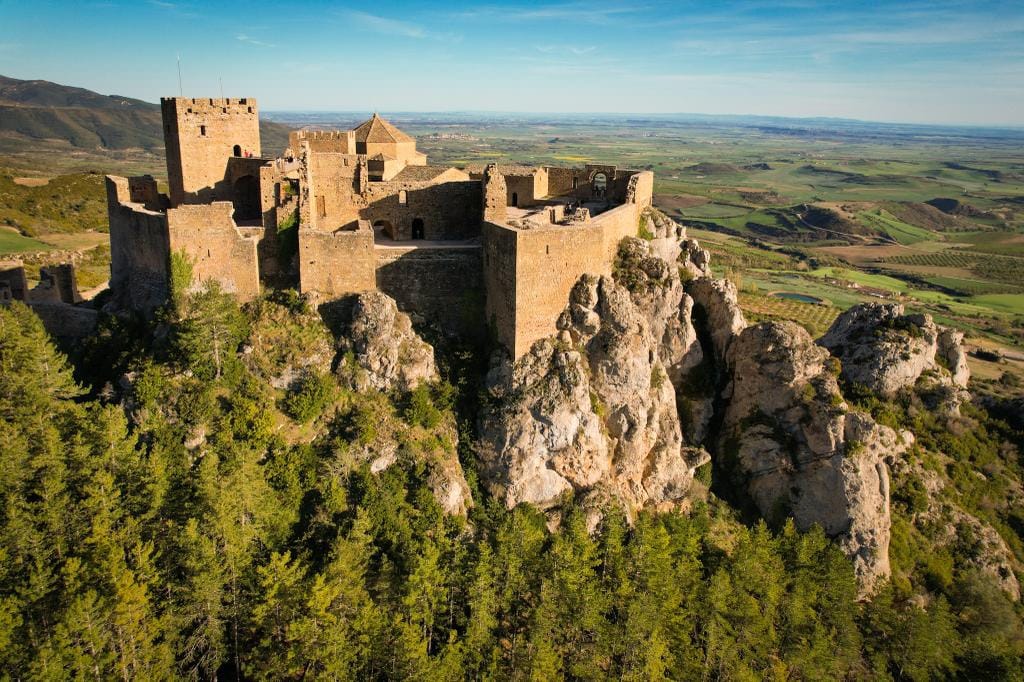
The Castle of Loarre stands on a limestone promontory near the town of Loarre in Huesca, Aragón, Spain. Archaeological evidence reveals that the site was once occupied by the Roman settlement Calagurris Fibularia, as indicated by Roman coins found there. The fortress itself was built in the 11th century by Christian forces during the Reconquista, marking a strategic frontier position overlooking the Hoya de Huesca plain and the Muslim-held town of Bolea.
Construction began between 1033 and 1035 under King Sancho III of Pamplona, also known as Sancho Garcés III. The castle served as a defensive outpost to protect the kingdom’s borders and to coordinate military campaigns against nearby Muslim territories. Its location on a high limestone outcrop provided a natural defense against siege tactics common at the time.
Around 1071, the castle underwent significant expansion during the reign of Sancho Ramírez. He established a monastery of Augustinian canons within the fortress, a religious foundation that received papal approval from Pope Alexander II in the same year. This addition gave the castle a dual military and monastic character, blending defense with spiritual functions.
Later, under King Pedro I of Aragón, the religious authority was transferred from Loarre to the monastery of Montearagón. This change ended the castle’s role as a monastic center and marked a shift in its administrative and religious importance. As Christian forces expelled Muslims from the Hoya de Huesca region, the castle’s military significance declined, reflecting the changing political landscape.
In 1413, during the revolt led by the Count of Urgel, the castle was besieged. It was defended by Abbess Violante de Luna, who held the fortress against royal forces for a time. Despite her efforts, the castle eventually fell to the king’s troops, signaling the end of its active military role.
By the 15th century, the population living at the base of the castle moved to what is now the village of Loarre. They reused stones and materials from the fortress in their new settlement, contributing to the castle’s gradual decline. In 1906, the Castle of Loarre was declared a National Monument, recognized for its exceptional preservation and historical value. Today, regional authorities seek to have it designated as a UNESCO World Heritage Site.
Remains
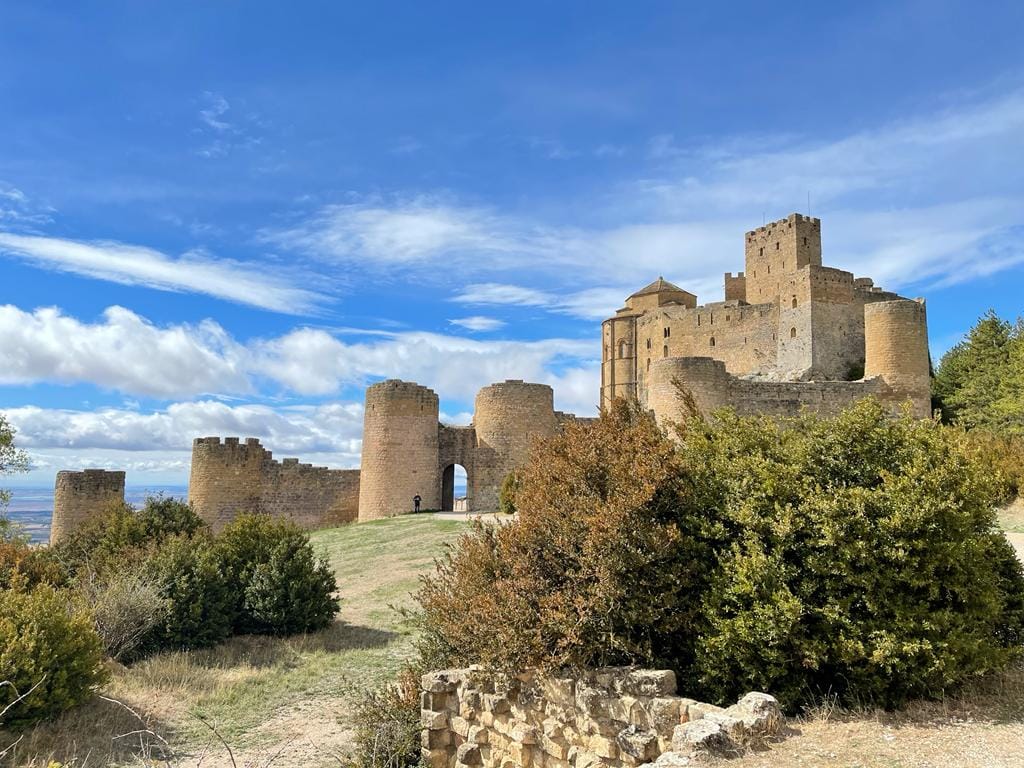
The Castle of Loarre is a large Romanesque fortress built atop a limestone promontory, which prevented attackers from undermining its walls during sieges. Its defensive walls, constructed in 1287, form a curtain enclosing about 10,000 square meters with a perimeter of 172 meters. The walls include semicircular towers of two to three stories, spaced irregularly between 10 and 30 meters apart, with diameters from 3.2 to 4.5 meters. A rectangular tower known as the “Puerta de los Reyes” guards the western entrance.
The main gate is Romanesque, featuring three stacked semicircular arches decorated with capitals carved with plant motifs. Originally, the tympanum above the entrance displayed a Pantocrator image, a depiction of Christ as ruler of the universe, but much of this was lost during restoration work in the 1940s. Beyond the gate lies a grand staircase covered by a barrel vault, adorned with a stone checkerboard pattern inspired by the nearby cathedral of Jaca. Flanking this staircase are two rooms: a guardroom on the left and the semicircular crypt of Santa Quiteria on the right. The crypt served as a burial place and includes a rectangular nave and an apse, noted for its remarkable acoustics.
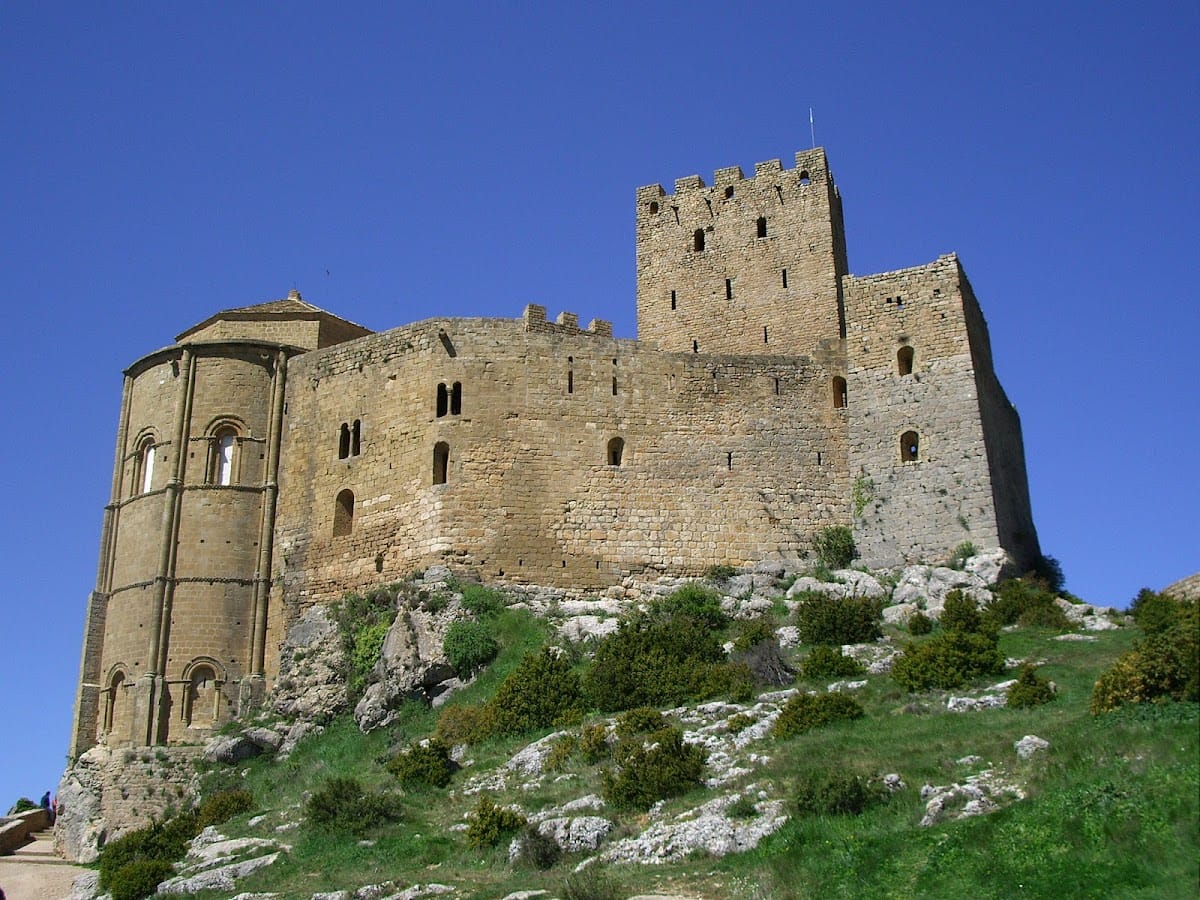
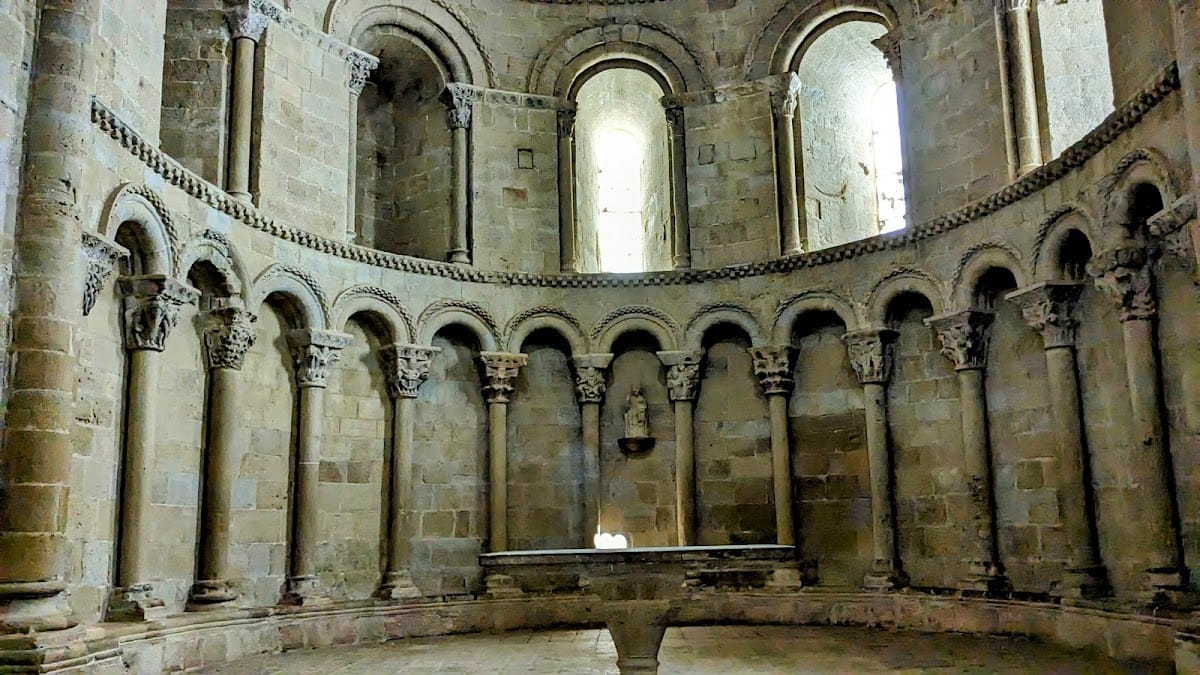
Above the crypt is the Church of San Pedro, a Romanesque single-nave building with a semicircular apse. The apse is decorated with engaged columns topped by capitals carved with fantastic, vegetal, and biblical motifs. The nave has a barrel vault and a long checkerboard frieze. A dome rising 26 meters high connects the apse and nave, an unusual feature in Romanesque architecture.
Adjacent to the church are living quarters for canons and nobles, a dungeon that also served as storage, and an armory. Several mullioned windows offer views toward the former village of Loarre, which existed until the 16th century. The southern section of the castle represents its original military core and includes the courtyard of arms, the older Church of Santa María, a cistern capable of holding 8,000 liters of water, military quarters, a ruined northern tower, and kitchens.
Near the entrance to the military area stands the Queen’s Tower, which functioned as a defensive stronghold. The main keep, or tower of homage, rises 22 meters tall with five floors and was once connected to the rest of the castle by a drawbridge. The fortress’s construction harmonizes with the natural landscape despite its large size, contributing to its status as one of the best-preserved Romanesque fortresses in Europe.
The castle also contains archaeological remains from Roman and Islamic periods, integrated into its structure. These layers reflect the site’s long history of occupation and cultural transitions.
Nearby sites