Castle of Cosona: A 15th-Century Fortified Farmstead in Pienza, Italy


Visitor Information
Google Rating: 4.4
Popularity: Very Low
Google Maps: View on Google Maps
Official Website: www.cosona.it
Country: Italy
Civilization: Unclassified
Remains: Military

History
The castle of Cosona is located in the municipality of Pienza, Italy. This fortified farm complex was constructed during the 15th century, reflecting the rural agrarian society of the time within this area. It was built by the local communities under the influence of the Tuscan nobility who sought to protect their agricultural holdings.
Throughout the centuries, the ownership of the castle changed several times. These transitions mirrored the shifting economic and social conditions of the region, as well as the evolving uses of the estate. While originally designed as a defensive structure linked to farming, the castle increasingly served as a noble residence and a hub for managing surrounding agricultural lands.
In the 19th century, the site saw notable additions, including the erection of a rectangular building used primarily as a granary. This expansion was commissioned by the Forteguerri family, a noble lineage whose heraldic shields mark the structure to this day. Early in the 20th century, architect Arturo Viligiardi from Siena led a significant restoration of the complex. In 1913, part of the renovation involved transforming an existing agricultural building into a chapel, linking the site to a religious function alongside its farming role.
The castle remained occupied by tenant farmers up until the 1970s. After this period, it ceased to be a traditional agricultural holding and was repurposed for other uses, adapting to new economic realities.
Remains
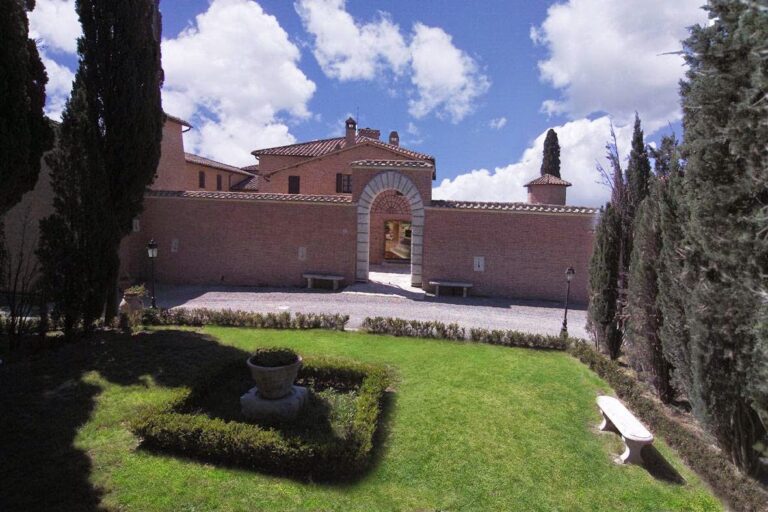
The castle of Cosona presents a distinctive polygonal layout formed by adjoining structures that together create fifteen sides. This unusual plan distinguishes it within the context of fortified farmsteads. All the buildings were constructed to support the dual purposes of defense and agriculture in a rural setting.
One of the most prominent architectural elements is a square tower located on the western side of the complex. This tower likely served as a lookout point and symbolized the fortified nature of the site. Its robust construction emphasizes its military function within the larger farmstead.
Within the castle’s grounds stands a well-cistern built in 1659, designed to collect and store water for the inhabitants. This feature was carefully restored in 1913 during the early 20th-century renovations. The presence of the cistern highlights the importance of water management for sustaining life in an isolated rural compound.
The 19th-century granary, added as part of the estate’s agricultural expansion, is notable for featuring two heraldic shields belonging to the Forteguerri family. These emblems confirm the noble association and patronage behind the building’s construction. The granary was intended to provide storage for harvested crops, underscoring the castle’s ongoing role in local farming production.
Today, the castle maintains a good state of preservation thanks to its adaptive reuse over time. The care taken in restoration and maintenance has ensured that the main features remain intact and reflect the complex’s historical functions as both a fortified residence and agricultural center.
Nearby sites