Castello del Potentino: A Medieval Castle and Agricultural Estate in Tuscany


Site at a Glance
- Rating
- 4.5
- Popularity
- Very Low
- Country
- Italy
- Primary era
- Medieval
- External website
- Open
- Eras represented
- Medieval, Early Modern
- Civilizations
- Holy Roman Empire, Republic of Siena
- Site type
- Military
- Remains
- Castle
On this page9 sections
History
Castello del Potentino is a medieval castle in Italy, located near Seggiano in Tuscany, whose origins date to around the year 1000. It was built as a possession of the bishops of Chiusi, an episcopal center whose medieval diocese extended across the Monte Amiata area. The castle formed part of the bishops’ territorial holdings and administrative authority.
Medieval lordship
During the thirteenth century, Castello del Potentino came under the Republic of Siena, a major Tuscan power that expanded its authority over surrounding castles and rural estates. The castle also remained connected with the Abbey of San Salvatore al Monte Amiata, a medieval monastery on Monte Amiata, and with the Aldobrandeschi, a powerful noble family of southern Tuscany.
At the beginning of the fourteenth century, ownership was contested among prominent families of the Sienese countryside, including the Buonsignori, Tolomei, and Salimbeni. These families divided the property, and the complex developed into an important rural estate.
Renaissance transformation and later ownership
Sienese interventions carried out between the fifteenth and sixteenth centuries gave the principal building its Renaissance character. Renaissance architecture in Italy drew on classical forms and proportions, and this later appearance distinguishes the main building from the complex’s medieval elements.
In the seventeenth century, the entire fortified complex was acquired by the Bourbon del Monte family, a Tuscan noble house with estates and political influence in central Italy. Further changes of ownership followed in later centuries. During the twentieth century, the castle was acquired by the British writer Graham Greene. His heirs transformed the property into a well-known agricultural enterprise, a role it continues to serve.
Remains
Castello del Potentino lies in the Potentino locality, in the northern part of the municipality of Seggiano, beyond the Vivo stream. Its surviving complex is arranged in distinct areas. An outer zone contains associated rural buildings and leads toward a more enclosed inner section, while a separate third area occupies the grounds beyond the principal part of the castle.
Fortified and principal areas
Gateway and curtain wall
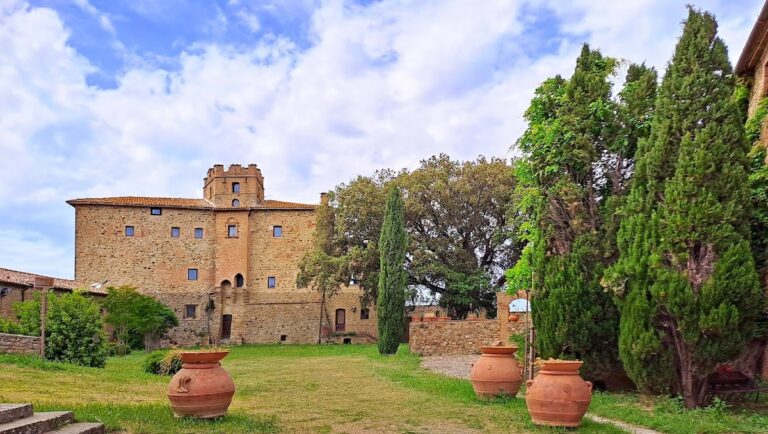
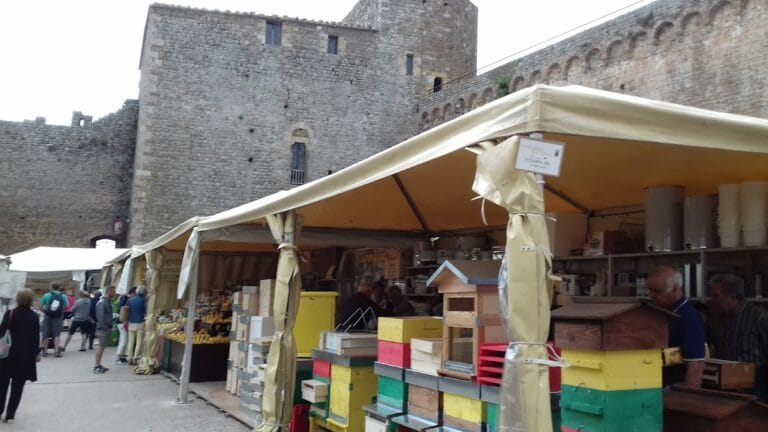
Entry into the inner area passes through an arched gateway set within a curtain wall, the fortified boundary wall of a complex. Crenellations, the raised alternating sections along the wall’s upper edge, remain visible and reinforce the medieval character of this approach.
Castle proper
The principal area is occupied by the castle proper, an L-shaped building arranged around a courtyard. Unlike the rest of the complex, the main building has the Renaissance appearance created by the Sienese alterations. Its entrance has a doorway with a horizontal lintel, or architrave, above the opening, and a heraldic coat of arms surmounts it. A small bell gable, a wall-like structure with an opening for a bell, rises above the roof.
Rural buildings and chapel
The outer area includes various rural buildings associated with the estate. Within the castle settlement stands a noble chapel dedicated to Saint Anthony of Padua, the thirteenth-century Franciscan friar and preacher venerated as a Catholic saint.
Garden area
Beyond the principal area is a separate third section that formerly contained an Italian-style garden. Such gardens were traditionally arranged with geometric layouts, symmetry, and ornamental design. The garden at Castello del Potentino has since been substantially reduced and altered, while the wider complex remains in agricultural use.