Castle of Benaguasil: A Historic Fortress in Spain
Visitor Information
Google Rating: 5
Popularity: Very Low
Country: Spain
Civilization: Unclassified
Site type: Military
Remains: Castle

History
The Castle of Benaguasil is located in the town of Benaguasil in Spain. It was constructed during the 12th century, likely between 1147 and 1172, by the Christian forces as part of the reconquest efforts in the region. The initial construction served defensive purposes, addressing both military threats and the need to establish territorial control.
Between 1184 and 1199, the castle and the adjoining urban walls underwent significant reinforcement and aesthetic enhancement, reflecting its growing strategic and administrative importance. The first known written mention of the castle appears in 1237, following the conquest by King Jaime I of Aragon. It is recorded in the “Libro del Repartimiento,” which describes the settlement as a walled town featuring both a mosque, indicating earlier Islamic presence, and the castle itself.
Throughout the 14th and early 15th centuries, the Castle of Benaguasil played an active role in regional conflicts. In 1348, during a revolt opposing the Union — a coalition of nobles and municipalities — the castle was besieged. Loyalist forces supporting King Pere II of Aragon came to its relief, underscoring the castle’s strategic significance. Later, in 1403, intense clashes between two noble families, the Centelles and the Vilaragut, marked the castle’s history. The Centelles family repeatedly took refuge within its walls until the disputes ended in 1412.
Despite several royal orders for its demolition—first by King Pere II in 1364 and later by Emperor Charles I in 1527—aimed at weakening centers of rebellion, the castle remained standing. In the early 16th century, the castle became involved in the Germanías revolt (1520), a Valencian uprising against noble authority and royal rule. The radical leader Guillem Sorolla established his seat of power there during this upheaval.
By the early 1600s, as the town underwent repopulation efforts, official charters specifically mandated the preservation of the castle alongside the walls, gates, and prison. However, from the 18th century onward, urban expansion and population growth led to the gradual destruction of much of the medieval fortress and the surrounding historic fabric. The final remains of the castle were demolished between 1976 and 1977. Recognizing its historical value, the site was declared a protected monument in 2004, with defined protective boundaries established in the following year.
Remains
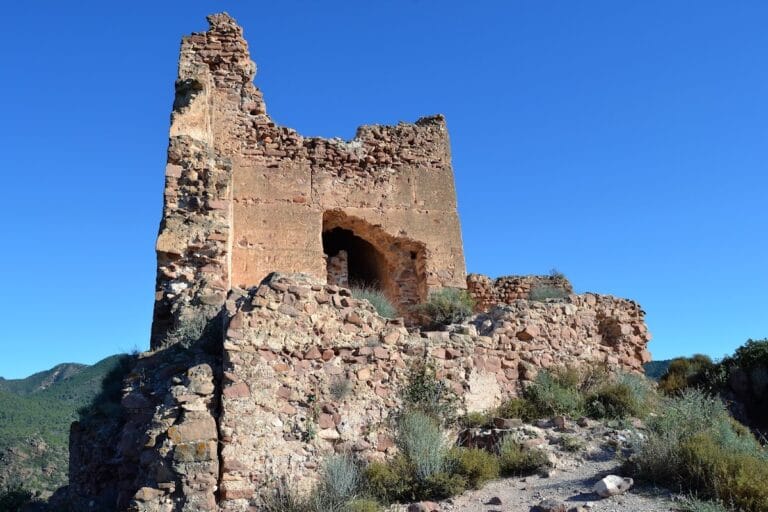
The Castle of Benaguasil once occupied a nearly 9,000-square-meter area within a much larger fortified enclosure stretching around 65,000 square meters, surrounded by a defensive wall running over a kilometer in length. Its layout was irregular, conforming to the terrain, with thick walls approximately three meters wide. The fortification included four corner towers, although today only the northeast tower remains partially intact.
This surviving northeast tower is quadrangular and contains a single interior room. Within this room, signs of a former wooden floor are visible through the presence of four beam sockets positioned about 1.85 meters above the ground. The tower’s upper terrace rests upon a barrel vault, an arched structure that supports the ceiling. A distinctive horseshoe-shaped arch spans transversely across the vault. This arch measures roughly 70 centimeters in width and 23 centimeters in height, with springing points starting more than four meters above the current ground level, showing the original impressive scale of the construction.
The tower’s walls are particularly massive, about 2.6 meters thick. They feature two openings, each approximately 73 centimeters wide and 140 centimeters tall, which were secured by heavy wooden doors reinforced with robust iron plates and numerous nails. One of these original iron-reinforced doors is preserved and displayed in the local municipal ethnological museum. From the terrace, a section of wall can be observed beginning at a right angle, which originally connected the tower to another now-lost octagonal tower located toward the southeast.
In modern times, the remaining tower is enclosed within newer buildings, including the cultural center of the Union Musical de Benaguasil, and it currently serves as storage space for the musical society. Inside the upper chamber of the tower, graffiti have been found inscribed on mortar that was still soft when marked. These marks depict various cross shapes and pointed weapon tips, suggesting a connection to the armory function the space may have had during the 15th century. This chamber sits above where a prison cell once existed, though it has no direct internal access to that area.
Beyond this northeast tower and a small adjacent section of wall, the rest of the castle’s structures and the expansive walls were removed during the late 20th century, leaving this tower as the sole visible trace of the castle’s historical defensive complex.
Nearby sites