Castle Bruneck: A Historic Fortress and Cultural Museum in Bruneck, Italy

Visitor Information
Google Rating: 4.3
Popularity: Medium
Google Maps: View on Google Maps
Official Website: www.messner-mountain-museum.it
Country: Italy
Civilization: Medieval European
Remains: Military

History
Castle Bruneck is located in the town of Bruneck within modern-day Italy. It was built by the medieval prince-bishops of Brixen (Bressanone), a prominent ecclesiastical authority of the region, to consolidate and protect their territorial holdings.
Construction of the castle began in 1251 under Bruno von Kirchberg, the prince-bishop of Brixen, and continued until 1288. This period also saw the founding of the town of Bruneck at the foot of the castle’s hill, signaling the strategic importance of the site for both military defense and administrative control in the Puster Valley. The castle’s earliest written mentions occur in 1271 and 1276, referring to it as “Castrum Bruneke.” Initially, it served as the administrative center and residence for the prince-bishops, with the first recorded overseer, or castellan, documented in 1309.
Throughout the 14th century, Bishop Albert von Enn undertook significant expansion efforts, strengthening the fortress with the addition of a high perimeter wall. In the 15th century, Prince-Bishop Georg Golser further enhanced the defenses, motivated in part by concerns over potential Turkish incursions, which reflects the broader geopolitical anxieties of the time. This era also included a notable military event in April 1460, when Archduke Sigismund of Austria besieged the castle amid a conflict with Cardinal Nicholas of Cusa, the then-bishop of Brixen. The siege ended with Nicholas compelled to sign a treaty under pressure.
Entering the early 16th century, Archbishop Christoph von Schroffenstein transformed Castle Bruneck from a strictly military fortress into a comfortable residential palace. The castle hosted various illustrious visitors over time, including Emperor Maximilian I, Emperor Charles V, and the future Empress Maria Theresa, underlining its continued political and social significance.
During the Napoleonic Wars, specifically between 1805 and 1812, the castle was appropriated by Franco-Bavarian troops. It was employed as a military base to quell local uprisings, showing a shift in function from ecclesiastical seat to military stronghold during this tumultuous period. Following the end of hostilities, the castle was restored and returned to episcopal authority.
In the 19th century, parts of Castle Bruneck were adapted to serve as a prison and military barracks, illustrating its ongoing use for state functions. By the 20th century, the building had fallen into disrepair, but a major renovation around 1900 under Bishop Simon Aichner revitalized its interiors and structural condition. Later, starting in 1969, some rooms were repurposed as school classrooms, indicating a further adaptation to community use.
In 2004, ownership of the castle transferred to the South Tyrolean Savings Bank on behalf of the city of Bruneck and alpinist Reinhold Messner. Subsequently, in 2011, Messner established the Messner Mountain Museum (MMM Ripa) within the castle, dedicating it to the cultures of mountain peoples from around the world. This marks the latest chapter in the evolving history of Castle Bruneck, blending heritage preservation with cultural exhibition.
Remains
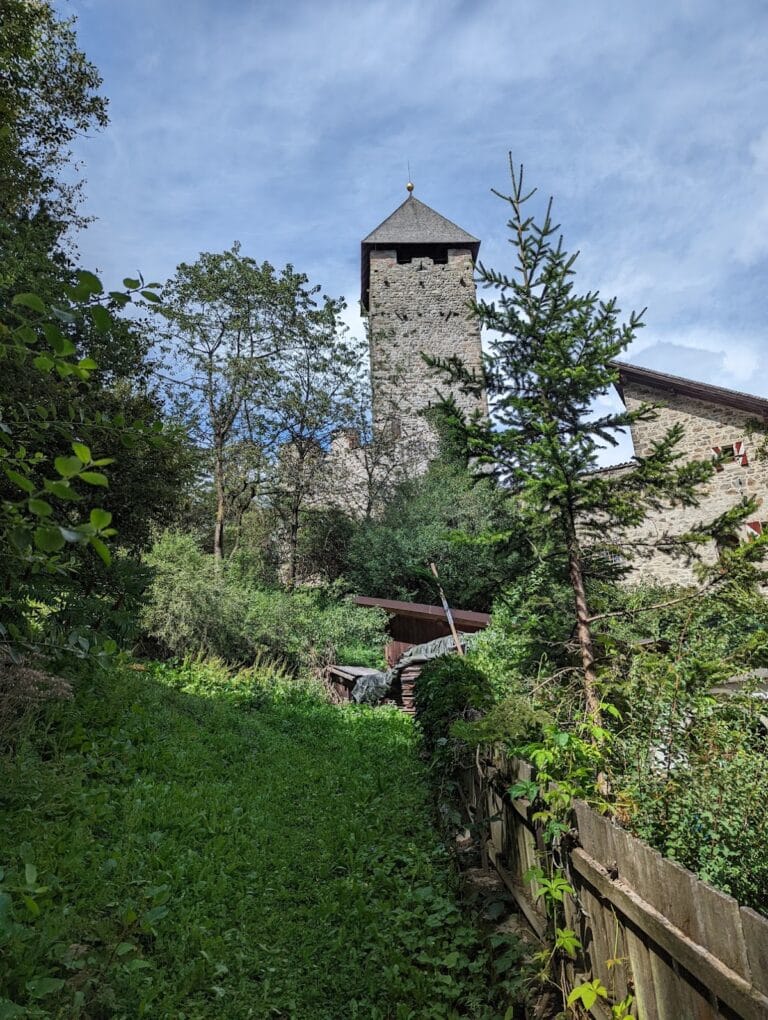
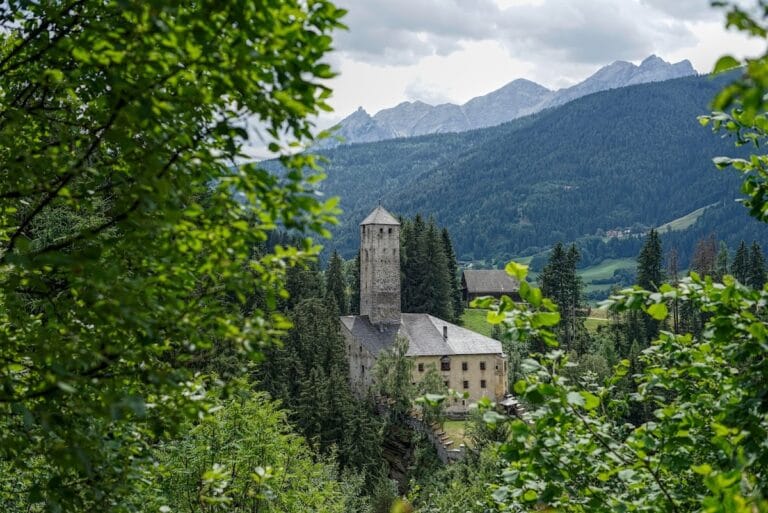
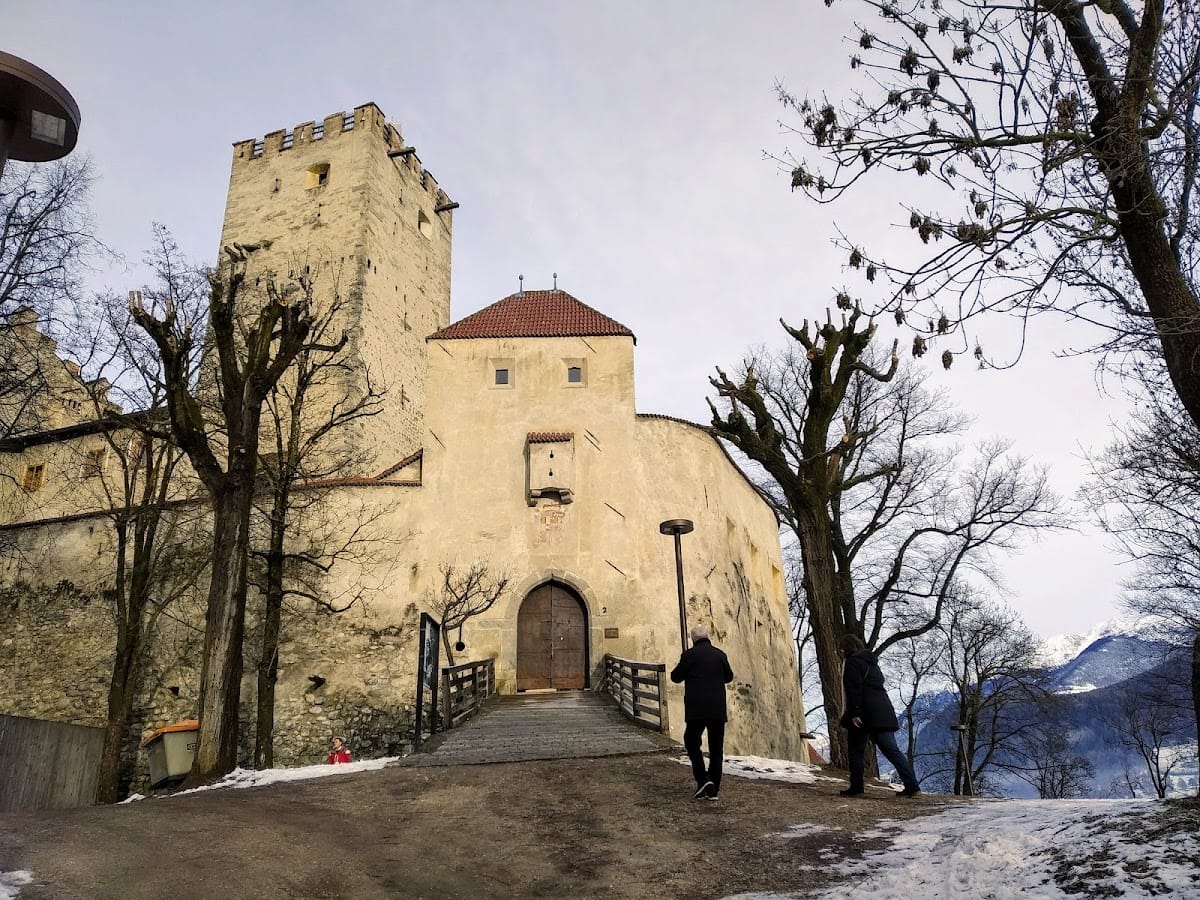
Castle Bruneck is positioned atop Schlossberg, a prominent hill overlooking the town of Bruneck, and exhibits a complex layout that evolved over centuries to accommodate both defensive needs and residential functions. The castle’s core comprises a fortified courtyard surrounded by multiple wings and notable towers enclosed by thick walls.
The oldest surviving structure is the bell tower, which served not only as a belfry but was likely inhabited. It stands as an early element around which subsequent buildings were assembled. Adjacent to the bell tower are other original structures contained within the defensive perimeter, which was augmented over time with features such as a zwinger—a type of outer ward or enclosed space added in the 14th century to strengthen the castle’s defense.
One of the castle’s main defensive improvements from the medieval period is a circular tower accessible via an internal spiral staircase, offering a protected route to upper levels and commanding views. The southern entrance originally featured a drawbridge, emphasizing its military function, though this was eventually replaced by a gate marked by a Gothic-style portal dated 1584, reflecting a transition to more permanent and ornamental access.
The castle’s right wing housed the bishop’s apartments, which, after renovations around 1900, became bright and spacious rooms with panoramic views of Bruneck. These chambers include a coffered ceiling decorated with the von Spaur family crest, signifying the bishop’s lineage. The wooden floors are detailed with carved decorations, including the year 1900 and the initials of Bishop Simon Aichner, who oversaw the restoration. Each room is warmed by stucco stoves—ornate heating units typical of the period.
Wall paintings decorate these episcopal rooms, mostly depicting imaginary landscapes, except for one that portrays the nearby city of Bressanone, linking the castle visually to its diocesan seat. The castle chapel was built during the 1900 restoration in the neo-Gothic style. It features a triptych altar illustrating several scenes from the lives of the Virgin Mary and Jesus Christ, with additional imagery drawn from Old Testament stories beneath. The chapel’s stained glass windows display coats of arms belonging to the Habsburg family (depicted as a double-headed black eagle), the Tyrolean region (a red eagle), and Bishop Simon Aichner—whose symbols include a lamb, an eagle bearing a pastoral staff, an arrow, and an anchor.
The castle’s defensive architecture also includes high surrounding walls and reinforced fortifications dating to the 14th and 15th centuries, constructed to protect against siege warfare. These elements highlight the castle’s original purpose as a military stronghold.
Today, the combination of restored residential quarters, preserved fortifications, and newly adapted exhibition spaces reflects the castle’s layered history, demonstrating multiple periods of construction, adaptation, and reuse. Since 2011, the castle serves as the venue for the Messner Mountain Museum, hosting exhibitions that focus on mountain cultures worldwide, linking Castle Bruneck’s historical identity as a strategic stronghold to its contemporary role as a center for cultural dialogue.
Nearby sites