Castello Visconteo: A Medieval Castle-Palace in Somma Lombardo


Site at a Glance
- Rating
- 4.5
- Popularity
- Medium
- Country
- Italy
- Primary era
- Medieval
- External website
- Open
- Eras represented
- Medieval, Early Modern
- Civilizations
- Duchy of Milan, Spanish
- Site type
- Military
- Remains
- Castle
On this page16 sections
History
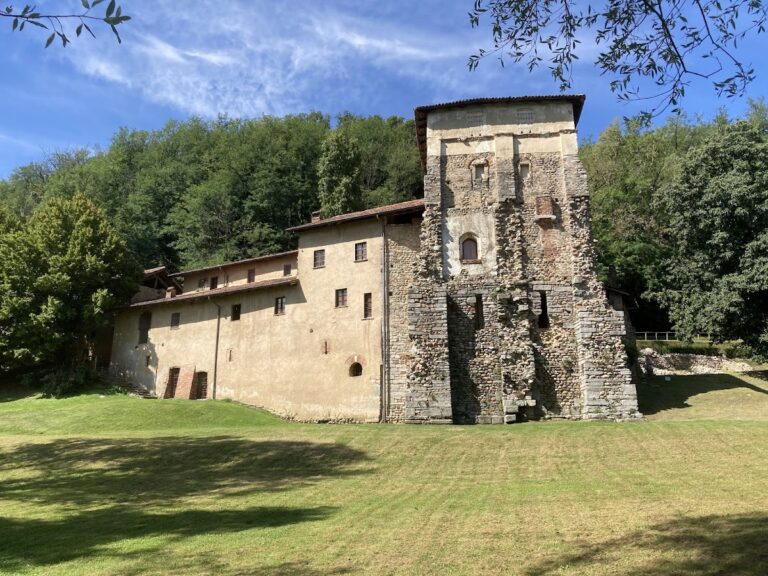
Castello Visconteo is a medieval castle-palace in Somma Lombardo, Italy, whose buildings include elements dating from the ninth century and whose fortress was established in the thirteenth century. It formed part of the defensive line along the Ticino River between Milan and Lake Maggiore, serving the strategic defense of Milan until its military role ended in 1862.
From Early Buildings to Fortress
The site was occupied by buildings from the ninth century before a fortress was created there in the thirteenth century. The stronghold developed by joining adjoining residences that had originally been enclosed by a single moat. This process produced a complex made up of older and newer sections rather than a single structure erected at one time.
The Visconti Divisions of 1448
The castle entered a decisive phase in 1448, after Duke Filippo Maria Visconti died in 1447 and the main Visconti line became extinct. The Ambrosian Republic, the republican government established in Milan after the duke’s death, created a political threat for the brothers Francesco and Guido Visconti. They withdrew to their family’s former lordship at Somma, where they divided their landholdings and parts of the castle. The building was refurbished that year, and the brothers received a formal oath of allegiance from all the men of the village.
Francesco took control of the newer portion, while Guido held the lower and older sections. Their divisions shaped two later aristocratic lines. Francesco’s branch became the Visconti di San Vito, while Guido’s descendants became the Visconti di Modrone and the Castelbarco Visconti of Cislago. The San Vito branch traced its origin to Uberto il Picco, the brother of Matteo I Visconti. Later heirs of Francesco’s line included the marquises of San Vito and the marquises della Motta.
Aristocratic and Religious Associations
In 1619, King Philip III of Spain granted Francesco Maria Visconti the fief of San Vito di Gaggiano, in the historical ecclesiastical district of Corbetta near Milan. The grant created a hereditary marquisate transmitted through the male line. The family adopted the Latin motto Sufficit Unus, meaning “One is enough.”
Castello Visconteo was also connected with Niccolò Sfondrati, a descendant of Guido who was born there on 11 February 1535. He became pope as Gregory XIV in 1590. The castle’s later history also includes a room devoted to Count Gabrio Casati, a politician and patriot of the Risorgimento, the nineteenth-century movement that led to the political unification of Italy. Casati supported the Five Days of Milan, the 1848 uprising against Austrian rule, and is commemorated in the room by a portrait painted by Eliseo Sala.
Royal Visits and Preservation
The Royal Chamber was reserved for the Italian kings Victor Emmanuel II of Savoy and Umberto I of Savoy when they stayed in Somma for military maneuvers along the Ticino or fox hunts in the Malpensata heath.
Gabrio Luigi Visconti di San Vito was the last descendant of the family. In accordance with his testamentary wishes, the Visconti di San Vito Foundation was established in 1997. Since 1998, it has worked to preserve the castle’s memory and support its opening to the public through guided tours. The preserved complex retains fabric associated with both the older and newer portions linked to the two Visconti lines.
Remains
Built of stone, Castello Visconteo consists of sections from different periods. Its surviving fabric combines the lower and older areas with later additions, reflecting the castle’s development from adjoining moated residences into a fortified aristocratic complex.
Wings and Principal Rooms
Wing of the Men-at-Arms
The northwestern wing, known as the Wing of the Men-at-Arms, dates from the fourteenth or fifteenth century. It forms part of the castle’s earlier surviving fabric and contributes to the complex’s layered arrangement of building sections.
Eastern and Southern Wings
The eastern wing was added in the fifteenth century, while the southern wing was built during the sixteenth century. Together, these additions show how the castle expanded beyond its earlier sections through successive building phases.
Salone d’Onore
The Salone d’Onore contains a cycle of frescoes from the beginning of the seventeenth century. The paintings have been attributed to the school or circle of Camillo Procaccini and draw on Flemish engravings by Crispjin van de Passe, Theodor Galle, Philippe Galle, and Adriaen Collaert.
Chapel of the Assumption
The Chapel is dedicated to the Assumption of the Virgin Mary. Its furnishings include liturgical objects, and it contains an Annunciation painting attributed to the workshop of Cerano, the name commonly used by the Italian painter Giovanni Battista Crespi.
Royal Chamber
The Royal Chamber contains a large seventeenth-century wooden bed in the Lombard style. Its furnishings preserve the room’s association with the stays of Victor Emmanuel II and Umberto I during their visits to Somma.
Paintings and Collections
Religious Paintings
A gallery of religious paintings is associated with the room dedicated to Niccolò Sfondrati. The gallery forms part of the castle’s preserved collection of paintings and its material connection with the future pope who was born there.
Barber Basins
The castle houses approximately 400 barber basins, shallow vessels traditionally used during shaving. The collection includes examples from Faenza and Savona, together with French, German, English, and Spanish pieces and eighteenth-century maiolica, a type of tin-glazed earthenware. Marquis Carlo Ermes Visconti di San Vito began assembling it during the last quarter of the nineteenth century.
Roman-Period Remains
A collection of Roman-period remains brought to light in the territory occupied by the fortification is housed within the castle. It consists mainly of inscribed stone slabs, cippi, which are small upright stone markers, and altars used for offerings or religious rites.