Castle Annenberg: A Medieval Fortress near Latsch, Italy
Visitor Information
Google Rating: 4.6
Popularity: Very Low
Google Maps: View on Google Maps
Official Website: www.castel-annenberg.de
Country: Italy
Civilization: Unclassified
Remains: Military

History
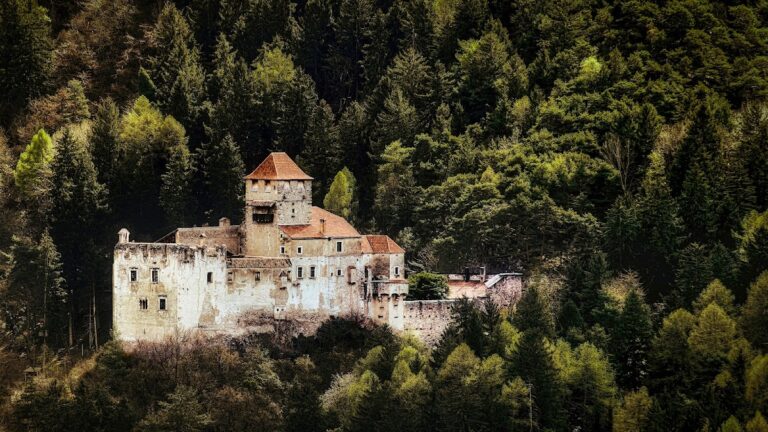
Castle Annenberg is a medieval fortress situated near the town of Latsch in Italy. Constructed by local nobility during the Middle Ages, it stands atop a rocky hill at over one thousand meters above sea level, commanding strategic views of the surrounding area.
The first known record of the site dates to 1252, when it was described as a tower house in the possession of the lords of Burgusio. By the late 13th century, the castle changed hands to Count Meinhard II of Tyrol, who in 1295 granted half of the property as a fief to the lords of Matsch. A few decades later, in 1315, King Henry of Austria bestowed the other half upon Burgrave Heinrich of Partschins. Adopting the name “von Annenberg,” Heinrich consolidated ownership and by 1327 held the entire estate.
Following a period of deterioration, the castle underwent restoration in the early 14th century under the Annenberg family’s care. This family was notable for establishing an important library around 1470, which housed manuscripts and incunabula—early printed books from before 1501. These precious collections passed out of their hands after the Mohr counts, who inherited the castle later, became extinct.
Between the late 1400s and early 1500s, the Annenbergs significantly expanded the fortress. They added a quadrangular outer wall with four corner towers, a design likely prompted by damages suffered during the Swabian War (1499). This defensive ring later served as inspiration for similar fortifications built at Castle Goldrain in the early 17th century.
After the Annenberg lineage ended in 1695, the property transferred to the Mohr counts and subsequently to the Haussmann family, who held it until 1813. A long phase of neglect followed, during which structural collapses occurred, including the failure of roofs and stair towers. Restoration efforts commenced in 1896 under cavalry captain Martin Stocker. Progress continued under Captain Schörger from 1910, who raised the main residential building and tower by an additional floor and made the castle habitable once more.
Ownership later passed through several hands, including Paolo Drigo in the 1920s, the Counts Bensa from Genoa between 1928 and 1972, and veterinarian Karl-Heinz Politzar. Since 2010, the castle has been privately owned by the Fuchs family, whose stewardship maintains the site as a private estate not open for public access.
Remains
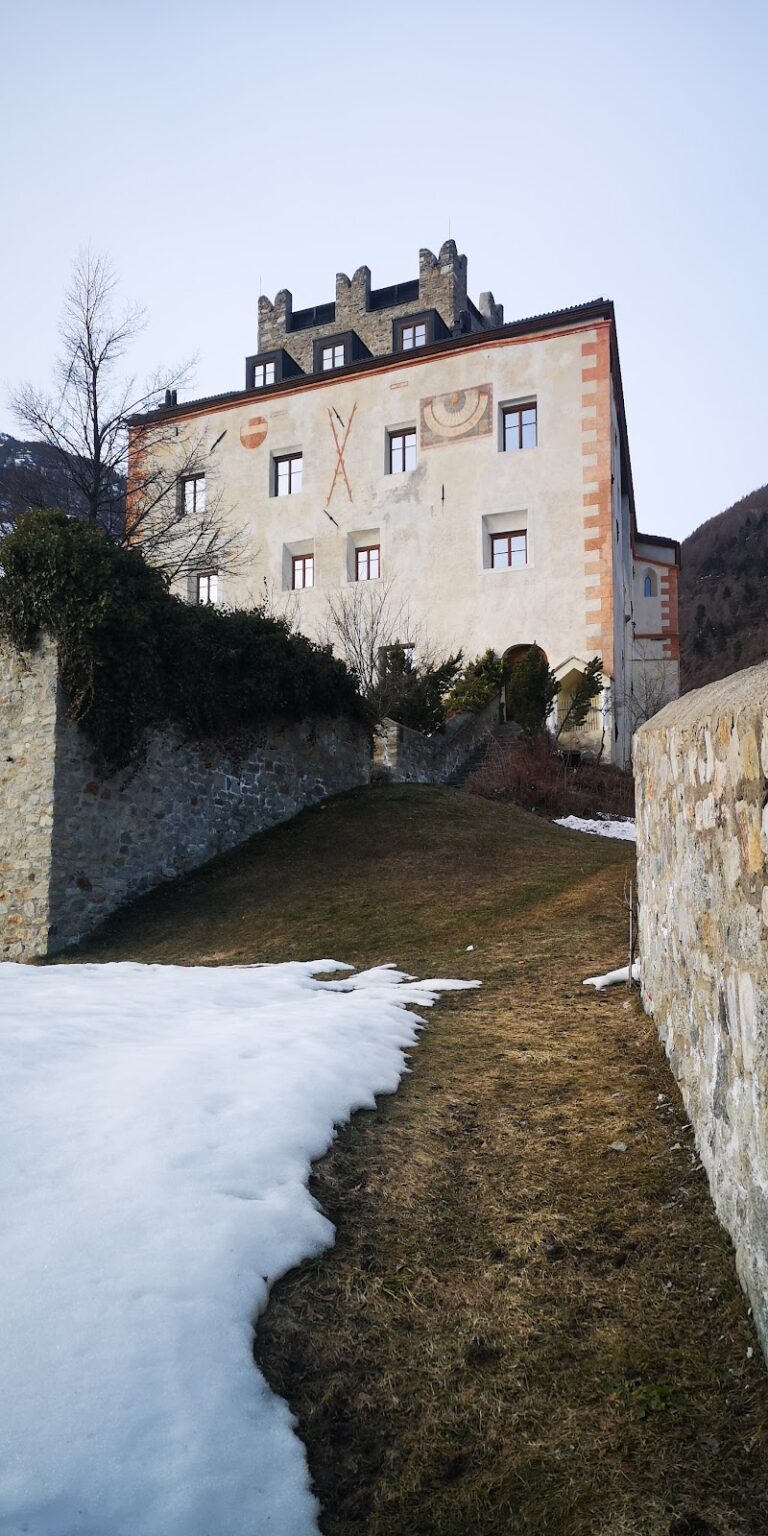
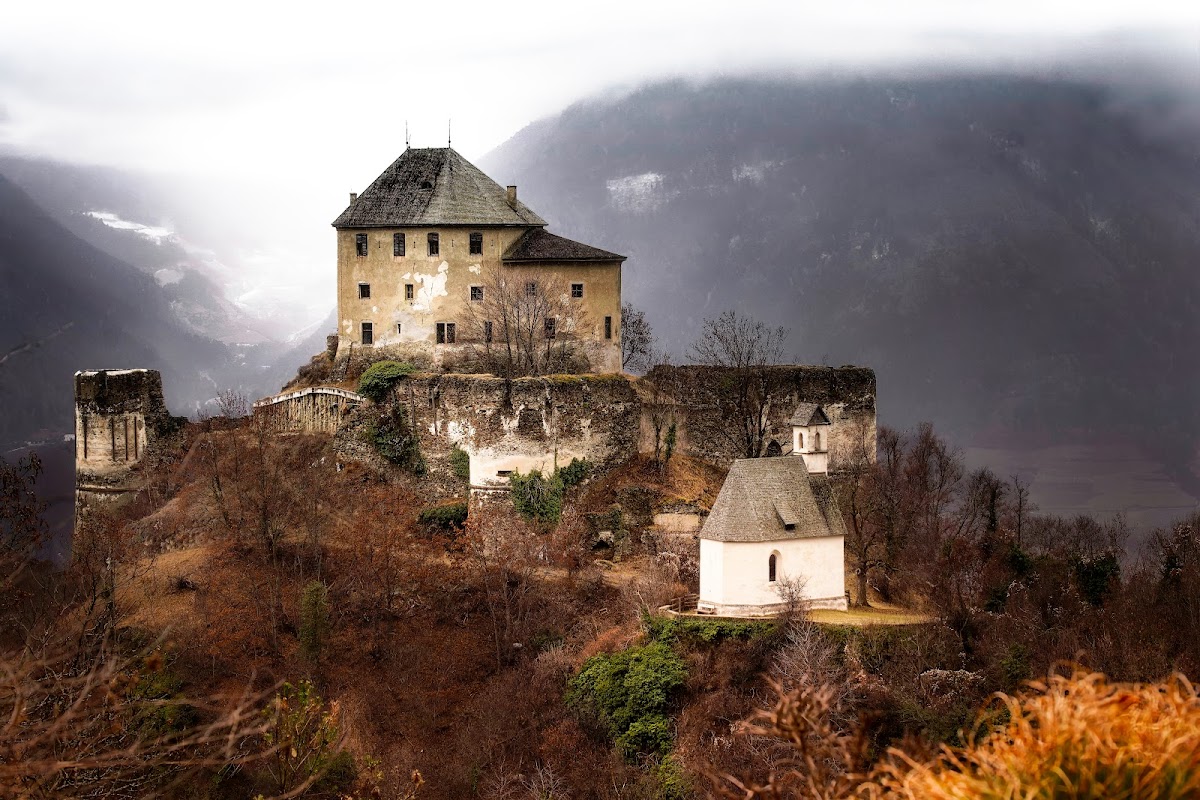
Castle Annenberg is built atop a rocky hill shaped like a cone, designed as a fortified manor typical of the medieval period. The core features a three-story rectangular main building known as a palas, with a distinctive chamfered corner on its northwest side. Attached to the palas is a two-story semi-circular annex, adjacent to a southeastern stair tower that resembles a bergfried—a tall defensive tower common in medieval castles used as a refuge and lookout.
A crenellated wall encloses the space between the semi-circular annex and the stair tower, providing additional battlement protection. The main entrance is located on the east side of the castle, reached by passing through a southern ring wall that surrounds the central buildings. This ring wall is plastered with gray mortar, a coat that helps preserve the masonry.
Encircling the rocky hill is a lower, square-shaped outer ring wall equipped with four corner towers. Three of these towers—situated to the southwest, northwest, and northeast—date back to the medieval period and served defensive functions. Each contains wooden intermediate floors and incorporates arrow slits for archers, as well as some gun ports reflecting the later adaptation to firearms. The southeastern corner tower differs as a battery tower; it is filled with earth and capped by a regular crenellation, designed to support artillery.
The gate within the ring wall is notably small and was never fitted with a drawbridge, suggesting the entrance was intentionally limited and controlled. The northeastern corner of the ring wall shows partial collapse, especially over two-thirds of its western section. A concrete retaining wall has been installed behind it to stabilize the slope and prevent further landslides. Portions of the lime mortar plaster coating the ring wall survive, offering insight into the castle’s original appearance.
Beyond the main fortifications on the northern flank of the rocky hill stands the castle chapel dedicated to Saint Anna. Though no longer in use at the site, some of its original fittings have been preserved, including choir stalls and an altar crafted by Sebastian Scheel in 1517. These are now housed at the Tyrolean State Museum in Innsbruck.
On the northern side, just outside the ring wall, remnants remain of an outbuilding that likely served a protective role for the otherwise exposed approach to the castle. This structure’s exact nature is not fully established, but its position suggests it functioned defensively.
Today, Castle Annenberg and a nearby farmstead remain privately owned by the Fuchs family, whose stewardship restricts public access, preserving this historic medieval site largely as it has survived across centuries.
Nearby sites