Castillo de Arenas: A Medieval Fortress in Campillo de Arenas, Spain

Visitor Information
Google Rating: 4.6
Popularity: Very Low
Country: Spain
Civilization: Unclassified
Site type: Military
Remains: Castle

History
The Castillo de Arenas is situated in the municipality of Campillo de Arenas in Spain. This fortress was primarily constructed by Muslim builders during the medieval period, with origins reflecting earlier civilizations on the site.
The earliest surviving structures at Castillo de Arenas date back to between the 9th and 11th centuries, indicating an initial phase of fortification in the early Middle Ages. During the 14th century, significant rebuilding and expansion took place, solidifying its role as a formidable stronghold. The castle’s strategic position on the Cerro del Castillo de Puerta Arenas in the Sierra de Alta Coloma gave it control over important mountain passes between the cities of Granada and Jaén, making it a key defensive site in the region.
Following its initial Muslim use, the castle came under Castilian control in the early 1200s during the Christian efforts to expand their territory. However, the fortress switched hands multiple times throughout the Late Middle Ages, with both Christian and Muslim forces contesting its possession due to its vital role along the frontier separating the Kingdom of Jaén and the Emirate of Granada. After the city of Jaén fell to Castilian forces in 1246, deliberate agreements allowed the castle to remain under Nasrid, or Muslim Granadan, control, underscoring its importance in the border dynamics of the period.
Throughout the 13th to 15th centuries, Castillo de Arenas was at the center of numerous military campaigns. Notable figures such as Alfonso X, his brother Infante Don Sancho, and later Castilian nobles like Don Miguel Lucas de Iranzo and Juan de Navarrete led operations aimed at seizing or defending this fortress. Despite repeated Castilian attempts, it remained under Nasrid control well into the late 1400s.
In 1486, after the fall of nearby fortifications including Cambil and Alhabar, the castle was surrendered without conflict as part of the gradual Christian reconquest of Granada. Following this peaceful transition, the lands surrounding Castillo de Arenas were restructured under Castilian administration within the jurisdiction of Jaén. In the 16th century, new villages such as Campillo de Arenas and Valdepeñas de Jaén were established in the area, marking a new chapter in its historical landscape.
Remains
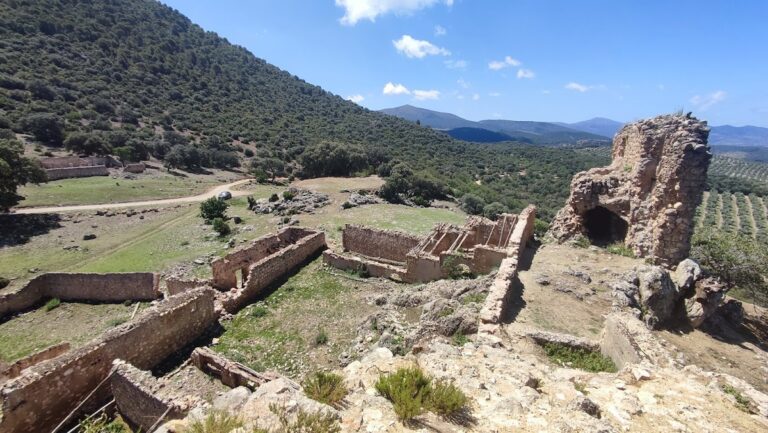
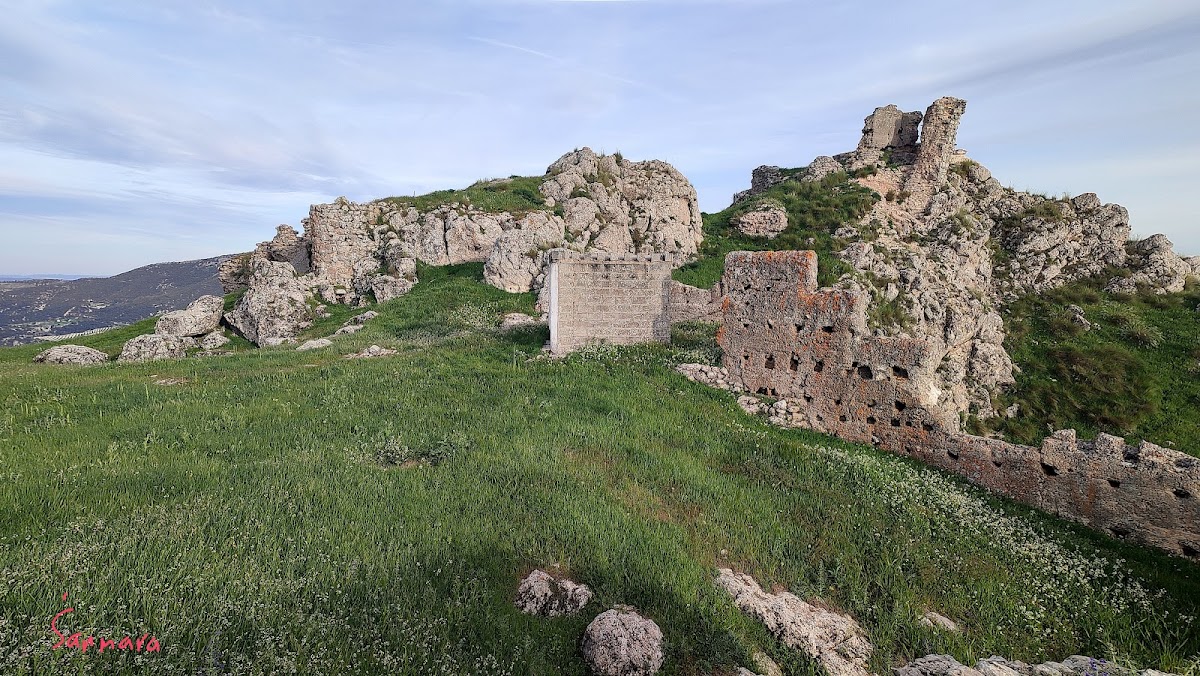
Castillo de Arenas is built upon an L-shaped platform that extends roughly from south to north along its longer arm and from west to east on its shorter arm. The site is naturally defended by steep terrain at each of these promontories, enhancing its strategic position. The earliest parts of the fortress, from the 9th to 11th centuries, are found at the western end of the shorter arm. These consist of an irregular enclosure made with thick walls formed from rammed earth, a traditional technique involving compressed soil mixed with lime. These walls, about 60 centimeters thick, bear indications of wooden additions through embedded beam slots.
The main surviving portions of the castle date to the Almohad era and later periods, when builders combined rammed earth with stone fragments to enhance stability. The majority of the fortress seen today reflects 14th and 15th-century construction and expansion phases. The castle is organized into three successive enclosures. The outer enclosure wraps around the hill’s eastern, southern, and partly western sides. It is lined with masonry walls featuring three polygonal towers at strategic points. These towers likely originate from Castilian efforts to strengthen the fortress, as evidenced by their use of rubble and precisely cut stone, or ashlar, at the corners.
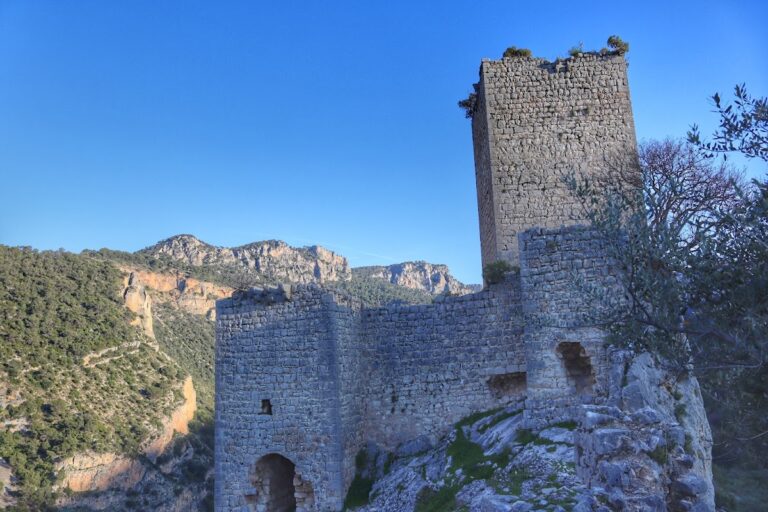
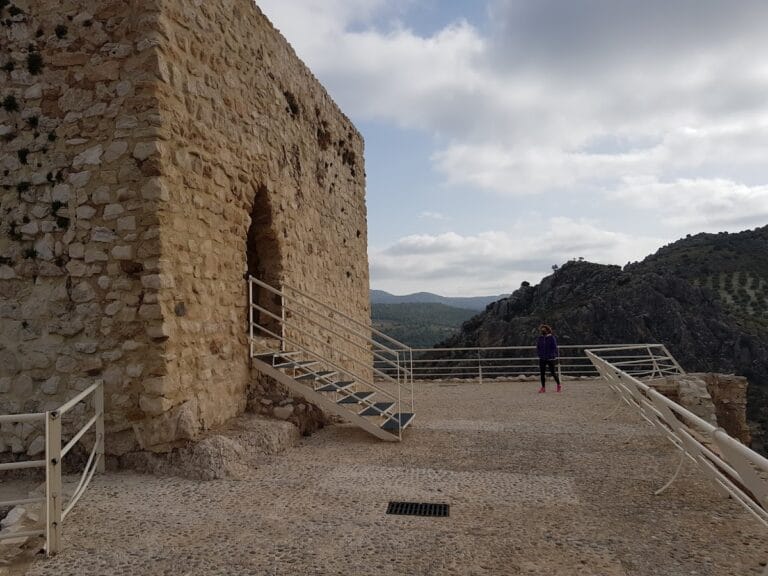
Between the outer and upper enclosures lies a middle enclosure that functioned as a defensive moat or buffer zone, though this area has suffered from structural collapse, rendering much of it inaccessible today. At the southern end sits the upper enclosure, which housed the fortress’s core facilities, including two large cisterns (or aljibes) designed to store water. Though these cisterns no longer have roofing, they remain as important features demonstrating the castle’s capacity to sustain defenders during sieges. This upper sector also contains remains of other buildings, alongside a large tower restored in recent times and believed to be from the Nasrid period.
The main gate to the fortress is located near this prominent western tower within the upper enclosure. Originally, access here was controlled by a zig-zagging enclosed passage designed to slow and expose attackers. Today, the historic defensive ensemble includes a modern chapel constructed of concrete blocks and enclosed by an iron grille, interrupting but respecting the original structure.
The castle’s walls show a blend of construction styles, incorporating older rammed earth fortifications alongside later stone masonry, reflecting successive adaptations over centuries. Its position on rugged terrain, combined with layered defenses and water storage facilities, confirms its historical role as a secure refuge and military stronghold overseeing critical mountain routes in this contested borderland.
Nearby sites